



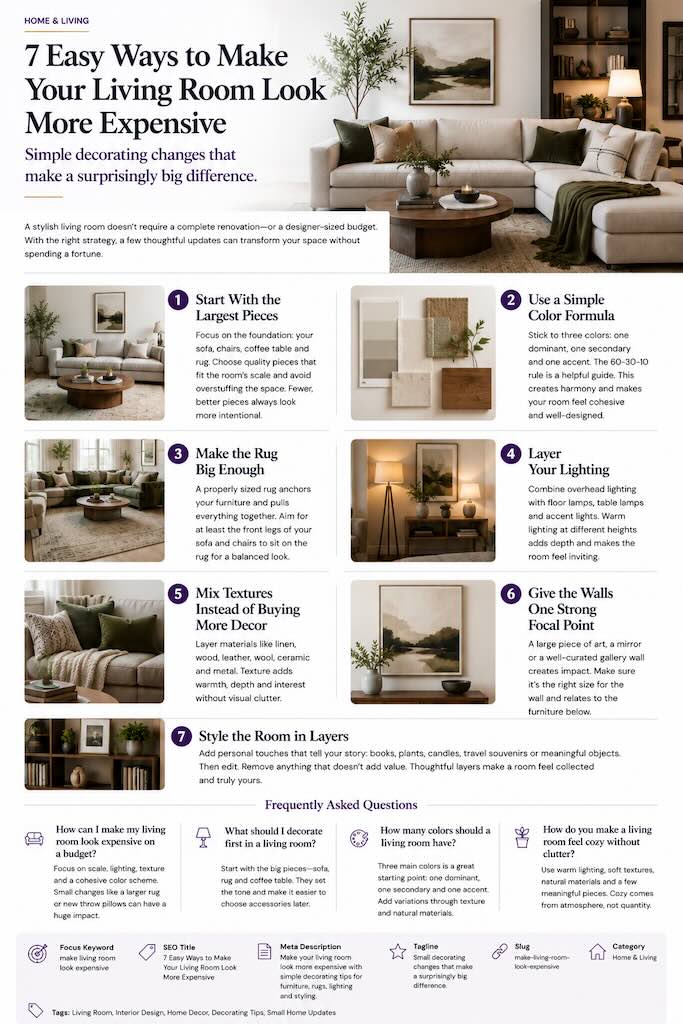
A stylish living room doesn’t require a complete renovation—or a designer-sized budget. Often, the rooms that feel the most polished aren’t filled with expensive furniture. They simply get the proportions, lighting, texture, and finishing details right.
If your living room feels unfinished, cluttered, or slightly disconnected, resist the temptation to replace everything at once. A few intentional changes can completely shift how the space looks and feels.
1. Start With the Largest Pieces
Before buying decorative accessories, look at the furniture that establishes the room’s proportions: the sofa, coffee table, armchairs, rug, and media unit.
One of the most common decorating mistakes is choosing furniture that’s too small for the room. A tiny coffee table floating in front of a large sofa or an undersized rug can make even expensive furniture look slightly awkward.
Instead of filling every empty corner, choose fewer pieces with enough visual presence to anchor the space. Giving furniture a little breathing room often makes a living room feel calmer and more considered.
2. Use a Simple Color Formula
If choosing colors feels overwhelming, start with three: one dominant shade, one supporting color, and one accent.
This is essentially the idea behind the 60-30-10 decorating rule, which can help prevent a room from looking either too coordinated or completely disconnected.
You don’t have to follow the percentages perfectly. Think of them as a visual guide. Warm white walls, for example, could form the foundation, with natural wood and beige upholstery providing the secondary tones and rust, olive, burgundy, or black appearing in smaller accents.
3. Make the Rug Big Enough
A rug has more influence over a living room than almost any other accessory. Too small, and it visually separates the furniture. Large enough, and it helps connect everything into one defined conversation area.
As a general styling principle, aim for a rug large enough for at least the front legs of the sofa and surrounding chairs to sit on it. In larger rooms, placing all of the main furniture on the rug can create an even more cohesive effect.
4. Layer Your Lighting
A single ceiling light rarely creates the warm, inviting atmosphere we associate with beautifully designed living rooms.
Instead, create several pools of light around the room. Combine overhead lighting with a floor lamp beside the sofa, a table lamp on a console, and smaller accent lighting where appropriate.
Warm lighting at different heights instantly gives a room more depth—and it’s one of the easiest ways to make an ordinary space feel more atmospheric in the evening.
5. Mix Textures Instead of Buying More Decor
When a neutral living room feels flat, the problem isn’t necessarily a lack of color. It may simply need more texture.
Try combining linen, wool, wood, glass, ceramic, boucle, leather, or brushed metal. A linen cushion against a structured sofa, a chunky throw beside a smooth wooden table, or handmade ceramics on a sleek shelf creates subtle contrast without adding visual clutter.
This is particularly effective if you prefer Scandinavian-inspired or minimalist interiors, where texture can provide warmth without sacrificing simplicity.
6. Give the Walls One Strong Focal Point
You don’t need artwork covering every available wall. In fact, one oversized piece can often look more sophisticated than a collection of smaller decorations bought simply to fill space.
A large artwork, sculptural mirror, framed textile, or carefully composed gallery wall can establish a focal point and give the room personality.
Scale matters here too. Artwork hanging above a sofa should feel visually connected to the furniture beneath it rather than appearing like a small object floating on a large wall.
7. Style the Room in Layers
The final layer is what makes a living room feel lived-in rather than staged.
Add a few objects that actually mean something to you: books you read, ceramics collected while traveling, a beautiful candle, a favorite photograph, or a plant that brings softness to an empty corner.
Then edit. If every surface is covered, remove a few things. Negative space is part of decorating too.
The Detail That Makes the Biggest Difference
The most stylish living rooms usually have something in common: they feel intentional.
The sofa relates to the rug. The artwork relates to the furniture. Colors repeat subtly around the room. Lighting creates atmosphere instead of simply illuminating the space.
Before buying something new, look at what you already own and ask whether moving, removing, or restyling it could solve the problem first. Sometimes the best living room makeover costs almost nothing.
Frequently Asked Questions
How can I make my living room look expensive on a budget?
Focus on scale, lighting and texture before buying decorative objects. A properly sized rug, layered lighting, coordinated colors and fewer well-chosen accessories can make a bigger difference than filling the room with new furniture.
What should I decorate first in a living room?
Start with the largest elements, particularly the sofa and rug, because they establish the scale and color direction of the room. Smaller accessories are much easier to choose once those pieces are working together.
How many colors should a living room have?
There’s no strict limit, but starting with three main colors can make decorating easier. Use one dominant shade, a secondary tone and a smaller accent color, then introduce variations through natural materials and textures.
How do you make a living room feel cozy without clutter?
Use warm lighting, tactile fabrics, natural materials and a small number of personal objects. Coziness comes from texture and atmosphere rather than simply adding more things.