



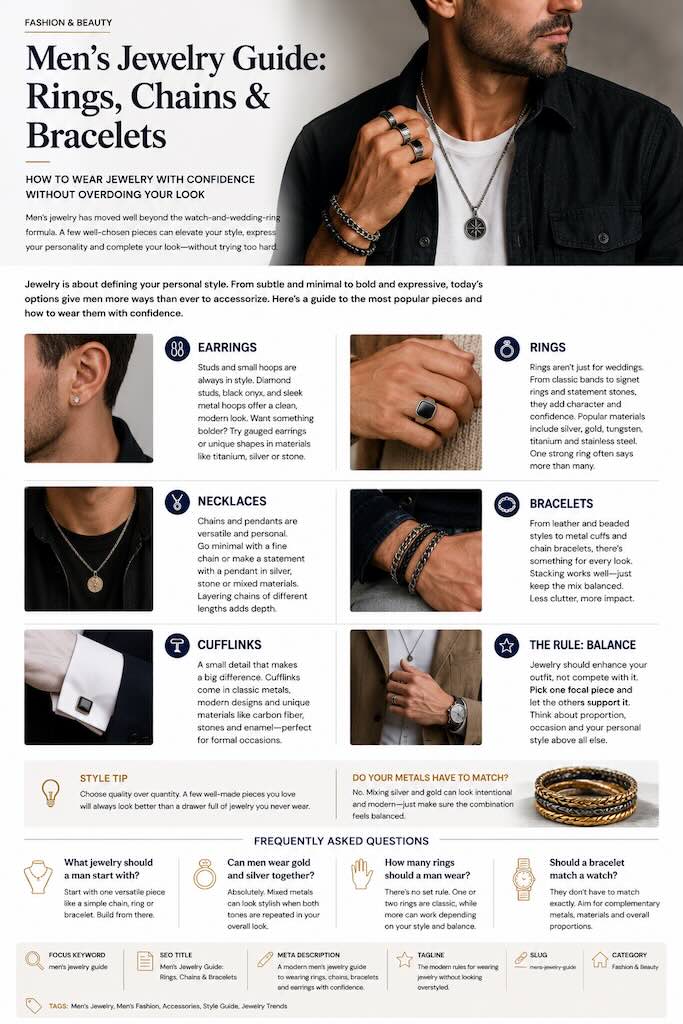
Men’s jewelry has moved well beyond the watch-and-wedding-ring formula. A slim silver chain under a white T-shirt, a signet ring worn with tailoring, or a simple cuff beside a favorite watch can change an outfit without making it feel overstyled.
The trick isn’t wearing more jewelry. It’s choosing pieces that feel connected to your personal style and knowing when to stop. From rings and chains to bracelets and earrings, here’s how to make men’s jewelry feel intentional rather than like an afterthought.
Start With One Piece
If you rarely wear jewelry, don’t begin by stacking three necklaces, four rings and a wrist full of bracelets. Start with one piece you genuinely like.
A chain is one of the easiest options because it works with everything from a plain T-shirt to an open-collar shirt. A signet ring can serve the same purpose, while a simple bracelet is an understated choice if you already wear a watch.
Once that first piece feels natural, adding another becomes much easier.
Rings Are No Longer Just for Weddings
Rings have become one of the most versatile elements of men’s jewelry. Clean bands, signet rings and sculptural designs can all work, depending on the rest of your wardrobe.
If your style is minimal, try a narrow silver or gold band. For something with more character, a signet ring or a piece featuring onyx, turquoise or another stone can become the focal point.
You don’t need a ring on every finger. One substantial ring often has more impact than several pieces competing for attention.
Chains Can Be Quiet or Statement-Making
The chain has become a modern menswear staple because its personality changes depending on its length, thickness and material.
A fine chain sitting close to the collarbone is subtle enough to disappear beneath a shirt. A heavier chain worn over a T-shirt becomes part of the outfit itself.
Layering can work too. The easiest approach is to combine two chains of noticeably different lengths so that each piece has its own space rather than tangling into one visual line.
Bracelets Work Best With Restraint
Bracelets can add texture without dominating an outfit. Metal cuffs and chain bracelets create a cleaner, more polished look, while leather, cord and beaded designs tend to feel more relaxed.
If you’re wearing a watch, consider the proportions of both pieces. A substantial watch paired with several heavy bracelets can make the wrist look crowded. A slim bracelet on the opposite wrist—or a single understated piece beside the watch—usually creates better balance.
Earrings Can Be as Minimal as You Want
Men’s earrings range from tiny studs and close-fitting hoops to more expressive drops and sculptural pieces. There’s no single formula for getting them right.
A small silver or gold hoop works particularly well with a pared-back wardrobe, while a larger or more unusual earring can become the statement piece in an otherwise simple outfit.
If you’re wearing a noticeable earring, you may want to keep necklaces and other jewelry quieter so the overall look still has a clear focal point.
Don’t Forget the Cufflink
Cufflinks may be more traditional than chains and rings, but they’re still one of the easiest ways to personalize formalwear.
Simple silver or gold designs are the most versatile, while vintage, enamel or sculptural cufflinks can bring personality to a classic suit. Because they’re small, they’re also a good place to experiment without changing the entire character of an outfit.
Do Your Metals Have to Match?
No. Matching every piece of metal perfectly can look polished, but it isn’t a rule.
Silver and gold can sit together beautifully when the combination looks deliberate. If you’re experimenting with mixed metals, repeat each tone somewhere in the outfit. A silver watch, gold ring and mixed-metal chain, for example, creates a clearer connection than several unrelated pieces.
Choose Jewelry for Your Wardrobe
The best jewelry isn’t necessarily the piece attracting the most attention. It’s the one that looks as though it naturally belongs with what you’re wearing.
Minimal wardrobes pair easily with clean chains, narrow rings and simple cuffs. Workwear and casual styles can handle heavier metals and textured pieces. Tailoring works particularly well with signet rings, watches and understated chains.
Think about jewelry in the same way you think about shoes: it should complement the outfit rather than exist separately from it.
How Much Jewelry Is Too Much?
There isn’t a universal number. Someone with a maximalist personal style can comfortably wear far more than someone whose wardrobe revolves around minimalist tailoring.
A useful test is to look for competition. If your rings, watch, bracelets, chain and earrings are all demanding attention simultaneously, remove one or two pieces and look again.
Great accessorizing usually has hierarchy: one piece leads, while everything else supports it.
Buy Less, Choose Better
Instead of building a drawer full of pieces you rarely wear, create a small jewelry collection that works across your wardrobe.
Pay attention to materials, construction, clasps and finishes. Sterling silver, gold, stainless steel and titanium can all have a place depending on your budget and aesthetic. What’s more important is choosing pieces you actually want to reach for again.
And that’s ultimately what modern men’s jewelry gets right: it doesn’t need to follow an old set of rules. A ring, chain or bracelet can be subtle, expressive, polished or unconventional. The best combination is simply the one that feels like you.
Frequently Asked Questions
What jewelry should a man start with?
A simple chain, ring or bracelet is an easy starting point. Choose one versatile piece that works with clothes you already wear before experimenting with layering.
Can men wear gold and silver jewelry together?
Yes. Mixed metals can look intentional and sophisticated. Repeating both metal tones across two or more pieces helps make the combination feel cohesive.
How many rings should a man wear?
There’s no fixed rule. One or two rings create an understated look, while several can work with a more expressive style. The important thing is maintaining balance with your other accessories.
Should a bracelet match a watch?
It doesn’t have to match exactly. Look for complementary proportions, materials or metal tones rather than trying to make every accessory identical.