




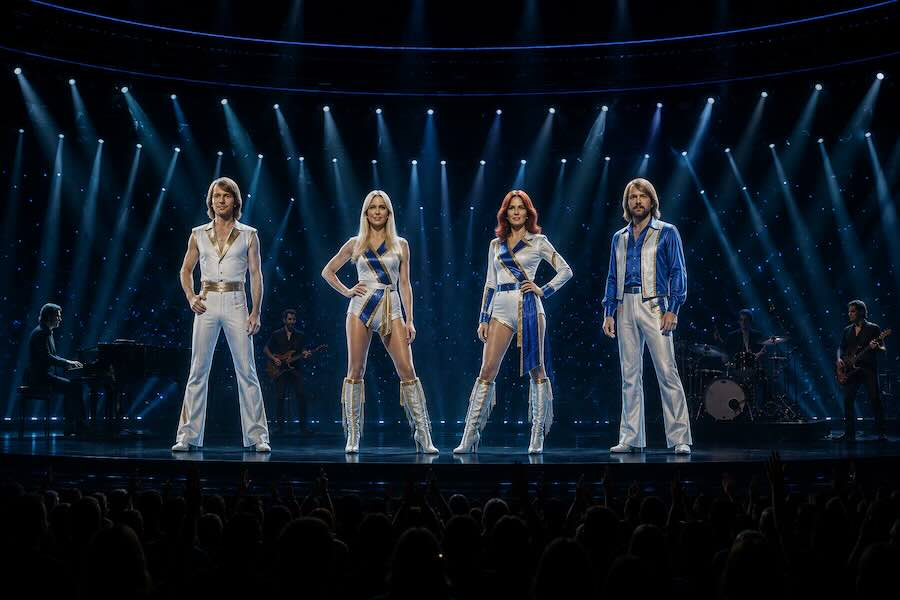
When ABBA announced Voyage in September 2021, the scale of the comeback was difficult to absorb. Agnetha Fältskog, Björn Ulvaeus, Benny Andersson and Anni-Frid Lyngstad had recorded together again after four decades, a new album was coming, and digital versions of the group would perform in a purpose-built London arena.
Nearly five years later, the strangest part of the story is how normal it all feels. ABBA Voyage is no longer a futuristic proposal waiting to be tested. It opened on May 27, 2022, and in 2026 the production remains at home in London’s ABBA Arena, with performances continuing and tickets now available into 2027.
The ABBA comeback that actually happened
The original announcement arrived with two new songs, “I Still Have Faith in You” and “Don’t Shut Me Down.” They were the first glimpse of Voyage, ABBA’s first studio album since 1981’s The Visitors.
Released on November 5, 2021, Voyage was more significant than a conventional reunion record. The four members had returned to Benny’s Riksmixningsverket studio in Stockholm and made new music together, rather than simply repackaging the catalogue that had kept ABBA culturally present for decades.
There was something particularly affecting about hearing Agnetha and Frida together again. Time had changed the voices, naturally, but it had not erased their chemistry. “Don’t Shut Me Down” carried that tension beautifully: unmistakably ABBA, yet aware of every year that had passed.
Then came ABBA Voyage
The album was only one half of the idea. The more radical part was the concert.
ABBA worked with Industrial Light & Magic and a large creative team to build digital performance versions of themselves. The process involved motion capture with the four members, translating their physical presence into younger digital counterparts capable of appearing onstage alongside a live 10-piece band.
That distinction still matters. ABBA Voyage is not simply four projections playing against a screen. The approximately 100-minute production is constructed around the relationship between digital performance, live musicians, lighting, sound and the physical architecture of the arena.
The result sits somewhere between concert, theatre and digital illusion. At its best, those boundaries become difficult to see. Familiar harmonies move through the room, lights cut across the audience, the live band supplies physical weight, and the distinction between archive, memory and present-tense performance becomes strangely fluid.
The purpose-built arena became part of the idea
ABBA Voyage opened at the 3,000-capacity ABBA Arena in Queen Elizabeth Olympic Park, London. Building a venue around one production was an unusually ambitious decision. In retrospect, it was also central to why the concept works.
The technology does not have to adapt itself to a conventional touring arena every night. The room, sightlines, stage, lighting and audience positions belong to the production. That control allows the illusion to feel integrated rather than inserted into an existing concert format.
In 2026, the arena remains at Pudding Mill Lane in East London, and ABBA Voyage is in its fourth year. Current ticketing extends into January 2027, an extraordinary lifespan for something that initially sounded like an experiment in how a band might perform without physically appearing onstage.
Why Voyage became more than nostalgia
ABBA could have returned in a much safer way. A deluxe retrospective, archival documentary or conventional reunion appearance would have attracted enormous attention. Instead, Voyage asked a more interesting question: what does a reunion look like when the artists do not want to pretend that 40 years haven’t passed?
The answer was to make time itself part of the production.
The people who recorded “Waterloo,” “SOS,” “Knowing Me, Knowing You” and “Dancing Queen” are older now. The figures performing those songs inside ABBA Voyage appear younger. Yet the movements behind them originated with the actual members of ABBA. Past and present occupy the same stage.
That creates a curious emotional tension. Audiences know what they are seeing is technologically constructed, but pop music has always been tied to memory. A song can collapse decades within seconds. ABBA Voyage simply makes that sensation visible.
ABBA’s music was already built to survive generations
The technology would mean very little without the songs underneath it.
Since winning Eurovision with “Waterloo” in 1974, ABBA have occupied an unusual place in pop. The surfaces can be brilliantly bright: piano, strings, stacked vocals, immaculate choruses. Beneath them sit loneliness, separation, regret and adult uncertainty. That contrast is one reason the records continue to connect with listeners who were born long after the group stopped recording together.
“Dancing Queen” can still fill a dance floor, but ABBA’s catalogue also contains the cold space of “The Winner Takes It All,” the ache inside “One of Us” and the increasingly strange beauty of their later recordings. Voyage did not erase that history. It added another room to it.
What happened to the people behind the original project?
The scale of the concert was apparent from its first announcement. Producer Svana Gisla and producer Ludvig Andersson worked alongside director Baillie Walsh, choreographer Wayne McGregor and a substantial creative and technical team, while Industrial Light & Magic entered unfamiliar territory by applying its visual-effects expertise to a music performance of this kind.
The ambition was not merely to recreate old television footage. ABBA participated in the performance process themselves, giving the digital production physical material from the people it was designed to represent.
Benny described the project at its launch as sailing into “uncharted waters.” That description has aged well. The intriguing difference is that those waters are no longer uncharted. ABBA Voyage has now been operating for years.
ABBA Voyage in 2026
For anyone discovering this story through the original 2021 announcement, the most important update is simple: the concert did not disappear after its opening season.
ABBA Voyage continues at the ABBA Arena with seated tickets, a standing dance floor and other ticket formats. The official production describes the show as approximately 100 minutes without an interval, with the digital versions of Agnetha, Björn, Benny and Frida accompanied by the live band.
Current performances and visitor information are available through the official ABBA Voyage website. Anyone travelling specifically for the concert should check the current calendar before arranging transport or accommodation, as schedules and ticket availability can change.
Nearly five years later, the comeback looks different
Back in 2021, the headline was that ABBA were back after 40 years. In 2026, that description feels incomplete.
The more interesting story is what they did with the return. Rather than attempting to become the ABBA of 1979 again, the group found a format in which their younger images, older selves, new recordings and classic songs could exist together.
There is a distinctly ABBA quality to that contradiction. Bright but melancholy. Familiar yet slightly uncanny. Human emotion carried through immaculate machinery.
More than four years after Voyage arrived and four years into the London concert’s run, ABBA’s comeback no longer feels like a closing chapter. It has become another unexpected phase in a career that was supposedly finished in 1982.
They asked fans to wait almost 40 years for a new journey. Few could have predicted that, nearly five years after the announcement, the voyage would still be moving.