


There has never been more information within reach — and that has created a surprisingly modern problem: what is actually the best way to learn something new?
You can spend an afternoon with a book, listen to a podcast on your commute, watch someone demonstrate a skill on YouTube, take an online course, or ask an AI tool to explain a difficult concept in seconds. Each can work brilliantly, but not necessarily for the same kind of learning.
The better question isn’t whether books, audio or video are universally “best.” It’s which format fits what you’re trying to learn — and how you combine them so the information actually sticks.
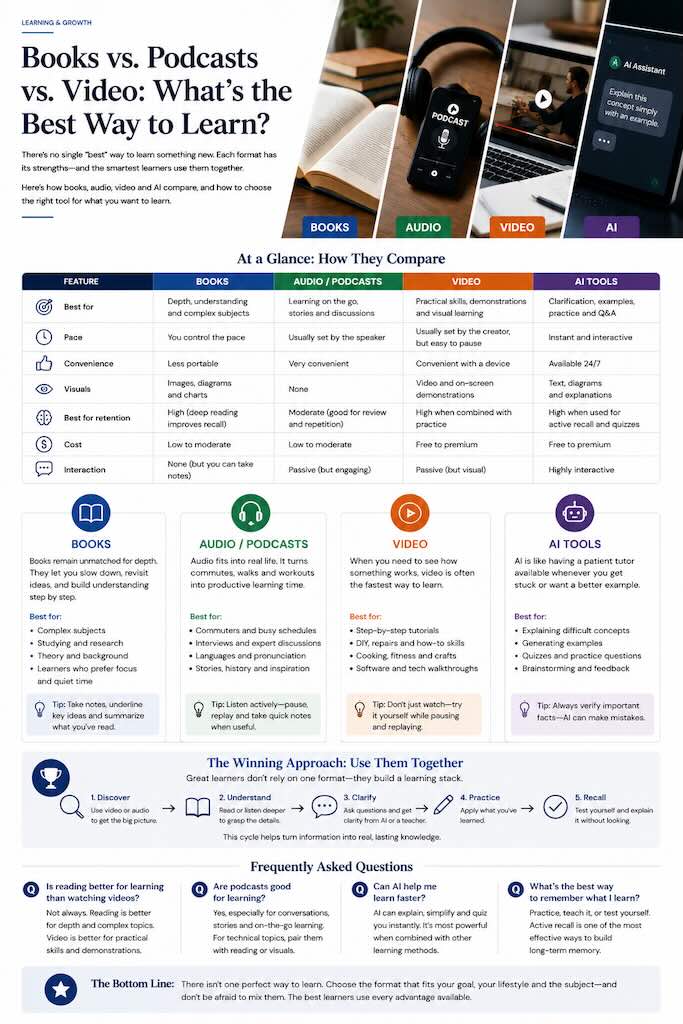
Books: Best for Depth and Focus
Books remain difficult to beat when you want to understand a subject rather than simply become familiar with it. Reading lets you control the pace, stop when something becomes complicated, reread a paragraph and move backwards through an argument whenever you need to.
That makes books particularly useful for subjects that require concentration and context: history, psychology, business, science, philosophy, music theory and countless other areas where understanding develops gradually.
There is another advantage that feels increasingly valuable: a book doesn’t constantly tempt you with another notification, recommendation or 30-second clip. When you sit down to read, you’re creating space for sustained attention.
Best for: deep learning, complex subjects, research, studying and anyone who likes to learn at their own pace.
Audio: Best for Learning While Doing Something Else
Podcasts and audiobooks changed where learning can happen. A commute, walk, gym session or hour spent cooking can suddenly become time for discovering a new subject.
Audio works especially well for ideas built around storytelling, discussion and explanation. History, biographies, languages, interviews and cultural topics can translate beautifully to the format because a good narrator or conversation can make complicated ideas feel remarkably approachable.
The trade-off is attention. Listening while answering emails, scrolling your phone or navigating heavy traffic isn’t the same as giving something your full concentration. Audio can make learning more convenient, but convenience doesn’t automatically mean better retention.
Best for: commuters, auditory learners, languages, interviews, biographies and introductory learning.
Video: Best When You Need to See How Something Works
Some things are unnecessarily difficult to explain with words alone.
Imagine learning a guitar chord entirely from a written description, figuring out a hairstyle without seeing the technique, or repairing something while trying to interpret several paragraphs of instructions. A short demonstration can make the same idea immediately understandable.
That’s where video excels. It combines explanation with visual demonstration, making it particularly useful for practical skills.
- Cooking techniques
- Music lessons
- Fitness movements
- Beauty and hair tutorials
- DIY projects
- Software demonstrations
The weakness of video is also what makes it appealing: it’s easy to consume passively. Watching someone perform a skill can create the feeling that you’ve learned it before you’ve actually tried doing it yourself.
Best for: demonstrations, practical skills and anything involving movement, technique or a visual process.
What About AI?
AI has introduced something the other formats can’t easily provide: interactive learning on demand.
Instead of searching through an entire chapter because one concept doesn’t make sense, you can ask an AI assistant to explain it differently, simplify it, create an example or quiz you on what you’ve just studied.
Used well, that makes AI less of a replacement for books, teachers or courses and more of a learning companion.
For example, you might read a chapter about music theory and then ask an AI tool to create five questions testing your understanding. Or watch a tutorial on photography and ask for a beginner exercise based on the technique you just learned.
AI does have an important limitation: it can produce incorrect or misleading information. For anything important, factual claims should still be checked against trustworthy sources rather than accepted automatically.
Best for: explanations, brainstorming, practice questions, personalized exercises and getting unstuck.
So, Which Learning Method Is Best?
| What you want to do | Best starting format |
|---|---|
| Understand a complicated subject | Books |
| Learn during a commute or walk | Audio |
| Learn a physical or practical skill | Video |
| Get a concept explained differently | AI |
| Study a subject seriously | Mixed media |
| Remember what you’ve learned | Practice + self-testing |
The Real Secret Is Mixing Formats
You don’t have to choose one.
In fact, one of the most practical ways to learn is to let different formats do different jobs. Start with a video to understand the big picture. Read about the subject when you want greater depth. Listen to an expert discussing it while you’re walking. Then practise the skill or test yourself without looking at the answer.
That last step matters. Consuming information and learning something are not quite the same thing. You can watch twenty guitar tutorials and still not know how to play a chord until you pick up the guitar.
The same applies to almost everything else. Write the code. Speak the language. Cook the recipe. Take the photograph. Answer the question from memory.
Build a Learning Stack
Rather than searching for one perfect method, try creating a simple learning stack:
- Discover: Watch or listen to something that introduces the subject.
- Understand: Read a deeper explanation.
- Clarify: Ask questions when something doesn’t make sense.
- Practice: Do the thing yourself.
- Recall: Try explaining what you’ve learned without looking at your notes.
Suddenly, books aren’t competing with podcasts, videos aren’t replacing reading, and AI isn’t replacing everything else. Each has a different role.
The Bottom Line
The best learning format is the one that matches both the subject and the moment. Read when you need depth. Listen when your eyes and hands are occupied. Watch when seeing the process matters. Use interactive tools when you need clarification. Most importantly, practise when you want knowledge to become a skill.
With so many ways to learn available now, the challenge is no longer finding information. It’s turning all that information into something you genuinely understand.
Frequently Asked Questions
Is reading better for learning than watching videos?
Neither format is automatically better. Reading is particularly useful when you need depth and want to control the pace, while video is often better for demonstrating physical processes and techniques.
Are podcasts good for learning?
They can be, particularly for interviews, storytelling and introductory explanations. However, highly technical subjects may be harder to understand without accompanying text, diagrams or demonstrations.
Can AI help me learn faster?
AI can make learning more interactive by explaining concepts, generating examples and creating practice questions. Because AI-generated information can be inaccurate, important facts should still be verified with reliable sources.
What’s the best way to remember something I’ve learned?
Don’t only consume the information. Try recalling it without looking at your notes, explaining it in your own words or applying it through practice. Active learning gives you a much clearer idea of what you actually understand.