




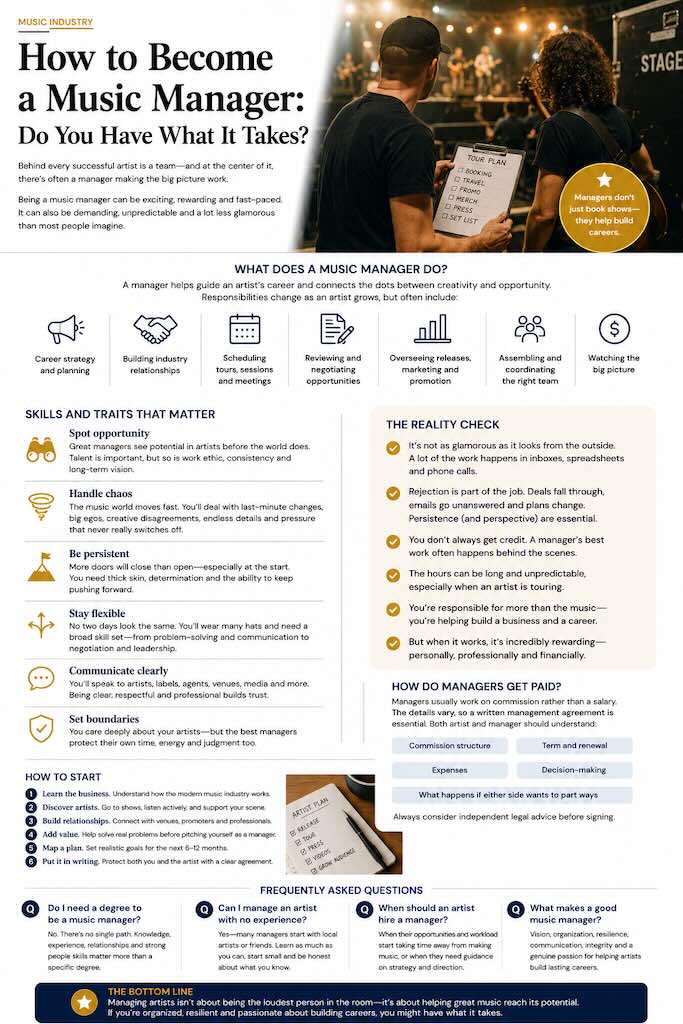
Behind almost every artist building a serious career is a network of people handling the business that listeners rarely see. Booking agents secure shows. Publicists generate coverage. Lawyers negotiate agreements. Labels and distributors help get music into the world. And somewhere near the center of it all, there may be an artist manager helping connect the pieces.
For anyone fascinated by music but more comfortable building careers than standing under stage lights, artist management can be one of the industry’s most interesting paths. It can also be demanding, unpredictable and considerably less glamorous than it appears from the outside.
Managing an artist isn’t simply about discovering a brilliant band and waiting for success to arrive. It means helping someone turn creative potential into a sustainable career — often while juggling strategy, relationships, deadlines, negotiations and the occasional crisis at the same time.
What Does a Music Manager Actually Do?
The precise job changes depending on where an artist is in their career.
An emerging independent artist may need a manager who does a little of everything: helping plan releases, contacting industry professionals, organizing schedules, reviewing opportunities and keeping everyone focused on what happens next.
Once an artist’s career grows, those responsibilities are more likely to be divided among specialists. Booking agents handle live opportunities. Publicists work on media. Lawyers deal with contracts. Business managers may oversee financial matters.
The artist manager increasingly becomes the person looking at the entire picture.
That can include coordinating release strategies, discussing long-term goals, evaluating partnerships, communicating with labels and distributors, helping assemble the right team and making sure dozens of individual decisions still serve the artist’s wider career.
You Need to Recognize Potential — Not Just Talent
Being able to recognize a great voice or an unforgettable song certainly helps. But talent alone doesn’t automatically create a sustainable music career.
A good manager also notices momentum.
Is the audience growing? Do people return after discovering the artist? Are live shows becoming stronger? Does the artist consistently create good material? Do they understand who they are creatively? Most importantly, are they prepared to put in the work when progress is slow?
An artist with enormous talent but little commitment can be considerably harder to build around than someone who combines strong music with discipline, curiosity and a willingness to improve.
You Have to Understand the Business of Music
You don’t necessarily need a music-business degree before helping an emerging act, but enthusiasm isn’t enough either.
A manager should gradually develop a working understanding of areas such as recording and publishing rights, distribution, royalties, touring, marketing, contracts, licensing and the different roles played by labels, publishers, booking agents, publicists and lawyers.
You don’t need to personally perform every one of those jobs. In fact, knowing when a specialist is needed is part of becoming a good manager.
The goal isn’t to know everything. It’s to know enough to ask the right questions and recognize when professional advice is necessary.
Organization May Matter More Than Glamour
Forget the image of spending every night backstage.
Much of artist management happens in decidedly unglamorous places: email inboxes, spreadsheets, calendars, phone calls and meetings.
A single release can involve masters, artwork, metadata, distribution deadlines, social content, press materials, videos, interviews, rehearsals and live dates. Missing one deadline can affect several other parts of the campaign.
If you’re naturally good at keeping complicated projects moving while everyone around you is concentrating on something else, management may suit you surprisingly well.
You Need to Be Comfortable With Rejection
Music careers are built around considerably more unanswered emails and unsuccessful pitches than breakthrough moments.
A manager might approach venues, agents, labels, publishers, playlists, brands or potential collaborators and hear nothing back. An opportunity that looked certain can disappear. A release can underperform. A promising meeting might lead nowhere.
Persistence matters, but there’s an important distinction between persistence and simply refusing to accept an answer.
Strong managers learn from rejection. They reconsider the pitch, strengthen the artist’s position, build another relationship and try again when there is a better reason to do so.
Relationships Are One of Your Biggest Assets
The music industry remains remarkably relationship-driven.
That doesn’t mean collecting thousands of contacts or sending identical pitches to everyone you can find. Useful networks are built when people trust your judgment.
If you repeatedly introduce good artists, communicate professionally and respect people’s time, an email from you eventually carries more weight.
That reputation can become one of a manager’s most valuable assets.
You Have to Tell an Artist What They Don’t Want to Hear
A manager isn’t supposed to be a professional cheerleader.
There will be moments when the most useful answer is no: the deal isn’t strong enough, the release isn’t ready, the opportunity doesn’t make strategic sense, the budget is unrealistic or everyone needs to wait rather than rush something out.
That requires trust.
The strongest artist-manager relationships allow disagreement without turning every disagreement into a battle. The artist remains the creative force behind the project, while the manager provides another perspective on the career developing around that creativity.
You Need Boundaries Too
Working closely with an artist can blur the distinction between professional and personal relationships. Managers frequently become trusted confidants as well as business partners.
But being available doesn’t mean being available every minute of every day.
Clear expectations around communication, responsibilities, money and decision-making can prevent small misunderstandings from becoming much larger problems later.
How Do Music Managers Get Paid?
Artist managers commonly work on commission rather than receiving a conventional salary from the artist, although arrangements vary considerably.
That makes the details of a management agreement extremely important. Both sides should understand what income is commissionable, how expenses are handled, how long the relationship lasts and what happens when either party wants to leave.
Those aren’t details to settle casually over a handshake. Before entering a serious management agreement, both artist and manager should consider obtaining appropriate independent legal advice.
How to Start Managing an Artist
You don’t have to begin with an established artist.
Many careers in management begin much closer to home: an impressive local songwriter, a friend’s band, an independent artist gaining momentum online or someone you’ve watched perform several times and genuinely believe could go further.
Before announcing yourself as their manager, start by discovering whether you can actually add value.
- Learn how the modern music business works.
- Attend local shows and discover developing artists.
- Build genuine relationships with venues and music-industry professionals.
- Help an artist solve a specific problem rather than making enormous promises.
- Create a realistic plan for the next six to twelve months.
- Put any professional management arrangement in writing.
Your first objective doesn’t need to be securing a major-label deal. It might simply be improving the artist’s release planning, finding better live opportunities or building a more professional team around them.
So, Do You Have What It Takes to Manage an Artist?
You might — particularly if you’re the person who naturally organizes the project while everyone else is talking about the idea.
Good managers tend to combine ambition with patience. They communicate well, notice opportunities, stay calm when plans change and understand that their job is ultimately to help someone else’s talent develop into a career.
And perhaps most importantly, they genuinely love music without needing to be the person standing in the spotlight.
Frequently Asked Questions
Do you need qualifications to become a music manager?
There isn’t one universal qualification required to become an artist manager. Knowledge of the music business, strong communication skills, organization, industry relationships and practical experience can all be extremely valuable.
What does a manager do for an independent artist?
For an emerging independent artist, a manager may help coordinate releases, develop career strategy, evaluate opportunities, build an industry team and communicate with outside partners. The role usually becomes more specialized as the artist’s career grows.
When does an artist need a manager?
A manager becomes particularly useful when opportunities and administrative work begin taking significant time away from making music. However, hiring a manager simply because an artist believes they are supposed to have one isn’t necessarily beneficial.
Can you manage an artist with no experience?
Everyone has to start somewhere, and emerging managers often learn alongside emerging artists. Start small, educate yourself about the business, be transparent about your experience and seek professional expertise for areas such as contracts and legal matters when necessary.