




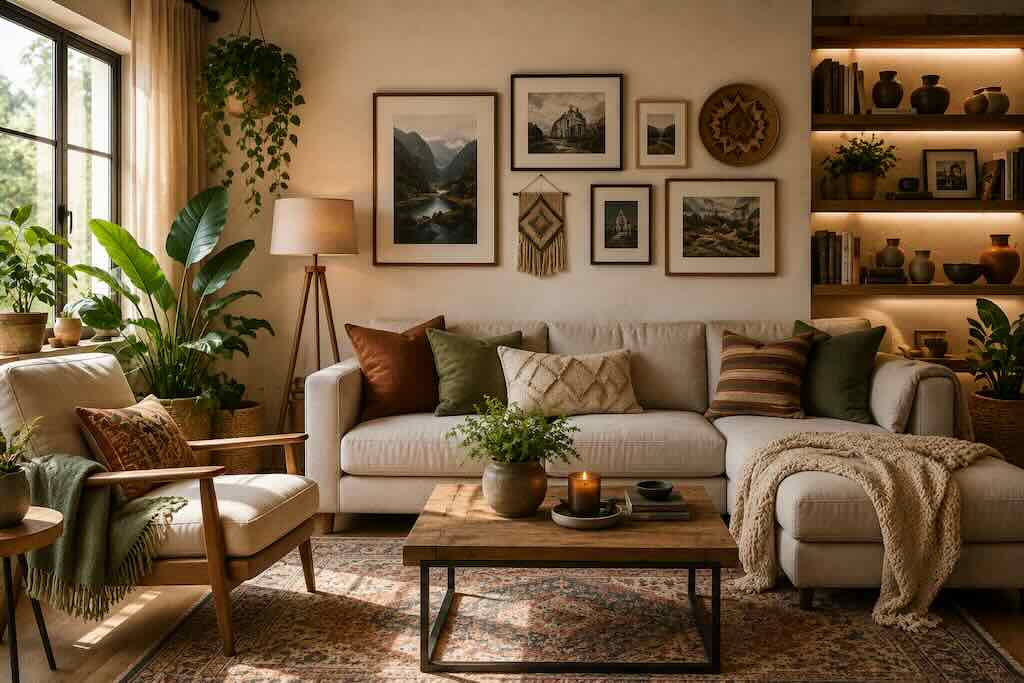
A home feels personal long before anyone notices whether it follows a particular design trend. Morning light across a timber floor, the weight of a wool throw, the quiet around a reading chair and the objects collected over years can shape a room more convincingly than a perfectly coordinated furniture set.
Editor’s note: This article has been updated for 2026 to remove unsupported trend claims, correct misleading statements about houseplants and indoor air quality, replace commercial shopping links with authoritative sources, and focus on practical design choices with longer staying power.
Designing a home around how you live rather than how a room photographs can also make decorating easier. You begin with light, movement, comfort and function. Color and decoration follow.
That approach works in a compact apartment just as well as a large house. Divine’s guide to balancing functionality and style in the bedroom explores the same principle on a smaller scale, while our feature on how architecture can affect the way you feel looks more closely at the relationship between spaces and their occupants.
1. Design for the Senses
A room is not experienced visually alone.
Consider what happens when you walk through it. A tightly woven rug changes the sound beneath your feet. Linen filters hard daylight differently from a heavy curtain. Timber, stone, wool, cotton and ceramic each introduce a distinct temperature and texture.
Sound deserves attention too. Soft furnishings can make a sparse room feel acoustically calmer, while a dedicated speaker or quietly placed radio can add atmosphere without becoming the visual center of the space.
Be more restrained with fragrance. Candles, diffusers, incense and scented sprays may create a particular mood, but fragrance is not necessary for a home to feel inviting. If someone in the household is sensitive to scented products, an unscented environment may be considerably more comfortable.
Start with the surfaces you touch and the sounds you actually hear. Sensory design works best when it is subtle enough to stop demanding attention.
2. Bring Nature Indoors Without Expecting It to Clean the Air
Plants remain one of the simplest ways to introduce organic shape and living color into an interior. A tall plant can soften an empty corner. Herbs can make a kitchen windowsill useful. Trailing foliage can interrupt the rigid geometry of shelving.
There is, however, an important distinction between decorating with plants and treating them as air-purification equipment.
The U.S. Environmental Protection Agency states that there is currently no evidence that a reasonable number of houseplants removes significant quantities of pollutants in homes and offices. It also cautions against overwatering because persistently damp soil can encourage microorganisms.
Keep the plants. Just choose them for greenery, texture and the pleasure of living alongside them rather than expecting a fiddle-leaf fig to perform the work of ventilation or filtration.
3. Choose Materials for a Longer Life
Sustainable interiors become more convincing when sustainability is treated as a practical decision rather than an aesthetic.
Before replacing a table, cabinet or chair, ask whether the existing piece can be repaired, refinished, reupholstered or used somewhere else. When something genuinely needs replacing, durability and repairability deserve as much attention as its appearance.
The EPA’s sustainable materials guidance emphasizes using materials productively across their life cycles and reducing material use and environmental impacts. Its guidance for the built environment also supports adaptability, durability, salvage and reuse.
In practice, that can mean buying a well-made secondhand timber cabinet instead of a new disposable one, keeping a sound kitchen carcass while changing its fronts, or reupholstering a chair whose frame still has decades of life left.
The most sustainable-looking room is not necessarily the most sustainable room. Sometimes the better choice is simply keeping what you already own.
4. Let Daylight Set the Rhythm
Lighting changes a room more dramatically than many decorative purchases.
Begin with daylight. Avoid blocking useful windows with unnecessarily tall furniture, and consider how curtains, blinds and reflective surfaces affect the way light travels through the room. Divine’s guide to using natural light to transform your home offers additional ways to work with existing windows rather than against them.
After sunset, layer artificial lighting instead of depending on one bright ceiling fixture. Combine general illumination with task lighting beside a desk, sofa or reading chair, then add lower accent lighting where it genuinely improves the atmosphere.
Dimmers can make this arrangement more adaptable. Smart controls can be useful too, but technology is optional. Several carefully positioned lamps can create a beautifully responsive room without an app.
Bedrooms deserve particular care. The National Heart, Lung, and Blood Institute recommends keeping bedrooms quiet, cool and dark for sleep and limiting bright artificial light before bedtime.
Bright mornings and softer evenings create a natural visual rhythm: light when you need activity, darkness when the room needs to become quiet.
5. Personalize With Objects That Have a Reason to Be There
Personal interiors rarely arrive in a single shopping trip.
A photograph from a journey, ceramics found at a local market, inherited glassware, a battered record collection or a chair rescued from another room can introduce something that new matching accessories cannot easily reproduce: history.
Display fewer objects and give them room. A handmade bowl on an otherwise quiet shelf has more visual presence than the same bowl surrounded by ten unrelated decorations.
Mixing periods can help as well. An older wooden table beside a contemporary lamp creates tension. Smooth plaster behind weathered timber makes both surfaces more visible. The room starts to look assembled over time rather than purchased as a package.
6. Design Around Daily Habits
One of the simplest ways to make a home feel better is to notice where everyday life creates friction.
If shoes continually accumulate beside the door, the entrance needs better shoe storage. If everyone charges a phone on the kitchen counter, create a discreet charging point there instead of pretending the habit does not exist. If a beautiful armchair is never used because there is nowhere to put a drink or book, add a small table.
Good design responds to behavior.
This is particularly important in smaller homes, where every piece of furniture consumes valuable floor area. A bench with storage, an extendable table or shelving that uses vertical wall space can solve a genuine problem without making the room feel crowded.
7. Use Color More Personally
Color forecasts can be entertaining, but a home does not need to be recolored every January.
Warm earth shades, muted greens, mineral tones and soft neutrals can create a calm foundation, but they are options rather than rules. Deep blue, chalky pink, ochre or saturated red may make considerably more sense in the right home.
Look at the room’s daylight before choosing paint. The same shade can appear cool beside a north-facing window and warmer under evening lamps. Test larger samples on different walls and observe them through a full day before committing.
Most importantly, choose a color because you want to live with it, not because it has been declared fashionable for 2026.
8. Leave Some Space Unfinished
Not every wall needs artwork. Not every corner needs a plant. Not every shelf needs styling.
Empty space gives the eye somewhere to rest and allows the objects that matter to become more visible. It also leaves physical and visual room for a home to change naturally.
That may be the most useful design principle of all. A home is never truly finished. Books arrive. Furniture moves. Families change. Objects are inherited, repaired, given away and discovered.
Designing with a little spare capacity makes those changes easier.
A Practical Home Refresh
- Remove or relocate objects that consistently interrupt how the room functions.
- Rearrange existing furniture before buying replacements.
- Use daylight as the starting point for the lighting plan.
- Add task lamps where you read, cook, work or prepare for the day.
- Repair or reuse furniture when it remains structurally useful.
- Introduce natural materials through pieces you will keep rather than temporary decoration.
- Display personal objects selectively instead of filling every surface.
- Choose plants for visual pleasure rather than air-purification claims.
- Test paint colors in the room’s actual daylight and evening lighting.
- Leave some walls, shelves and corners intentionally quiet.
Conclusion
A personal home does not require a complete renovation or a catalogue of this year’s trends.
It can begin with a chair moved toward the window. A lamp lowered beside the sofa. An old cabinet repaired instead of replaced. Linen at the window, timber under the hand, photographs that belong to an actual memory rather than a styling brief.
The strongest interiors accumulate character slowly. They support daily life, make room for change and reveal something about the people living inside them.
That is more enduring than being on trend.
Frequently Asked Questions
How can I refresh my home without spending much?
Start by rearranging furniture, removing visual clutter and moving lamps, artwork and textiles between rooms. Repairing or repurposing existing pieces can change a space without requiring a large shopping budget.
What home colors are popular in 2026?
Earthy neutrals, greens and warm natural shades remain visible across contemporary interiors, but color forecasts change quickly. The more useful choice is a shade that works with your room’s light, existing materials and personal taste.
Do indoor plants improve air quality?
Houseplants can contribute greenery and texture, but the EPA says there is no evidence that a reasonable number removes significant quantities of pollutants in normal homes and offices. Ventilation, source control and appropriate filtration are more effective indoor-air strategies.
How can I make a small room feel less crowded?
Prioritize appropriately scaled furniture, clear circulation routes and vertical storage. Removing unnecessary pieces can often make a greater difference than adding mirrors or more decorative objects.
Is minimalism still relevant in 2026?
Minimalist principles such as reducing clutter, choosing useful objects and allowing visual space remain practical regardless of trend cycles. They can be combined with color, texture, vintage furniture and personal collections rather than producing a stark interior.
What is the simplest way to make a home more sustainable?
Start with consumption. Keep useful furniture longer, repair when practical, buy secondhand where appropriate and choose durable replacements when something genuinely needs to be replaced.