



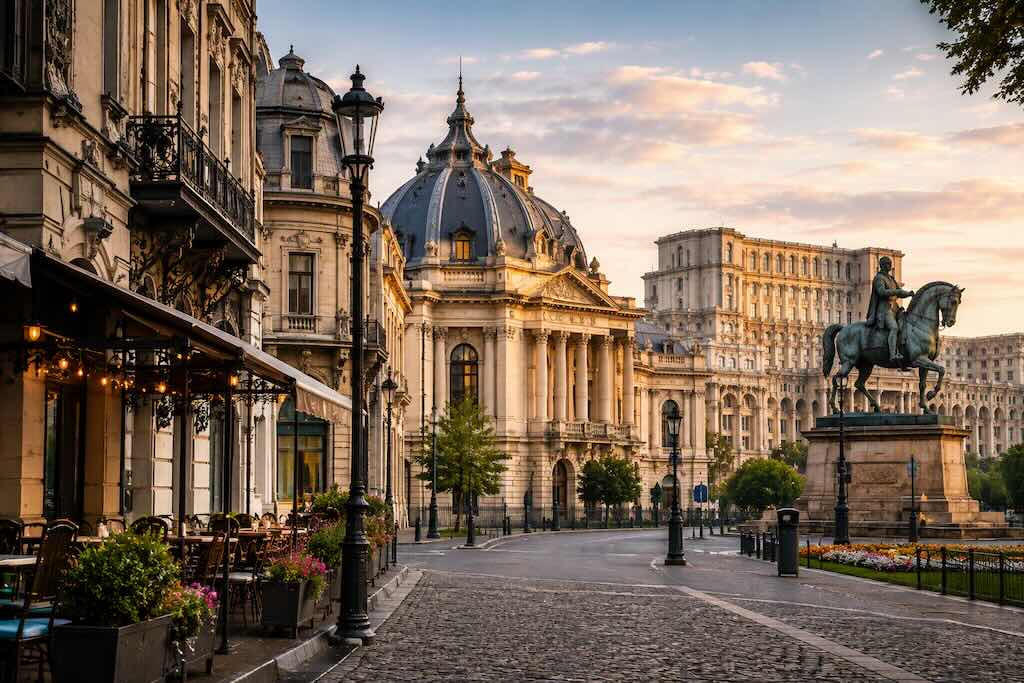
Bucharest rarely reveals itself all at once. Ornate late-19th-century façades stand beside severe Communist-era blocks, broad boulevards open onto quiet Orthodox churches, and leafy parks interrupt a cityscape shaped by radically different periods of Romanian history.
That contrast is part of the pleasure. Give Romania’s capital a long weekend and you can move between monumental architecture, galleries, traditional food, contemporary cafés and green spaces without turning the trip into an exhausting sequence of attractions.
Editor’s note: This Bucharest guide has been updated for late 2026 with refreshed airport and transport information, clearer historical context and more practical planning advice for a first visit.
Why Visit Bucharest?
Bucharest makes an interesting alternative to Europe’s most familiar city-break destinations. It is large enough to reward exploration but concentrated enough that a first-time visitor can understand its central districts over two or three days.
Architecture provides much of the visual drama. Belle Époque ornament, interwar Modernism, Orthodox churches, Communist civic projects and contemporary development sit within the same urban landscape. If the relationship between buildings and experience interests you, Divine’s feature on how architecture affects the way we feel offers another perspective on why cities can create such distinct moods.
You will frequently encounter Bucharest’s historical nickname, Little Paris, associated with the French cultural and architectural influence visible in the Romanian capital during the late 19th and early 20th centuries.
It is an evocative description, but modern Bucharest becomes more interesting when you stop expecting another Paris and allow it to be itself.
Start in Bucharest’s Old Town
Lipscani, the historic center, is the obvious starting point. Its compact streets contain restaurants, bars, churches and ornate façades, making it easy to explore on foot.
Look beyond the busiest restaurant terraces. Stavropoleos Monastery Church, founded in the 18th century, occupies a much quieter world of carved stone, frescoes and an intimate courtyard within the surrounding city.
Nearby, the elaborate CEC Palace provides another glimpse of Bucharest’s grander architectural period. Rather than moving between these places as isolated landmarks, walk slowly. Doorways, passages and contrasting façades are part of the experience.
See the Palace of Parliament
Few buildings communicate the scale and political history of modern Bucharest as forcefully as the Palace of Parliament.
The enormous complex emerged from Nicolae Ceaușescu’s redevelopment of central Bucharest during Romania’s Communist period. Its construction required sweeping changes to the surrounding urban fabric, making the building inseparable from the history of the area that was transformed around it.
Today, the complex houses Romania’s Parliament. Visitor access, identification requirements and tour arrangements can change, so check the official Chamber of Deputies visitor information before setting aside time for an interior visit.
Even if you do not go inside, seeing the scale of the building and the surrounding avenues helps explain a significant chapter in Bucharest’s physical development.
Walk Along Calea Victoriei
Calea Victoriei provides a different introduction to the capital. This historic avenue passes cultural institutions, hotels, shops and some of Bucharest’s most recognizable architecture.
Among its landmarks is the Romanian Athenaeum, whose domed neoclassical form has become one of the city’s visual signatures. Nearby, the former Royal Palace houses the National Museum of Art of Romania.
The museum is particularly useful for visitors who want to understand Romanian art within a broader historical context rather than leaving the city having seen only its streets and monuments.
Do not hurry along the avenue. Stop for coffee, look upward at the façades and allow the contrasts between restored buildings and rougher surfaces to remain visible. Divine’s guide to walking well in beautiful cities is especially relevant here.
Find the Green Side of Bucharest
Bucharest’s scale can feel intense after several hours among traffic and monumental buildings. Its parks provide the counterpoint.
Cișmigiu Gardens is conveniently positioned near the center and works well as a pause between museums and architectural sightseeing. Paths curve beneath mature trees around the lake, giving the city a noticeably softer texture.
Farther north, King Michael I Park offers substantially more room beside Herăstrău Lake. It is the kind of place where an intended 20-minute walk can easily become an afternoon.
Visit the Village Museum
Beside the park is the Dimitrie Gusti National Village Museum, an open-air collection of traditional buildings representing different parts of Romania.
After spending time among Bucharest’s palaces, apartment blocks and broad avenues, seeing vernacular houses and rural structures introduces an entirely different architectural language. It also makes the museum more than a collection of picturesque old buildings: it provides context for a country whose identity extends far beyond its capital.
Eat Romanian Food
Leave room in the itinerary for Romanian cooking rather than filling every meal with familiar international options.
Sarmale are stuffed cabbage rolls, commonly filled with seasoned meat and rice. Mici, also called mititei, are grilled minced-meat rolls. Ciorbă refers to a family of sour soups rather than one single recipe, while mămăligă is a cornmeal preparation that appears alongside numerous savory dishes.
Then there is papanași, a rich Romanian dessert often prepared as fried cheese-based dough and served with sour cream and preserves.
You do not need to order every traditional dish in one sitting. Food is more enjoyable when it remains dinner rather than becoming another sightseeing checklist.
Experience Bucharest After Dark
Bucharest has an energetic nightlife reputation, particularly around the Old Town, where bars and late-night venues sit densely together.
That is only one version of an evening in the city. Cocktail bars, wine bars, restaurants, live music and quieter terraces provide alternatives when crowded nightlife streets are not what you want.
Avoid planning around old lists of supposedly fashionable venues. Bars and clubs can change ownership, concept or opening hours relatively quickly. Check current information shortly before going out.
Getting Around Bucharest in 2026
Central Bucharest rewards walking, particularly around the Old Town and Calea Victoriei, but the city is too large to explore entirely on foot.
Public transport includes buses, trams, trolleybuses and the Metro. Surface transport operated by STB supports several ticketing methods, including transport cards, bank-card validation and mobile ticketing for applicable journeys.
Ticket products and rules can change, so check STB’s current public transport information before traveling rather than relying on an older city guide.
For a short stay, the useful approach is simple: walk when attractions are naturally connected and use public transport when crossing larger sections of the city. There is little benefit in spending half the weekend trying to prove that every destination can be reached on foot.
Getting From Bucharest Airport to the City
Most international visitors use Henri Coandă International Airport (OTP), north of central Bucharest.
The airport has a direct railway connection with Gara de Nord, Bucharest’s main railway station. The airport authority states that the rail journey takes approximately 20 minutes, although travelers should always check the current timetable before departure.
Do not confuse that rail service with a direct airport Metro. As of September 2026, Bucharest Airports states that Metro Line M6 is still under construction. When completed, it is intended to connect Gara de Nord and Henri Coandă Airport.
The airport is undergoing significant infrastructure work, so consult Bucharest Airports shortly before traveling for current rail, road-access and terminal information.
Where to Stay in Bucharest
For a first visit, a central location can save considerable time.
Old Town: convenient for restaurants, bars and historic sights, but potentially noisy at night.
Calea Victoriei: a useful compromise for sightseeing, architecture, museums and restaurants without placing you directly in the busiest nightlife streets.
Piața Romană and surrounding areas: useful for visitors who want central access while staying slightly removed from the Old Town.
Do not compare accommodation by nightly price alone. On a two- or three-day visit, an inconvenient location can cost something more limited than money: time.
How Long Do You Need in Bucharest?
Two full days provide a useful introduction. Three days create a more comfortable city break.
- Day 1: Old Town, Stavropoleos Church, Calea Victoriei and the central architectural landmarks.
- Day 2: Palace of Parliament, a museum, Romanian food and an evening exploring the city.
- Day 3: King Michael I Park, Village Museum and enough unscheduled time to revisit whatever caught your attention.
If you only have a weekend, cut something rather than compressing all three days into two. Bucharest’s contradictions become easier to appreciate when there is time to look at them.
Practical Tips for a Bucharest City Break
- Walk central districts: Old Town and Calea Victoriei are better understood at street level.
- Check major attractions: Verify current opening hours and visitor requirements before arriving.
- Use public transport for distance: Bucharest is larger than its historic center initially suggests.
- Leave room for Romanian food: Do not schedule every meal around international restaurants you could visit elsewhere.
- Look beyond Old Town: Bucharest becomes considerably more interesting once you move beyond its most concentrated visitor district.
Conclusion
Bucharest is not a city where every street has been polished into a postcard. That is part of what makes it memorable.
Grand façades coexist with concrete apartment blocks. Small Orthodox churches hide behind busy streets. The immense Palace of Parliament sits within the same capital as intimate cafés, tree-filled parks and old houses transported from rural Romania.
Give it a weekend, good walking shoes and some curiosity. The old comparison with Paris may explain one chapter of Bucharest’s history, but the city has more than enough personality of its own.
FAQ
Is Bucharest worth visiting for a weekend?
Yes. Two or three days allow enough time for the historic center, Calea Victoriei, Palace of Parliament, museums, parks and Romanian food without requiring a particularly complicated itinerary.
How many days should you spend in Bucharest?
Two full days are enough for the main central sights, while three days provide more time for museums, parks and slower neighborhood exploration.
Can you get from Bucharest Airport to the center by train?
Yes. Henri Coandă International Airport has a direct railway connection with Gara de Nord. Check the latest timetable before traveling because schedules and temporary service arrangements can change.
Does the Bucharest Metro go to the airport in 2026?
Not yet. As of September 2026, the airport’s official information states that Metro Line M6 is under construction. The existing direct rail connection to Gara de Nord is a separate service.
What Romanian food should you try in Bucharest?
Sarmale, mici, ciorbă and mămăligă are useful starting points for savory dishes. For dessert, look for papanași served with sour cream and preserves.