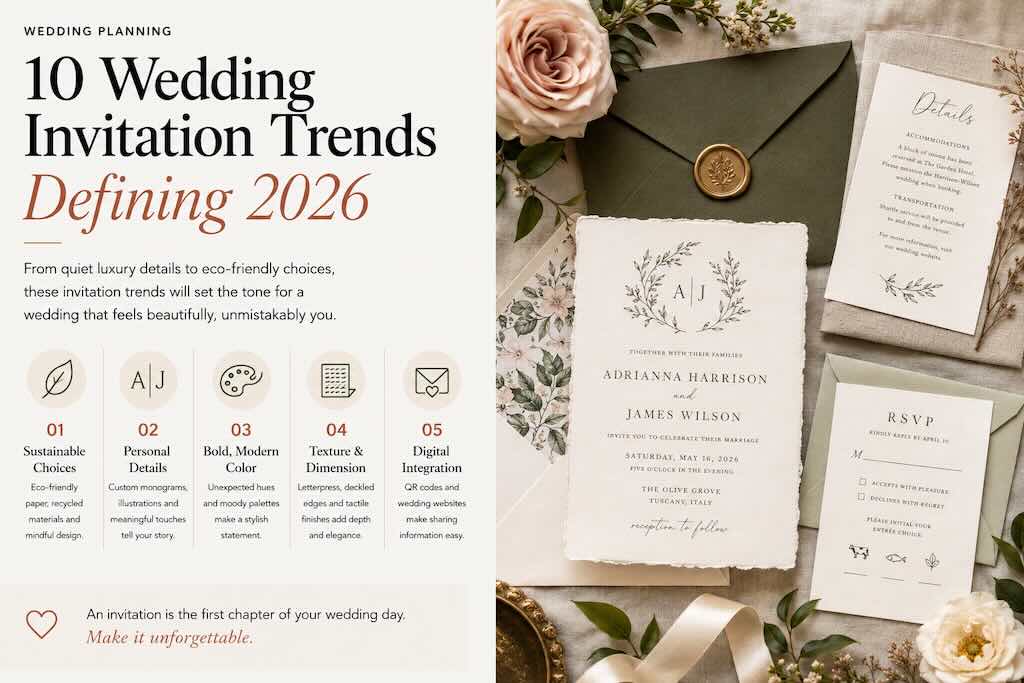
A wedding invitation does more than tell guests where to be and when. Long before the flowers are arranged, the tables are set, or anyone walks down the aisle, the invitation offers the first glimpse of how the celebration is going to feel.
In 2026, wedding stationery is becoming more personal, tactile, and intentional. Couples are moving beyond generic templates toward invitations that feel connected to the setting, season, and personality of the wedding itself — from beautifully restrained typography to hand-drawn details and unexpected color.
1. Quiet Luxury Invitations
Some of the most sophisticated wedding invitations of 2026 barely look as though they’re trying.
Think thick ivory or warm-white paper, generous negative space, beautifully proportioned serif typography, and perhaps one subtle detail such as blind embossing, letterpress, or a tiny monogram.
Instead of filling every corner with decoration, this approach relies on excellent materials and typography to create impact. The result feels timeless rather than tied to one particular wedding trend.
2. Hand-Drawn Illustrations That Tell a Story
Personal illustration is turning wedding stationery into something guests may actually want to keep.
A watercolor of the wedding venue is an obvious choice, but couples can take the idea much further. Illustrations might feature the skyline where they met, a favorite flower, their dog, the landscape surrounding the ceremony, or tiny symbols referencing important moments in their relationship.
Those details make an invitation feel distinctly personal without requiring an elaborate design.
3. Unexpected Color Palettes
White, cream, and blush aren’t disappearing, but they’re no longer the only sophisticated options.
Deep burgundy, chocolate brown, dusty blue, olive, terracotta, butter yellow, and muted plum can all bring more personality to wedding stationery. Rather than using several competing colors, a particularly polished approach is to choose one distinctive shade and repeat it across envelopes, menus, place cards, and other printed details.
Darker palettes work especially beautifully for autumn and winter weddings, while softer earth tones lend themselves naturally to outdoor and destination celebrations.
4. Custom Monograms Are Back
The wedding monogram is having another moment, but the 2026 version feels less formal than the elaborate crests traditionally associated with luxury weddings.
A simple intertwining of initials, a tiny illustrated emblem, or a bespoke symbol can give the entire stationery suite a visual signature.
Once created, the same mark can appear on menus, napkins, welcome signs, cocktail cards, favors, and thank-you notes, quietly tying the visual identity of the wedding together.
5. Texture Is Becoming Part of the Design
Digital wedding invitations have made communication faster and easier, which has given physical invitations a different role. When couples choose to send something through the mail, there’s an opportunity to make the object itself feel special.
Letterpress printing, embossed lettering, deckled edges, handmade paper, vellum overlays, ribbon, and textured card stock all introduce a tactile quality that can’t be reproduced on a screen.
You don’t necessarily need all of them. One carefully chosen texture can make a minimalist invitation feel considerably more luxurious.
6. The Return of Romantic Florals
Florals are hardly new to wedding stationery, but they’re becoming softer and more artistic.
Instead of perfectly symmetrical floral borders, look for loose botanical sketches, pressed-flower-inspired details, watercolor blooms, and illustrations that appear almost as though they’ve been taken from an old botanical book.
Using flowers that will actually appear in the wedding arrangements can create a subtle visual connection between the invitation guests receive and the celebration they eventually attend.
7. Destination-Inspired Stationery
For destination weddings, the location itself can become the design language.
A Mediterranean wedding might borrow from hand-painted ceramic patterns and citrus illustrations. A celebration in the mountains could incorporate topographic lines or sketches of the surrounding landscape. Coastal weddings can move beyond predictable seashell graphics toward watercolor horizons, organic blues, and understated nautical references.
The idea isn’t to turn the invitation into a travel brochure. A few carefully selected references can establish a sense of place before guests have even packed their bags.
8. Sustainable Wedding Invitations
Beautiful stationery doesn’t have to mean excessive paper and packaging.
Couples looking to reduce waste can consider recycled or responsibly sourced paper, vegetable-based inks, local printing, fewer inserts, or digital RSVPs instead of separate reply cards and envelopes.
Seed paper remains another option, although it’s worth checking whether the seeds are appropriate for where recipients live before sending plantable stationery across different regions.
A particularly elegant compromise is a beautiful physical invitation containing the essential information, with a wedding website handling accommodation details, directions, registry information, and RSVPs.
9. Unusual Shapes and Formats
Rectangular cards remain the practical standard, but couples wanting something less expected are experimenting with arches, scalloped edges, rounded corners, folded cards, and layered invitation suites.
The shape doesn’t need to become a novelty. An otherwise restrained invitation with a softly curved edge can feel contemporary without overwhelming the typography or information.
Just remember that unusual dimensions, weight, or embellishments can affect postage, so check mailing requirements before ordering hundreds of invitations.
10. Digital and Printed Invitations Are Working Together
The choice no longer has to be entirely digital or entirely traditional.
Many couples are combining a beautifully printed invitation with a wedding website accessed through a short URL or discreet QR code. The paper carries the emotional part of the invitation; the website handles information likely to change.
This hybrid approach can reduce the number of inserts required while making updates considerably easier if travel information, schedules, or accommodation details change later.
How to Choose a Wedding Invitation You’ll Still Love Years From Now
Wedding trends are useful for inspiration, but your invitation doesn’t need to incorporate every idea currently appearing on mood boards.
Start with three things: the setting, the atmosphere, and your personalities. A black-tie city wedding might call for restrained typography and beautifully heavy paper, while a relaxed countryside celebration could feel more natural with botanical illustration and warmer textures.
Then edit. One memorable detail usually feels more sophisticated than five competing ones.
The invitation should ultimately feel like a small preview of the celebration itself — recognizable as yours before guests even read the names.
Wedding Invitation Checklist
- Names of the couple
- Wedding date and start time
- Ceremony location
- Reception information when required
- RSVP instructions and deadline
- Wedding website address, if applicable
- Any essential dress-code information
- Correct postage and guest addresses
FAQ: Wedding Invitation Trends
When should wedding invitations be sent?
For many weddings, invitations are sent around six to eight weeks before the celebration. Destination weddings and events requiring significant travel generally benefit from considerably more notice, particularly when guests need to arrange flights and accommodation.
Are digital wedding invitations acceptable in 2026?
Absolutely. Digital invitations can be practical, attractive, and considerably easier to manage. Couples who still want the experience of traditional stationery can use printed invitations for the main announcement while moving RSVPs and additional information online.
Do wedding invitations need to match the wedding colors?
No. They can reference the overall palette without matching it exactly. Coordinating the mood, typography, or one accent color is often enough to create a connection with the wedding itself.
How can wedding invitations look expensive on a smaller budget?
Keep the design simple and invest in one strong element. Beautiful typography on quality paper can look more luxurious than an invitation overloaded with embellishments. Using a wedding website for additional information can also reduce the number of printed inserts required.