




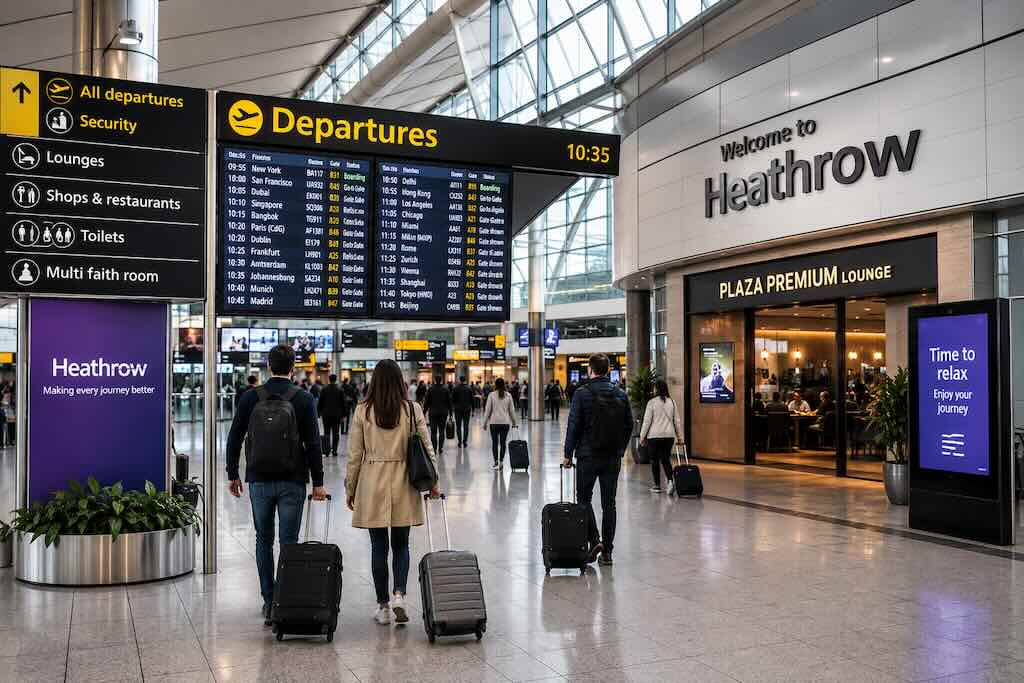
Heathrow is enormous, busy and surprisingly manageable when the important decisions are made before departure day. Know your terminal. Choose the right route to the airport. Leave enough time for disruption. Then let the airport become part of the journey rather than a final obstacle before it.
Editor’s note: This article has been updated for 2026 to remove outdated transport recommendations, clarify rail and terminal planning, strengthen practical departure advice, and include additional guidance for travellers who prefer pre-booked airport transfers.
Heathrow operates four passenger terminals — 2, 3, 4 and 5 — and the experience can vary considerably depending on your airline, departure time and route to the airport. The simplest way to reduce stress is to remove uncertainty before leaving home.
Use Heathrow’s official terminal guide to confirm where your flight departs, then check your airline’s instructions for check-in and baggage deadlines.
1. Choose Your Heathrow Transport Before Travel Day
Driving is only one way to reach Heathrow, and for many passengers it will not be the simplest.
From central London, the Elizabeth line provides direct Heathrow services from stations including Paddington, Bond Street, Tottenham Court Road and Farringdon. Transport for London maintains current service information, fares and timetables on its Elizabeth line pages.
The Piccadilly line provides another Underground connection, while Heathrow Express operates between London Paddington and Heathrow. Which option is best depends on where the journey begins, how much luggage you have, your terminal and whether there are disruptions on the day.
A taxi or pre-booked private car can still make sense for families, passengers carrying substantial luggage, groups splitting the fare or anyone travelling when rail connections are inconvenient. If you prefer door-to-door transport, you can book airport transfers in advance, but compare the service, total price and cancellation terms with the public transport options available for your journey.
If you do drive, compare Heathrow’s official parking products and allow time for any transfer between the car park and terminal.
2. Check Your Terminal Before You Leave
Few airport mistakes create stress as efficiently as arriving at the wrong terminal.
Do not assume that an airline always uses the terminal you remember from a previous journey. Confirm your flight through the airline and Heathrow before setting off.
Heathrow’s airport information service includes terminal information, maps and guidance for moving between terminals.
Take a screenshot of the terminal and flight details before leaving home. It is a tiny precaution that remains useful if your mobile connection becomes unreliable at exactly the wrong moment.
3. Build Extra Time Around the Journey, Not Just Check-In
The familiar formula of arriving exactly two or three hours before every flight is too simplistic.
Your airline’s check-in and bag-drop deadlines should determine the minimum timing. From there, work backwards and add realistic time for the journey to Heathrow, station changes, parking, luggage, children, mobility requirements and potential disruption.
If travelling by rail, check live service information shortly before departure. Planned engineering works or an unexpected suspension can make a route that looked perfect when the flight was booked considerably less attractive on the day.
The useful buffer is the one before things become urgent. Twenty relaxed minutes at the airport is easier to absorb than twenty missing minutes while sitting in traffic.
4. Track the Flight Through Your Airline and Heathrow
Once the practical journey is underway, information becomes the easiest way to reduce uncertainty.
Use your airline’s app or website for operational messages relating to your booking, and cross-check airport information through Heathrow’s official departures page.
Notifications are useful, but do not disappear completely into headphones and a coffee. Airport screens and announcements remain important, particularly when gate information changes.
Keep your phone charged and place essential travel documents somewhere accessible rather than buried beneath clothing and cables in your carry-on bag.
5. Prepare for Security Before Reaching the Queue
Security feels slower when preparation begins at the tray.
Check Heathrow’s current security and baggage instructions shortly before travelling because screening procedures can change. The same applies to your airline’s cabin-baggage dimensions and weight allowances.
Keep travel documents, medication and anything you may need to remove or present somewhere easy to reach. Avoid filling the top of your bag with loose objects that have to be reorganized while other passengers wait behind you.
For medication, baby supplies, mobility equipment or other circumstances requiring specific arrangements, consult Heathrow and your airline in advance rather than relying on general travel advice.
6. Use a Lounge Only If It Solves a Problem
A lounge can make a long wait quieter. It is not essential to a calm airport experience.
Heathrow lists lounge options across its passenger terminals. Facilities vary, but available lounges can include seating, food and drinks, Wi-Fi, charging and, in some locations, showers or private rest facilities.
Check the official Heathrow lounge directory for your specific terminal rather than buying access before confirming that the lounge fits your departure plans.
A lounge becomes more compelling during a long wait, when travelling with someone who needs a quieter environment or when a meal and workspace would otherwise be purchased separately. For a short gap before boarding, finding a calm corner near the gate may be easier.
7. Use Heathrow’s Free Wi-Fi and Charging Time Wisely
Heathrow provides free Wi-Fi throughout its terminals, making it easier to monitor flights, contact accommodation and retrieve travel documents while waiting.
Official details are available through Heathrow’s Wi-Fi information page.
Use waiting time to charge devices, download anything needed offline and confirm onward arrangements at the destination. A portable power bank can also be useful on a long travel day, provided it complies with your airline’s battery and baggage rules.
8. Carry an Empty Water Bottle
Small physical comforts matter when a travel day stretches across several hours.
Carry an empty reusable bottle through the airport and follow the current security instructions applicable to your journey. Once airside, use an available refill point before settling into the departure area.
It is a simple habit, particularly before a long-haul flight where the combination of airport air conditioning, coffee and hours in the cabin can leave you feeling depleted before the holiday has properly started.
9. Pack for the Airport, Not Only the Destination
A suitcase might be packed for a beach or winter city. Your carry-on should be packed for the hours between home and the hotel.
- Keep passports and travel documents immediately accessible.
- Carry essential medication in accordance with current security and airline rules.
- Keep charging cables and a compatible power bank within reach.
- Pack a lightweight extra layer for changing temperatures.
- Download important confirmations for offline access.
- Keep valuables and essentials out of checked luggage.
If overpacking tends to complicate your travel days, Divine’s guide to travelling light offers a simpler approach to luggage.
A Simple Heathrow Departure Plan
The evening before departure, confirm the terminal, airline requirements and route to Heathrow. Check for planned transport disruption and put passports, medication and essential electronics together.
On departure day, check the flight and transport status again before leaving. Allow enough margin that a delayed train or slower-than-expected road journey remains an inconvenience rather than an emergency.
At Heathrow, move through check-in and security before thinking about shopping, food or lounge access. Once those formalities are finished, the pace changes. Find your gate area, refill your water bottle and keep an eye on flight information.
The calmest airport routine is rarely complicated. It simply puts important decisions in the correct order.
Conclusion
Heathrow does not become relaxing because you spend more money at the airport. It becomes easier when uncertainty is removed early.
Know the terminal. Choose transport according to where you are actually travelling from. If door-to-door convenience matters, arrange a reputable transfer in advance. Follow your airline’s timing requirements, check live services before leaving and keep the essentials accessible.
Then, once security is behind you, find somewhere comfortable and allow the pace to soften. The journey has already started.
Frequently Asked Questions
How early should I arrive at Heathrow?
Follow the guidance issued by your airline for your specific flight rather than relying on one universal airport rule. Check-in and bag-drop deadlines vary. Add enough time for your journey to Heathrow, possible disruption and any additional assistance you require.
What is the best way to get from central London to Heathrow?
There is no single best option for every journey. The Elizabeth line, Piccadilly line and Heathrow Express provide rail connections, while taxis and private cars can be useful for some passengers. Compare your starting point, luggage, terminal, cost and live service conditions.
Should I book an airport transfer in advance?
Pre-booking can be useful when travelling with children, several suitcases or a larger group, or when public transport does not suit your flight time. Check the total fare, vehicle capacity, pickup arrangements and cancellation terms before confirming a transfer.
Is the Elizabeth line a good option for Heathrow?
Yes. The Elizabeth line provides direct Heathrow connections from several central London stations and can be particularly convenient when your journey begins close to its route. Check Transport for London for current services and planned works.
Does Heathrow have free Wi-Fi?
Yes. Heathrow provides free Wi-Fi throughout its terminals. Connect to the official Heathrow network and follow the registration instructions shown on your device.
Are there airport lounges at Heathrow?
Yes. Heathrow has lounge facilities across its passenger terminals. Access rules, opening hours, prices and amenities vary, so check the lounge serving your departure terminal before booking.
Can I travel between Heathrow terminals?
Yes. Heathrow provides terminal-transfer information and transport options between terminals. Follow the airport’s current instructions because the appropriate route depends on which terminals you are moving between.
Should I drive to Heathrow or take public transport?
It depends on your departure point, flight time, luggage and group size. Rail can avoid road congestion, while driving or a pre-booked car may be more practical for some early departures, families or passengers with substantial luggage. Check disruption before committing to the final route.