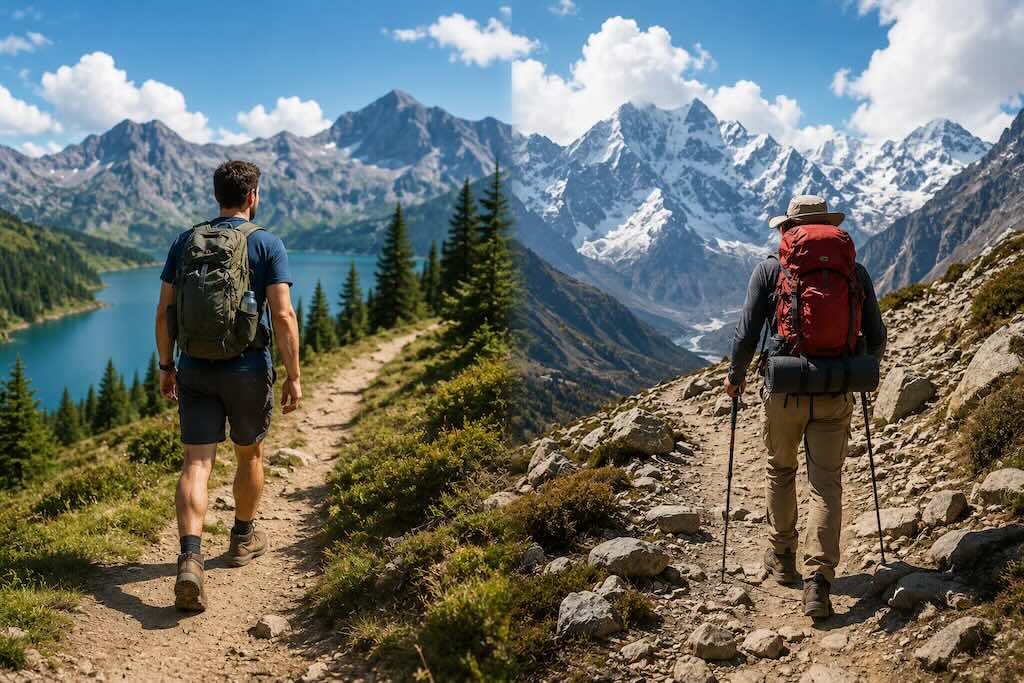
Hiking and trekking both begin with the same simple movement: putting one foot in front of the other outdoors. Beyond that, the distinction becomes less precise. A marked woodland path can be physically harder than a famous multi-day route, while a trek may include comfortable accommodation and established trails rather than remote wilderness.
- Hiking vs. Trekking: What’s the Difference?
- Hiking and Trekking at a Glance
- 1. Both Can Build Physical Fitness
- 2. Walking Supports Cardiovascular Health
- 3. Energy Use Depends on the Route
- 4. Time in Nature May Support Mental Wellbeing
- 5. Hiking Creates Space Away From Routine
- What You Need for a Day Hike
- What Changes When a Hike Becomes a Multi-Day Trek?
- Leave the Trail as You Found It
- A Practical Pre-Trip Check
- Conclusion
- Frequently Asked Questions
Editor’s note: This article has been updated for 2026 to remove commercial gear and trekking links, correct unsupported calorie, vitamin D and mental-health claims, and replace rigid definitions of hiking and trekking with practical guidance on distance, terrain, preparation and safety.
In everyday travel language, hiking usually describes recreational walking on trails, often completed within a day. Trekking tends to describe a longer journey on foot, frequently extending across several days and requiring more planning around accommodation, food, weather and equipment.
Those are useful distinctions rather than universal rules. What matters more is understanding the demands of the particular route before setting out.
Hiking vs. Trekking: What’s the Difference?
A hike might be a two-hour forest loop, a full day in the mountains or an overnight route. Trails can be flat and accessible or steep, exposed and technically demanding.
Trekking generally implies a journey rather than an individual walk. The route may connect villages, mountain huts, campsites or significant destinations over several days. That creates additional considerations: repeated physical effort, changing weather, food and water, navigation, accommodation and carrying equipment for longer periods.
Distance alone does not determine difficulty. Elevation gain, altitude, temperature, trail surface, pack weight, navigation and access to help can turn a relatively short route into a serious undertaking.
Before choosing either, assess the actual route rather than relying on whether somebody has labelled it a hike or trek.
Hiking and Trekking at a Glance
| Factor | Hiking | Trekking |
|---|---|---|
| Typical duration | Several hours to a full day, sometimes overnight | Often several days or longer |
| Route | Frequently established recreational trails | May connect multiple trails, settlements or stages |
| Equipment | Usually a day pack and route-specific essentials | Often requires additional clothing, food and overnight equipment |
| Planning | Weather, navigation, water, daylight and emergency preparation | The same considerations plus multiple stages, resupply and accommodation or camping |
| Physical demand | Ranges from gentle to extremely strenuous | Often increased by consecutive days and pack weight |
The important detail is that neither category automatically tells you whether a route is safe or suitable for your experience.
1. Both Can Build Physical Fitness
Walking is a straightforward form of physical activity, and hills, uneven surfaces and carried equipment can increase the effort considerably.
The World Health Organization recommends that adults accumulate at least 150 minutes of moderate-intensity aerobic physical activity each week, or at least 75 minutes of vigorous activity, with additional benefits associated with greater amounts of activity. Muscle-strengthening activity is also recommended on two or more days each week.
A regular hiking habit can contribute toward those activity targets. Steeper routes demand more from the legs and cardiovascular system, while uneven ground also requires continual adjustments in balance.
Trekking adds another variable: repetition. Walking for several consecutive days can be considerably different from completing one long Sunday hike and returning home to recover.
2. Walking Supports Cardiovascular Health
The original claim that hiking for exactly one hour a day, five days a week will significantly reduce heart-disease risk is unnecessarily specific. Health benefits depend on intensity, duration, individual health and the wider pattern of physical activity.
The broader evidence is stronger: regular physical activity is associated with important cardiovascular benefits. The U.S. Centers for Disease Control and Prevention notes that physical activity can reduce the risk of cardiovascular disease and contribute to lower blood pressure and improved health.
Hiking can make that movement particularly engaging because effort changes with the landscape. A flat path becomes a climb. The climb becomes a ridge. Pace slows on rock and increases again on an open trail.
For more outdoor inspiration, Divine’s guide to places for running, biking and hiking explores several ways to combine travel with movement.
3. Energy Use Depends on the Route
There is no reliable universal figure for calories burned while hiking or trekking.
Body size, walking speed, elevation, terrain, pack weight, weather and duration all change energy expenditure. A gentle coastal walk and a steep mountain ascent may both be called hikes while placing very different demands on the body.
That makes calorie estimates from watches and fitness apps better treated as approximations rather than precise measurements.
If weight management is the goal, hiking can form part of an active lifestyle, but it should not be reduced to a competition over calories burned per hour.
4. Time in Nature May Support Mental Wellbeing
There is growing research examining relationships between natural environments and mental health, but claims that outdoor movement is universally “proven” to reduce anxiety, depression and cortisol go beyond what a single study can establish.
A 2021 systematic review and meta-analysis examined nature-based outdoor activities and reported improvements across several adult mental-health outcomes, while also identifying substantial variation between interventions and studies.
The experience itself is easy to understand without overstating the science. A trail replaces notifications with weather, gradients, stones, roots and distance. Attention moves toward immediate surroundings and the next section of ground.
For some people that feels restorative. For others, a difficult route can be tiring or stressful. The setting does not guarantee a particular emotional response.
5. Hiking Creates Space Away From Routine
Claims that sunlight directly boosts creativity through vitamin D oversimplify two separate subjects. Sun exposure can contribute to vitamin D production, but that does not mean a sunny hike automatically makes someone more creative.
There is a simpler reason ideas sometimes arrive while walking: the context has changed.
You are away from the desk. The visual field opens. Movement settles into a rhythm, and familiar problems temporarily lose the surroundings in which you normally encounter them.
That may provide useful thinking space without needing to turn every walk into a productivity exercise.
What You Need for a Day Hike
Equipment should follow conditions rather than trends. A short urban-edge trail requires something very different from an exposed mountain route.
The U.S. National Park Service recommends planning around essentials including navigation, sun protection, insulation, illumination, first aid, fire, repair tools, food, water and emergency shelter. The exact contents should be adapted to the environment and route.
- Footwear appropriate for the terrain
- Enough water for the route and conditions
- Food plus an appropriate emergency reserve
- Weather-appropriate layers
- Sun protection
- Navigation you know how to use
- A basic first-aid kit
- A light source
- Emergency equipment appropriate to the location
A phone can be an excellent navigation tool, but batteries fail and reception disappears. Downloading offline maps and carrying an appropriate backup can matter on more remote routes.
What Changes When a Hike Becomes a Multi-Day Trek?
Multi-day travel introduces logistics that barely register on a short walk.
You need to know where water is available, where you will sleep, how weather may change across several days, whether food can be purchased en route and what happens if you cannot complete the planned stage.
Pack weight becomes more significant because every unnecessary object travels with you for hours. Foot care becomes more important because a small hotspot on day one can become a painful blister on day three.
Remote or high-altitude treks can introduce hazards that require specific knowledge and preparation. Difficulty should therefore be assessed from the actual itinerary, not from an appealing photograph or a generic “beginner-friendly” label.
Leave the Trail as You Found It
Sustainable hiking is less about buying products marketed as sustainable and more about how you behave outdoors.
Leave No Trace organizes responsible outdoor recreation around seven principles, including planning ahead, travelling and camping on durable surfaces, disposing of waste properly, leaving what you find, minimizing campfire impacts, respecting wildlife and considering other visitors.
Local regulations always take priority. Some environments require visitors to remain on designated trails, restrict fires or camping, or follow specific rules designed to protect sensitive habitats.
The quietest footprint is usually created by preparation and restraint rather than another piece of equipment.
A Practical Pre-Trip Check
- Distance: Know the complete route rather than just the distance to the destination.
- Elevation: Check total ascent and descent, not simply the highest point.
- Terrain: Identify steep, exposed, rocky or technically difficult sections.
- Weather: Check the forecast and understand how quickly conditions can change locally.
- Daylight: Leave enough time to finish safely before dark.
- Water: Know how much you need and whether reliable sources exist along the route.
- Navigation: Carry suitable maps or navigation tools and know how to use them.
- Communication: Do not assume a mobile signal will be available.
- Route plan: Tell someone where you are going and when you expect to return when appropriate.
- Turnaround point: Be willing to change or abandon the plan when conditions, time or fatigue make continuing unwise.
Conclusion
Hiking and trekking occupy the same landscape without being quite the same experience. A hike is commonly a shorter recreational journey on foot. A trek usually stretches farther through time, linking multiple stages and requiring greater logistical preparation.
Neither label tells the complete story.
A four-hour mountain hike can demand more skill than a comfortable day on a long-distance trek. Read the route, weather and terrain carefully. Carry what the conditions require. Know when to turn around.
Then there is the part that requires no terminology at all: boots against earth, wind moving through trees and a path disappearing around the next bend.
Frequently Asked Questions
Is hiking easier than trekking?
Not necessarily. Hiking is generally shorter, while trekking often involves several consecutive days, but a steep or exposed day hike can be considerably more difficult than an easy stage of a long-distance trek.
How long does a hike usually last?
There is no universal duration. A hike can last an hour, a full day or occasionally include an overnight stay. Route difficulty matters more than assigning a strict distance or time limit.
Do I need special equipment for trekking?
Multi-day treks generally require more planning and equipment than day hikes because you may need additional food, clothing, navigation, sleeping arrangements and emergency supplies. Requirements depend on the route and available accommodation.
Can beginners go trekking?
Yes, provided the route matches their fitness, experience and preparation. Starting with shorter stages, established routes and accessible accommodation can make the transition from day hiking more manageable.
Is hiking good for mental health?
Research suggests nature-based outdoor activities may support several aspects of mental wellbeing, but individual experiences vary and hiking should not be presented as a substitute for professional mental-health treatment.
Do I need a hiking app?
No. Digital mapping can be useful, particularly when maps are available offline, but the appropriate navigation system depends on the route. In remote terrain, do not rely solely on a phone, battery or mobile connection.