




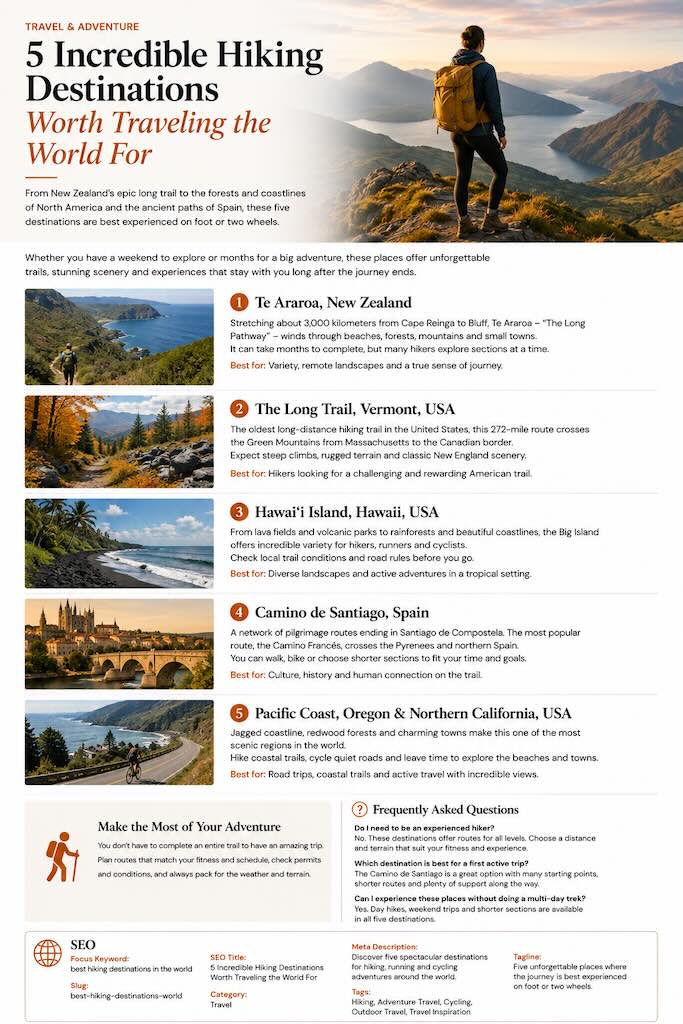
Some destinations are made for seeing through a window. Others make far more sense on foot or two wheels.
From a trail running the length of New Zealand to the forests and mountain passes of Vermont, the best active adventures aren’t simply workouts with prettier scenery. They slow travel down enough to notice the landscapes, small towns and unexpected moments that disappear when you’re rushing between attractions.
You don’t necessarily need months away or expedition-level fitness, either. Many of the world’s great long-distance routes can be experienced in sections, turning an intimidating multi-week journey into a day hike, weekend escape or week-long adventure.
1. Te Araroa, New Zealand
Few trails deliver a sense of journey quite like Te Araroa. Stretching roughly 3,000 kilometers from Cape Reinga at the top of New Zealand’s North Island to Bluff at the bottom of the South Island, its name translates to “The Long Pathway.”
The appeal is its extraordinary variety. Walkers encounter beaches, forests, farmland, rivers, volcanic landscapes, alpine terrain and communities along the way. Completing the entire trail is a serious undertaking usually measured in months rather than weeks, but you don’t have to become a thru-hiker to experience it.
Individual sections make it possible to build anything from a day walk to a longer hiking holiday around the route. That’s arguably one of Te Araroa’s greatest strengths: the adventure can be as ambitious as you want it to be.
2. The Long Trail, Vermont
For a classic American hiking experience, head into Vermont’s Green Mountains. The Long Trail runs for approximately 272 miles through the state from the Massachusetts border toward Canada and is recognized as the oldest long-distance hiking trail in the United States.
Don’t mistake its relatively modest distance for an easy walk. Sections can be steep, rocky, muddy and physically demanding, but that’s also what gives the trail its character. Mountain summits, dense woodland and distinctly New England scenery make it particularly memorable.
Vermont is equally appealing if you’d rather explore on two wheels. Quiet country roads, rolling terrain and small towns make it possible to combine hiking with road cycling during a longer trip.
Best for: hikers who want a rugged American trail without committing to something as enormous as the Appalachian Trail.
3. Hawaiʻi Island, Hawaii
Hawaiʻi Island — often called the Big Island — packs an astonishing range of landscapes into a single destination. Black lava fields can give way to tropical vegetation, beaches, ranch country and volcanic terrain within the same trip.
For hikers, Hawaiʻi Volcanoes National Park is the obvious centerpiece. Trails cross landscapes shaped by volcanic activity, creating an environment that can feel unlike almost anywhere else in the United States.
Elsewhere on the island, active travelers can find coastal walks, more demanding hikes and cycling opportunities. Conditions can vary significantly with elevation, weather and volcanic activity, however, so current trail closures and official guidance should always be checked before setting out.
The reward is an active trip that doesn’t have to be entirely about endurance. A morning hike can end with an afternoon beside the Pacific — exactly the kind of balance that makes adventure travel feel like a vacation rather than a training camp.
4. Camino de Santiago, Spain
The Camino de Santiago isn’t a single trail but a network of pilgrimage routes leading toward Santiago de Compostela in Galicia, Spain.
The best-known is the Camino Francés, traditionally beginning in Saint-Jean-Pied-de-Port in France before crossing the Pyrenees and continuing across northern Spain. Along the way are historic towns, rural landscapes, vineyards, forests and a constantly changing community of fellow travelers.
That social dimension is part of what distinguishes the Camino from a conventional hiking holiday. People arrive from around the world for religious, cultural, personal and purely adventurous reasons, often sharing meals and accommodations along the route.
You also don’t need to walk the entire Camino. Different routes and starting points make shorter journeys possible, while cyclists can tackle approved sections by bike.
Best for: travelers who want culture and human connection alongside the physical challenge.
5. The Pacific Coast, Oregon and Northern California
Few American road trips are as cinematic as the Pacific coast through Oregon and Northern California. Experiencing parts of it outside a car makes the landscape feel even bigger.
Think windswept beaches, enormous sea stacks, forested headlands and sections of coastline where the Pacific seems to stretch indefinitely toward the horizon. Continue into Northern California and the landscape gains another giant: the coast redwoods.
Rather than treating Highway 101 itself as one continuous running or cycling route, build an itinerary around established hiking trails, designated cycling routes, parks and quieter stretches appropriate for your activity. Traffic, shoulders and road conditions vary considerably along the coast.
This is particularly well suited to travelers who don’t want to choose one activity. Drive between bases, hike coastal trails one day, cycle another and leave enough time for beaches, forests and small coastal towns in between.
You Don’t Have to Complete the Whole Trail
There’s a temptation to think an iconic route only counts if you complete every mile. It doesn’t.
A three-day section of a 3,000-kilometer trail can be every bit as memorable as a months-long expedition. Choose the distance around your fitness, available time and the experience you actually want rather than treating somebody else’s finish line as the goal.
Whichever destination you choose, research seasonal conditions, permits, trail closures, transportation and local safety guidance before leaving. Remote landscapes are part of the attraction, but they also deserve preparation and respect.
The Divine Take
The best active trips aren’t necessarily the hardest ones. They’re the journeys where moving more slowly lets you experience a destination differently. Walk through a New Zealand landscape instead of photographing it from a viewpoint. Cycle between Vermont towns. Spend several days following an ancient route across Spain.
You might return home fitter. More importantly, you’ll probably remember far more of the journey.
Frequently Asked Questions
Do I need to be an experienced hiker for these trips?
Not necessarily. These destinations offer routes and sections for different experience levels. The important thing is choosing a distance and terrain appropriate for your fitness and preparing properly for the conditions.
Which destination is best for a first active vacation?
The Camino de Santiago can be particularly approachable because travelers can choose shorter sections and find towns, accommodation and services along many established routes.
Can I experience these destinations without doing a multi-day trek?
Absolutely. Day hikes and shorter sections are possible in all five destinations. A great active vacation doesn’t require completing an entire long-distance trail.