




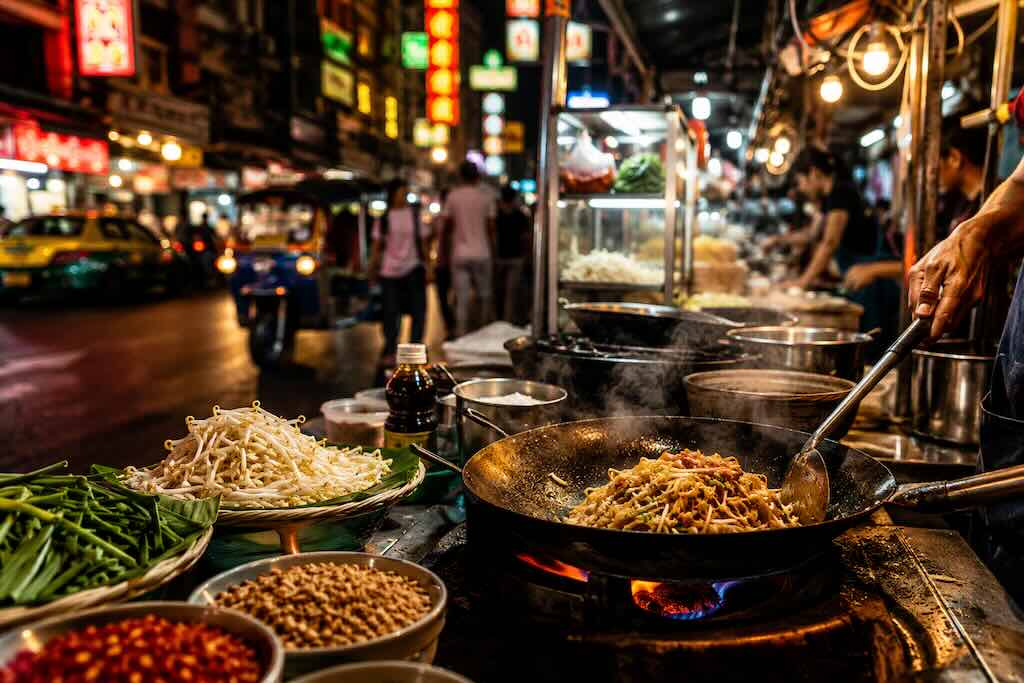
Bangkok rarely asks you to sit still. Tuk-tuks slip through traffic, markets glow after sunset, woks hiss beside the pavement and somewhere nearby, something fragrant with chilli, garlic or charcoal is being cooked to order.
Street food isn’t simply a convenient way to eat here. It’s part of the rhythm of the city. A plastic stool, a bowl assembled in minutes and the sound of traffic passing behind you can deliver one of the most memorable meals of an entire trip.
The difficult part is deciding what to order. From smoky skewers and fiery papaya salad to coconut-rich desserts, these are ten Thai street-food classics worth knowing before you start exploring Bangkok.
1. Pad Thai
Start with the familiar one—but don’t assume the version you’ve eaten at home tells the whole story.
Pad Thai is built around stir-fried rice noodles, typically balanced with tamarind, fish sauce, egg, bean sprouts and other ingredients before being finished with crushed peanuts and lime. Depending on the vendor, you’ll find versions with prawns, chicken or tofu.
Part of the pleasure is watching it come together: a fiercely hot wok, ingredients added in quick succession and dinner ready only minutes after ordering.
2. Som Tam
Few dishes capture Thailand’s talent for balancing contrasting flavours quite like som tam.
Shredded green papaya is pounded with ingredients such as chilli, lime, garlic and fish sauce, creating a salad that’s crunchy, sour, salty, sweet and potentially very hot at the same time.
If your tolerance for chilli is modest, say so when ordering. Bangkok‘s interpretation of “spicy” can be considerably more enthusiastic than yours.
3. Khao Pad
Khao pad proves that some of the best travel food doesn’t need to be complicated.
Thai fried rice usually combines fragrant rice with egg, vegetables and your choice of protein, with lime, cucumber or chilli served alongside. It’s comforting, quick and particularly useful when you want something satisfying between a morning of sightseeing and whatever Bangkok has planned for the afternoon.
4. Moo Ping
Follow the smell of charcoal in Bangkok and there’s a reasonable chance you’ll eventually encounter moo ping.
These grilled pork skewers are marinated before being cooked over hot coals until smoky and caramelised around the edges. They’re often eaten with sticky rice, turning what looks like a small snack into something considerably more satisfying.
They’re especially good when they’re handed over almost immediately after leaving the grill.
5. Tom Yum
Bangkok can be intensely hot, yet somehow a steaming bowl of tom yum still makes sense.
The aromatic soup typically brings together lemongrass, makrut lime leaves, galangal, chilli and lime, often accompanied by prawns or another protein. The result is fragrant and sharp rather than simply fiery.
Tom yum is also a good reminder that Thai food is rarely about one dominant flavour. Its character comes from several flavours pulling in different directions and somehow meeting perfectly in the middle.
6. Pad Kra Pao
If there’s one everyday Thai dish we’d add to the original list, it’s pad kra pao.
The dish combines stir-fried meat or another protein with chilli, garlic and holy basil, usually served over rice and often topped with a fried egg. It’s fast, fragrant and deeply savoury—the sort of uncomplicated meal you may find yourself ordering repeatedly.
7. Kuay Teow
Noodle stalls are part of Bangkok’s everyday food landscape, and kuay teow can take many forms depending on the noodles, broth and toppings you choose.
Rather than searching for one definitive version, treat noodle soup as an invitation to experiment. Look at what the stall specialises in, watch what regular customers are ordering and start there.
8. Pak Boong Fai Daeng
Often translated as stir-fried morning glory, this deceptively simple plate of water spinach becomes something altogether different once it hits a screaming-hot wok.
Garlic, chilli and savoury seasoning give the greens enormous flavour while keeping some of their bite. It’s particularly good alongside rice and richer grilled or stir-fried dishes.
9. Roti
Then comes dessert.
Thai street roti is cooked on a hot griddle until crisp and golden, then folded around or topped with sweet additions. Banana with condensed milk is a familiar combination, although stalls offer plenty of variations.
It’s sticky, crisp, unapologetically sweet and particularly difficult to walk past after you’ve smelled one cooking.
10. Mango Sticky Rice
Some desserts don’t need reinvention.
Mango sticky rice pairs ripe mango with glutinous rice enriched with coconut milk. The contrast is what makes it work: cool fruit, warm or room-temperature rice, creamy coconut and just enough sweetness.
When mango is beautifully ripe, very little else needs to happen.
Where to Start Exploring Bangkok’s Street Food
Bangkok doesn’t have a single street-food district, and that’s precisely the point. Some of the most interesting meals appear between shops, around markets and along streets you hadn’t intended to explore.
Yaowarat Road in Chinatown is one of the obvious places to begin after dark, when the neighbourhood fills with food stalls and restaurants. Markets are another easy introduction, while smaller neighbourhood stalls can provide a completely different experience away from the busiest visitor areas.
Don’t try to eat everything at one famous destination. Leave room for the stall you discover accidentally.
A Few Things to Know Before You Eat
A busy stall can be a useful sign: high turnover means food is being prepared continuously. Watch how ingredients are stored and cooked, choose food that’s freshly prepared and piping hot, and use the same common sense you would anywhere else while travelling.
Dietary restrictions require a little more attention. A dish that appears vegetarian may still contain fish sauce, shrimp paste or another animal-derived ingredient, so don’t rely on appearance alone.
Most importantly, don’t arrive with a rigid checklist. Try the classics, certainly, but let Bangkok surprise you. The meal you remember years later may be the one you never planned to order.