This guide covers the best Thai food for foreigners. Anyone visiting Thailand genuinely wants to explore the country’s world-famous cuisine.
Without much familiarity with local Thai food, foreigners often stick to what they already know — or worse, default to Western food while traveling in Thailand. Thai cuisine is genuinely diverse enough that there’s a delicious option for every type of eater. Here’s what we believe is the best Thai food for foreigners to start with. The best way to actually experience local cuisine anywhere is to visit local markets — in Thailand, Chatuchak Weekend Market in Bangkok is a genuinely excellent place to start.
This list covers only the best Thai food for foreigners — dishes that the majority of first-time visitors genuinely love, and all-time favorites among expats, including plenty of medium-spice options. With that said, here are the recommendations.
The best Thai food for foreigners is:
1. Tom Yum Goong
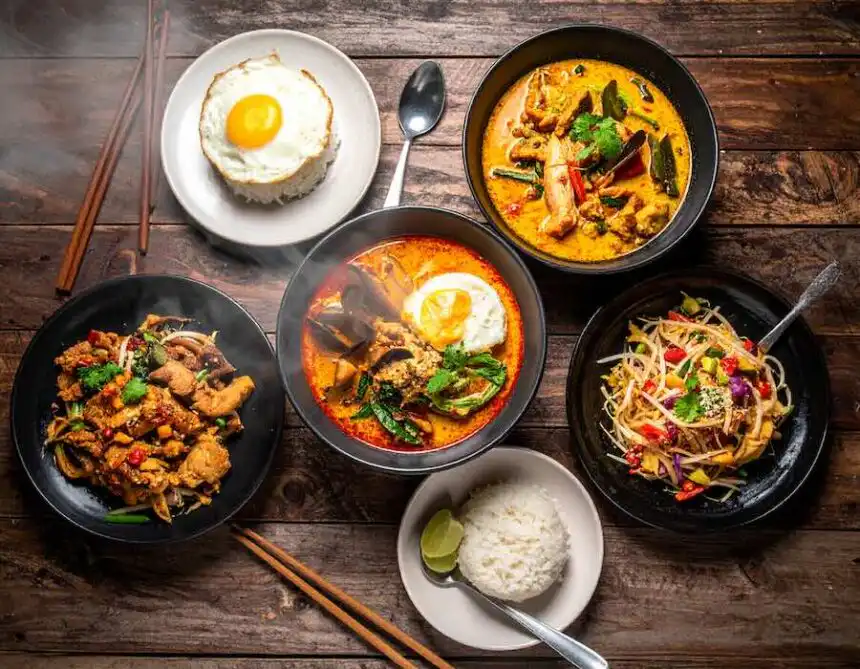
Tom Yum Goong is a spicy and sour soup with prawns (Goong means prawns in Thai), and it’s among the most popular Thai dishes for foreigners. This soup genuinely represents what Thai gastronomy stands for — spiciness, sourness, sweetness, saltiness, and umami all in one bowl. Tom Yum can run spicy, but the general level most restaurants serve is genuinely manageable for most foreigners, with a few exceptions here and there. Beyond prawns, or any other protein of choice, the soup comes packed with mushrooms and herbs. Some of those herbs aren’t meant to be eaten directly — the move is to scoop out the fragrant broth, prawns, and mushrooms instead. Tom Yum shows up on nearly every Thai restaurant menu, most commonly served with prawns.
It’s genuinely common to order Tom Yum Goong as a shared dish among companions, very typical of Thai dining culture. Because of that, it’s often served in a hot pot bowl to keep the soup warm through the meal. Two versions exist — Tom Yum Nam Khon and Tom Yum Nam Sai. Tom Yum Nam Khon, the creamier of the two, is by far the more popular choice.
2. Pad Kra Pao
Pad Kra Pao ranks among the most popular dishes for Thai people and foreigners alike. This stir-fried dish is genuinely Thailand’s answer to the hamburger — a real fast-food staple, served within minutes. Choose a protein (pork or chicken most commonly), and within minutes, an addictively good stir-fry with steamed rice arrives. The heartiness, saltiness, and spice are what make Pad Kra Pao work — seasoned with garlic, oyster sauce, soy sauce, sugar, chilies, and most importantly, Thai holy basil leaves. That basil is exactly why foreigners often know the dish as “Stir-Fry Holy Basil.”
Pad Kra Pao runs genuinely spicy as Thai food for foreigners goes, though restaurant staff will usually ask directly whether you can handle spice. Since it’s made fresh to order, requesting a milder or non-spicy version is genuinely easy. One more detail worth knowing: Pad Kra Pao is often served with a Thai fried egg — a deep-fried egg, sunny side up. The combination of a crispy-edged fried egg with a running yolk, steamed rice, and spicy, savory Pad Kra Pao is genuinely delicious enough that many Thais and expats eat it almost daily. We highly recommend doing the same.
3. Som Tam
Som Tam, better known to foreigners as Papaya Salad, is genuinely the most popular Thai dish there is. This spicy, sour salad is made from green, unripe papaya and originates from the Isaan region — one of Thailand’s most interesting regional cuisines. Som Tam shows up on nearly every restaurant menu and at countless street food stalls too. In a wooden mortar, scraped green papaya gets pounded together with chilies, garlic, roasted peanuts, fish sauce, palm sugar, lime, and tomato, served within minutes. Like Pad Kra Pao, it’s genuinely easy to request a milder or non-spicy version since it’s made fresh.
Worth knowing: several versions of Som Tam exist. Som Tam Thai — genuinely the most common and the best starting point for foreigners — is the safest bet, since other versions include ingredients less familiar to outside palates. Som Tam with Pla Ra, a popular version among Thais, includes fermented fish with a genuinely strong, unusual smell that won’t do much for most foreign appetites.
4. Khao Soi
Khao Soi is by far the most popular dish of Northern Thai cuisine, especially among foreigners. It originates from Burmese cuisine, though Chiang Mai and other northern regions have genuinely made it their own over time. Khao Soi is a Northern Thai curry built from shrimp paste, lemongrass, ginger, turmeric, coriander seeds, lime leaves, cardamom, chilies, and palm sugar. It’s served with noodles and topped with crispy fried noodles for genuine textural contrast. Khao Soi always comes with pickles, red onions, and lime — the Thai equivalent of salt and pepper on a Western table. Though herby, the flavor stays less extreme than something like Som Tam, which is exactly why it’s such popular Thai food for foreigners.
Khao Soi has genuine Muslim roots, making it one of the few Thai dishes rarely served with pork, and one of the few regularly served with beef. Beef remains a less common protein in Thai cuisine generally — not forbidden by Buddhism, but there’s a cultural preference against eating large animals. With that in mind, Khao Soi most often shows up with chicken, typically drumstick.
5. Pad Thai
Not necessarily a personal favorite, but there’s no denying Pad Thai is genuinely typical Thai food for foreigners. Many visitors assume Pad Thai is Thailand’s most popular dish — it isn’t, historically speaking. During World War II, when Thailand faced a rice shortage from floods and war, Pad Thai was crowned the country’s “National Dish” specifically to promote noodle consumption and Thai nationalism. That PR campaign worked remarkably well, especially outside Thailand, to the point that foreigners who’ve never visited often assume it’s what Thais eat every day.
Still, Pad Thai is genuinely everywhere in Thailand, and Thais do enjoy it too. Thai cuisine builds around five core flavor elements including spice, and Pad Thai leans sweet, savory, and sour rather than spicy — which is exactly why it works so well as Thai food for foreigners. The most famous version in the country can be found at Pad Thai Thip Samai in Bangkok.
6. Massaman Curry
Massaman Curry is another creamy, herby, not-too-spicy option similar to Khao Soi, and genuinely popular among foreigners. Like Khao Soi, it carries Muslim roots. The curry itself builds on cardamom, cinnamon, cloves, star anise, cumin, bay leaves, and nutmeg — a genuinely fragrant list of spices on its own. Served with chicken or beef, the creamy curry comes loaded with large chunks of boiled potato, alongside steamed rice. It’s not quite as ubiquitous as some other dishes on this list, so it’s worth seeking out specifically. Some restaurants now prepare the curry paste with modern equipment rather than the traditional method, which can leave the finished curry noticeably oilier — the traditional, less-oily version is genuinely the better one to seek out.
7. Deep-Fried Seabass with Fish Sauce
Deep-fried seabass with fish sauce ranks among the genuine standout Thai seafood dishes — and because the flavors suit the Western palate well, it’s excellent Thai food for foreigners. The seabass, known locally as Pla Ka Pong Tod, is either sliced in half or filleted and cut into large chunks before being deep-fried in batter for a crispy, hearty crust. Filleted and chunked ahead of frying is genuinely the better version, for two real reasons: no fish bones to navigate while eating, and smaller chunks crisp up more evenly than a whole fish would.
Several ways to serve Pla Ka Pong Tod exist — oyster sauce, fish sauce, or Thai herbs. The herb version is genuinely the most fragrant, and possibly a bit wild for some newcomers. Fish sauce remains the safest bet, and honestly, the most popular option among Thais and foreigners alike. This dish shows up at essentially every seafood-focused Thai restaurant.
8. Laab
Laab is another popular dish from the Isaan region — genuinely fragrant, often spicy, and unofficially considered Laos’s national dish too. It’s technically a meat salad, though it bears little resemblance to what that phrase usually conjures. Laab is made from marinated, boiled meat finished with fish sauce, green onion, shallot, cilantro, lime juice, toasted rice, and mint leaves. It might not sound like the tastiest combination on paper, but eaten with rice — sticky rice especially — it genuinely becomes a favorite fast.
Two things are worth watching for with Laab. First, in the Isaan region specifically, it’s sometimes served with undercooked pork — genuinely worth avoiding for health reasons, though this isn’t common elsewhere in Thailand. Second, entrails show up regularly in Thai cuisine, and Laab is a common vehicle for intestines specifically. Higher-end Thai restaurants typically skip the intestines; the very local spots usually don’t.
9. (Boat) Noodles
Thai cuisine offers countless noodle varieties, and plenty of them are genuinely popular with foreigners. Listing every single one would get overwhelming fast, so boat noodles specifically are worth a deeper look, given how popular they are as Thai food for foreigners.
Tiny bowls of noodles in an incredibly fragrant broth, often costing as little as 15-20 THB per bowl at genuinely local shops — what’s not to like? Boat noodles originate from Bangkok and Ayutthaya, where vendors once served food directly from canoes along the canals. Because vendors had to sell everything from a small boat, the bowls stayed small too. Boat noodles aren’t sold from actual canoes anymore, but restaurants in Bangkok and Ayutthaya still serve them in the same tiny bowls, and these spots remain genuinely popular — expect to order several bowls per meal, since one alone won’t be enough.
10. Kai Yang
Grilled meats served with a spicy dipping sauce and sticky rice — another genuine staple of Isaan cuisine, which offers plenty beyond just chili-packed dishes. Kai Yang is barbecued chicken with a subtly smoky flavor genuinely familiar to Western palates. Street food vendors sell it everywhere, though quality and hygiene can vary; a proper restaurant is the safer bet for grilled chicken done well. Grilled beef and marinated pork or chicken skewers round out the other popular options, with skewers found mostly at street food stalls specifically.
11. Panang Curry
The last curry recommendation here, though Thailand offers plenty more to discover beyond it. Panang Curry shares more in common with popular Thai curries like Green Curry, Red Curry, and Yellow Curry than the other curries covered above. The real advantage for foreigners: Panang is genuinely the most accessible curry Thai cuisine offers, flavor-wise. It’s still slightly spicy, but noticeably milder than the alternatives. Panang Curry shows up at most Thai restaurants and is typically served with chicken, peas, and kaffir lime leaves — fragrant, herby, and refreshing in a way many foreigners genuinely love.
12. Crispy Pork
Pork is by far the most common protein in Thai cuisine, prepared in countless ways. One genuinely popular method bakes the fat and skin until crispy, leaving the outside crunchy and the inside still succulent. Thais use crispy pork in noodles and noodle soups, and as a protein in popular dishes like Pad Kra Pao. It also stands alone as its own dish, served with a thickened soy dipping sauce. The texture, saltiness, and savoriness alongside the sweetness of the soy sauce make for a genuine treat. Crispy pork rarely makes other “best of” lists, but it’s genuinely worth trying — simple, not overly complex in flavor, and exactly the kind of dish that makes ideal Thai food for foreigners.
13. Mango Sticky Rice
Everything so far has covered main courses, but Thais genuinely love their daily dose of sweetness too. Plenty of Thai desserts exist and are generally safe for foreigners to try, though a few unusual combinations and ingredients do show up. When it comes to dessert, though, there’s genuinely one clear winner for foreigners: Mango Sticky Rice. A ripe mango gets sliced and served alongside sticky rice, topped with sweetened condensed coconut milk. The quality genuinely depends on the mango — a deep yellow color and real ripeness matter, and mango season (April through June) is when the fruit gets genuinely incredible. Mango Sticky Rice is available year-round regardless, just noticeably better during peak season.
14. Moo Ping
The last recommendation here is Moo Ping, a genuinely popular street food dish found everywhere in Thailand. Moo Ping is marinated, minced pork grilled on a skewer — not spicy at all, which makes it excellent Thai food for foreigners specifically. It’s one of countless street food options available to any visitor, and exploring street food genuinely ranks among the top activities for many tourists in Thailand.
Conclusion
That’s the full rundown — the best Thai food for foreigners, from soups and salads to curries, street skewers, and dessert. Working through every dish on this list over a trip to Thailand genuinely builds a clear, well-rounded picture of what Thai gastronomy is actually about.
FAQ: Thai Food for Foreigners
Q: How do I order Thai food at a mild spice level without missing out on flavor? A: Most Thai dishes are genuinely made to order, so requesting “mai pet” (not spicy) or “pet nit noy” (a little spicy) works well at most restaurants — the other seasonings (fish sauce, sugar, lime, herbs) still come through fully even with the chilies dialed back.
Q: Is street food in Thailand safe for foreigners to eat? A: Generally, yes, at genuinely busy stalls with high turnover — food that’s cooked fresh and served hot to a constant stream of customers is usually a safe bet. Stalls with visibly low traffic or food sitting out for extended periods are worth skipping.
Q: What’s the best way to try multiple dishes without over-ordering? A: Thai meals are traditionally shared family-style, so ordering 2-3 dishes plus rice for a group and sampling everything works well — a much better approach than each person ordering an individual entrée.
Q: Are there vegetarian or vegan versions of these dishes? A: Many genuinely translate well — Som Tam, Pad Thai, and several curries can be made without fish sauce or meat on request (“mangsawirat” for vegetarian). It’s worth confirming directly, though, since fish sauce and shrimp paste show up as base seasonings in dishes that otherwise look meat-free.