




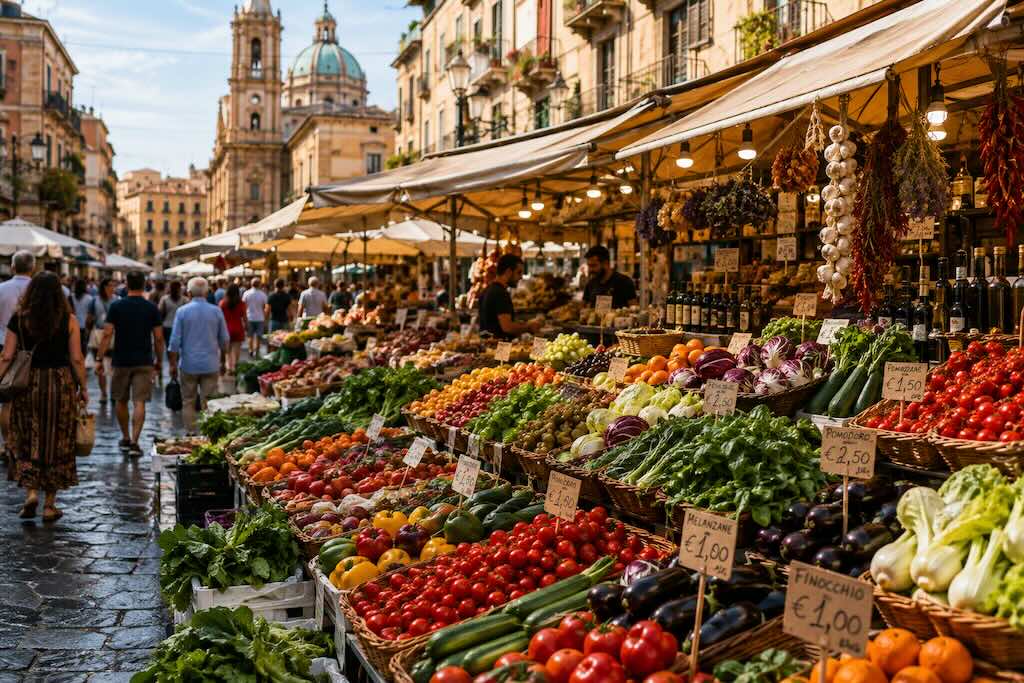
Italy’s markets are at their best before they become a shopping exercise. Listen first: vendors calling across narrow lanes, knives working through produce, scooters passing at the edge of a piazza. Then come the colors—tomatoes, citrus, leather, flowers, painted ceramics and, in Naples, entire miniature worlds built by hand.
Markets also offer something Italy’s monumental sights cannot. They show cities functioning in real time. Some remain closely tied to food and neighborhood routines; others have evolved into destinations where local tradition meets tourism. These four markets in Palermo, Rome, Naples and Florence are worth approaching slowly, with enough room in the day to wander.
Ballarò Market, Palermo
Ballarò is not the place for a perfectly composed shopping experience. That is precisely its appeal. Palermo’s historic market spills through streets in the Albergheria district with fruit, vegetables, seafood, meat, spices and prepared food packed tightly beneath awnings and signs.
The atmosphere carries traces of Sicily’s long Mediterranean history. Palermo was shaped by Phoenician, Roman, Arab, Norman and later cultures, and its markets remain one of the most immediate places to sense the city’s layered identity.
Come hungry rather than arriving with a rigid shopping list. Look at what is in season, watch where residents stop, and make time for Palermo’s street-food culture. The experience is as much about sound, movement and conversation as whatever eventually ends up in your bag.
Campo de’ Fiori Market, Rome
Few markets occupy a setting quite like Campo de’ Fiori. By morning, wooden stalls bring produce, flowers and food into one of central Rome’s most recognizable squares. Later, the market disappears into a different rhythm as restaurants and bars take over the surrounding streets.
According to Rome’s official tourism portal, the market traditionally runs in the morning from Monday through Saturday and moved here from Piazza Navona in 1869. The square’s history reaches much further back, and its center is marked by the imposing monument to philosopher Giordano Bruno.
The surrounding lanes make the visit stronger. Small shops, artisan businesses and cafés extend the experience toward Piazza Navona and the Pantheon, making Campo de’ Fiori easy to incorporate into a morning spent walking through Rome’s historic center.
Not everything sold in such a heavily visited area is necessarily an undiscovered local treasure, so shop with a little discernment. Sometimes the better purchase is simply fresh fruit for the day’s walk.

Via San Gregorio Armeno, Naples
San Gregorio Armeno is different. This is less a conventional produce market than a street of workshops and shops devoted to one of Naples’ most distinctive craft traditions: the presepe, or Neapolitan nativity scene.
Artisans create miniature figures, architectural details and elaborate scenes, with traditional religious characters often sharing space with recognizable figures from contemporary culture. The result can feel devotional, theatrical and playfully Neapolitan at the same time.
The street sits within Naples’ historic center, so it works best as part of a longer walk rather than an isolated shopping stop. Look closely at the workshops and craftsmanship instead of rushing through the displays. Even travelers with no intention of buying a nativity figure can appreciate the extraordinary concentration of handwork.
Christmas naturally intensifies interest, but the tradition is embedded in the street throughout the year. For anyone interested in craftsmanship, folk culture or the visual eccentricity of Naples, San Gregorio Armeno is difficult to forget.
San Lorenzo and Mercato Centrale, Florence
Florence offers two closely connected market experiences around San Lorenzo, and distinguishing between them makes the area easier to understand.
Inside the 19th-century Mercato Centrale, food is the focus. Florence’s official FeelFlorence tourism portal describes ground-floor vendors selling fruit, vegetables, meat, fish and bread, while the upper level contains food shops and restaurants.
The building itself deserves attention. Its iron, cast-iron and glass structure belongs to the period when Florence was capital of the Kingdom of Italy. The nearby outdoor San Lorenzo market has a different character, with stalls focused largely on clothing, leather goods, objects and souvenirs.
If food matters most, start indoors. If you are shopping for leather or gifts, continue through the outdoor stalls—but compare quality rather than assuming every item represents Florentine craftsmanship simply because it is sold in Florence.
The market also fits naturally into a food-focused day in Tuscany. Divine’s earlier Tuscan dining story offers another glimpse into the region’s relationship with the table.

How to shop Italian markets well
Go early when visiting food markets. Produce is fresh, the temperature is usually kinder, and you have a better chance of seeing the market before the busiest visitor traffic arrives.
Carry some cash, but do not assume every vendor requires it. Payment options vary considerably. The same applies to bargaining: negotiating may be appropriate in some flea, souvenir or clothing markets, but it should not be treated as a universal rule for Italian market shopping.
Most importantly, verify opening days and hours shortly before visiting. Markets change with holidays, seasons and local regulations. Official city tourism resources are more reliable for practical information than old travel posts that may still rank prominently in search results.
Conclusion
Italy’s markets reveal different layers of the country. Ballarò is visceral and food-driven. Campo de’ Fiori places everyday commerce inside the monumental fabric of Rome. San Gregorio Armeno turns craft into street theatre, while Florence’s San Lorenzo district moves between ingredients, architecture, leather and souvenirs.
Buy something if it feels right. Taste something you have never ordered before. But leave enough time simply to watch. In an Italian market, the most memorable part often cannot be packed into a suitcase.
FAQ: Visiting markets in Italy
What are some of the best markets to visit in Italy?
Ballarò in Palermo is particularly strong for atmosphere and Sicilian food culture, while Campo de’ Fiori provides a historic market experience in central Rome. San Gregorio Armeno in Naples specializes in traditional nativity craftsmanship, and Florence’s San Lorenzo area combines a food market with outdoor shopping.
What is the best time to visit Italian food markets?
Morning is generally the most rewarding time. Food stalls are active, produce is plentiful and many traditional markets finish or become quieter later in the day. Always confirm current hours for the specific market before traveling.
Should you bargain at markets in Italy?
It depends on the market and product. Bargaining may occur at some flea markets and souvenir or clothing stalls, but haggling is not appropriate everywhere. Food stalls and clearly priced goods should generally be approached as fixed-price purchases unless the vendor indicates otherwise.
Do Italian markets accept credit cards?
Many vendors now accept electronic payments, but facilities vary by market and stall. Carrying a modest amount of euros provides a useful backup for small purchases.
What should you buy at an Italian market?
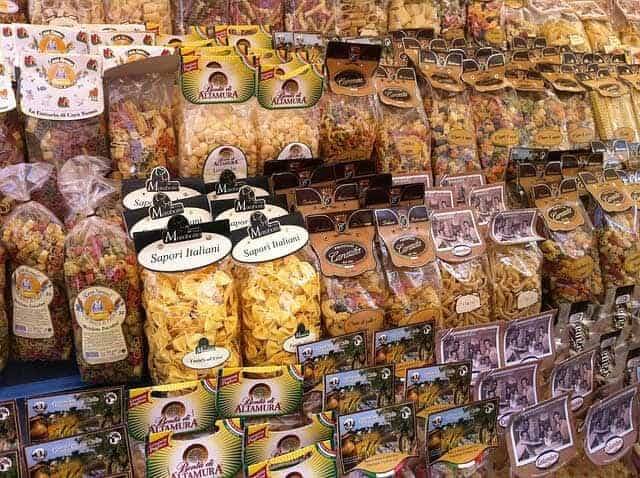
Look for goods connected to the market itself rather than generic souvenirs: seasonal food in Palermo, artisan nativity pieces in Naples or ingredients in Florence’s Mercato Centrale. When buying leather, crafts or packaged foods, check provenance and quality rather than relying solely on location or labeling.