




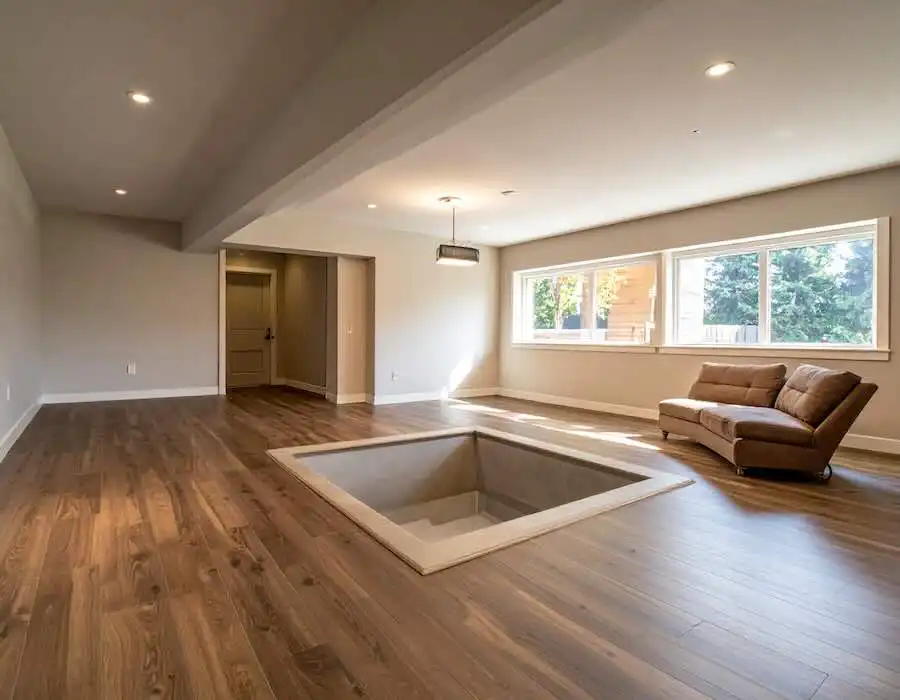
A basement is the one room in the house that starts as a problem to solve rather than a blank canvas. Low ceilings, moisture, a single stairwell down — every basement conversion begins by working around what’s already there. That constraint, handled well, tends to produce the most distinctive room in the house.
Solve Moisture and Light Before Anything Else
Moisture is the issue that separates a basement conversion that lasts from one that fails within two winters. Exterior waterproofing, a vapor barrier, proper insulation, and a dehumidification plan need to be settled before a single cosmetic decision gets made — flooring, paint, and furniture all depend on that groundwork holding. Skipping it is the most common, and most expensive, mistake in basement work.
Light follows the same logic. Basements built as bedrooms require an egress window under most residential codes — the International Residential Code’s Section R310 sets a minimum net clear opening, a window well sized to match, a threshold that drains rather than pools. Treated well, that code requirement becomes an amenity: a deeper window well with tiered planting, angled to catch morning sun, does double duty as both exit and outlook.
Design in Zones, Not One Open Room
A basement’s low ceiling and single light source make one continuous open-plan room feel flatter than it should. The stronger move is zoning: a media or lounge area near the stairs, a work nook with dedicated lighting and wiring, a fitness corner finished in rubber flooring, a wet bar positioned to serve all three. Each zone gets its own lighting temperature and flooring material, which does more to define the space than any wall would.
| Zone | Best flooring | Notes |
|---|---|---|
| Lounge / media | Rigid-core LVP (SPC or WPC) | Handles subfloor irregularities better than flexible vinyl |
| Home gym | Rubber tile | Sound dampening and moisture tolerance |
| Wet bar / bath | Porcelain tile | Fully moisture-resistant |
| Work nook | Rigid-core LVP | Pair with layered task lighting |
Let Ceiling Height Set the Palette
Below-grade ceilings are almost always lower than the rest of the house, and fighting that with heavy trim or dropped soffits only draws attention to it. Warm, light wall and ceiling tones — soft plaster white, pale oat, muted clay — push the room outward instead of down. An exposed, painted ceiling reads as intentional rather than unfinished, and frees up the inches a dropped grid would take.
Layered lighting does the rest of the work daylight can’t. Recessed ambient light for the whole room, a warmer secondary layer over the lounge zone, and focused task lighting at the work nook — together they replace the sense of a single overhead bulb with something closer to daylight variation.
Where the Budget Actually Goes
Labor accounts for close to half the total cost of a basement conversion, and the line items that push a budget upward fastest are the ones invisible once the project is finished: waterproofing beyond basic interior drainage, egress window installation, and any structural change to ceiling height. It’s tempting to spend early on visible finishes, but the better sequence is the reverse — secure moisture control and code-compliant egress first, then spend what’s left on cosmetics.
Basement conversions also recover a solid share of their cost at resale — NAR’s 2025 Remodeling Impact Report puts basement-to-living-area conversions at roughly 71% cost recovery nationally, on par with new wood windows and ahead of most cosmetic upgrades — though realtors still rank it behind smaller, cheaper projects when the goal is prepping a home to sell quickly.
A Modern Basement Doesn’t Try to Hide What It Is
The basements that feel most contemporary right now aren’t the ones dressed up to mimic the floor above — they’re the ones that lean into being below grade: cooler tones, exposed materials, a slightly more private register than the rest of the house. A basement doesn’t need to pretend to be a living room upstairs. It can be the one room built for a different kind of quiet.
FAQ
Do I need an egress window if I’m not adding a bedroom?
Most codes only require egress windows in rooms designated as bedrooms. General living space, media rooms, and gyms typically don’t trigger the requirement — but always confirm with local building regulations before finalizing a layout.
What flooring handles basement moisture best?
Rigid-core luxury vinyl plank (SPC or WPC) is the most reliable all-purpose choice — it tolerates subfloor irregularities and moisture better than flexible vinyl, with porcelain tile as the stronger option for wet zones specifically.
How much of the budget should go toward waterproofing?
There’s no fixed percentage, but most experienced contractors recommend budgeting a contingency of 10–20% of total project cost specifically for drainage and waterproofing surprises, on top of the base waterproofing plan.
Conclusion
The basements worth converting are the ones treated as their own kind of room from the start — moisture solved, light planned rather than apologized for, zones that give the space a rhythm the low ceiling can’t take away. Get the invisible work right first. Everything visible follows more easily than it looks like it should.