




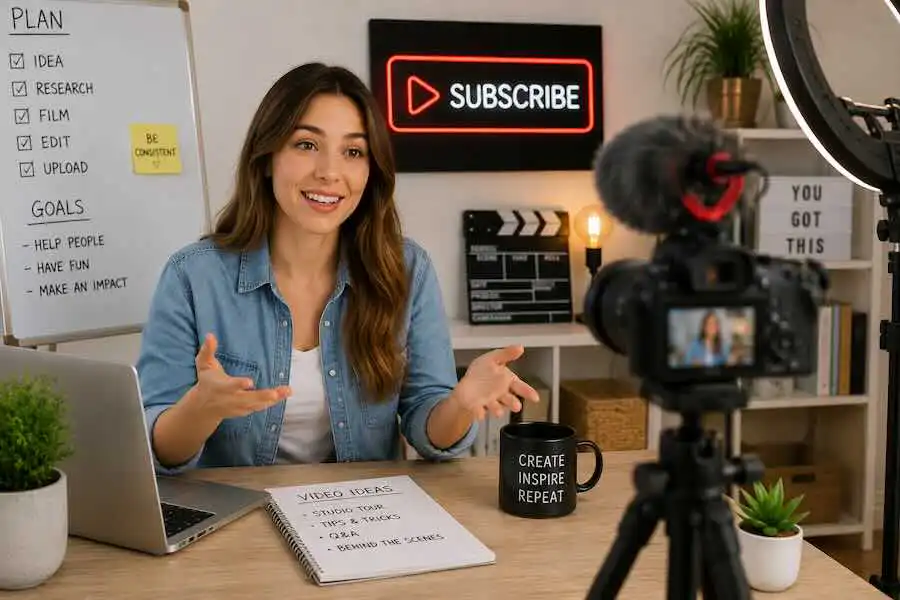
A successful YouTube channel rarely begins with an expensive camera or a perfectly designed studio. It begins with something less visible: a clear reason for making videos and an understanding of who should want to watch them.
That distinction matters because YouTube is no longer simply a place to upload videos and hope an audience appears. Creators are competing for attention across long-form video, Shorts, search results, recommendations and subscriptions. Building a channel takes experimentation, consistency and the patience to study what viewers actually respond to.
Choose a clear focus for your YouTube channel
Start with the intersection between what you genuinely enjoy and what you can make repeatedly. One entertaining video idea is not necessarily a sustainable channel idea.
If you love cooking, for example, “food” is an enormous category. Weeknight meals for students, Scandinavian baking, inexpensive vegetarian recipes or restaurant recreations give viewers a much clearer reason to understand and remember the channel.
This does not mean every upload needs to be identical. Think in terms of a recognizable territory rather than a rigid formula. A focused channel can still contain several recurring formats as long as they make sense for roughly the same audience.
Decide what success means before chasing views
A creator trying to build a business may make different decisions from someone using YouTube to support a music career, document a hobby or develop filmmaking skills.
Set goals you can influence. Subscriber counts and viral views are outcomes, while publishing six strong videos, improving audience retention or testing three thumbnail approaches are actions you can control.
It also helps to define a simple editorial identity: what subjects will you cover, who are they for, what will viewers gain and what should the channel feel like? Those answers can guide everything from scripts to thumbnails.
Build the channel around the viewer
Once the direction is clear, set up the channel so a new visitor can understand it quickly. Use a recognizable profile image, appropriate channel artwork and a description that communicates what viewers can expect.
The official YouTube Help guidance on creating a channel provides the current setup process, while YouTube Help should be your reference for platform features and policies that can change over time.
Brand consistency helps recognition, but do not confuse consistency with making every thumbnail look interchangeable. Each video still needs its own compelling visual idea.
Plan videos before pressing record
A useful video begins before the camera turns on. Decide what promise the video makes and whether the content actually delivers it.
For tutorials, the promise may be solving a specific problem. Entertainment channels may build around curiosity, personality or tension. Reviews need a clear question to answer. Essays need a point of view rather than a collection of loosely connected facts.
You do not necessarily need a word-for-word script. A structured outline can be enough: opening hook, essential context, main sections, payoff and a natural next action for the viewer.
Prioritize audio before expensive camera gear
You can start a YouTube channel with a modern smartphone. Sharp 4K footage is useful, but viewers will notice echoing, distorted or difficult-to-hear speech immediately.
Begin with what materially improves the viewing experience: understandable audio, stable framing and controlled light. A window can provide beautiful soft illumination. An inexpensive microphone positioned correctly may improve a video more noticeably than replacing a capable phone with an expensive camera.
As your format develops, you can add equipment according to actual problems. A tripod solves unstable framing. A dedicated microphone improves sound capture. Lighting creates consistency when daylight disappears. A camera upgrade becomes useful when your production genuinely requires capabilities your current equipment cannot provide.
If you are building a more advanced production setup, this filmmaking equipment overview offers additional ideas.
Learn thumbnails and titles as seriously as filming
A beautifully produced video cannot do much if nobody chooses it. Packaging matters.
The title and thumbnail should work together to communicate a clear reason to watch without promising something the video does not deliver. Avoid stuffing the thumbnail with unnecessary details. On a phone screen, one strong subject and a readable visual hierarchy will usually communicate faster than a miniature poster.
Titles should be specific enough to create expectation while leaving enough curiosity for the viewer to click. Search-friendly wording can be valuable for tutorials and informational content, while recommendation-driven entertainment may depend more heavily on the idea and packaging.
Understand YouTube SEO without writing for robots
Search optimization still has a place on YouTube, particularly when people actively search for the subject you cover. Use clear language in titles and descriptions so both viewers and the platform can understand the topic.
But keywords cannot rescue a video viewers do not want to watch. The content itself needs to satisfy the expectation created by its packaging.
Instead of forcing the same phrase repeatedly into a description, explain the video naturally and accurately. Think first about the question or interest that brought someone to the video.
Make the opening earn the next minute
The first moments of a video are expensive. Viewers have already seen the thumbnail and title. Repeating them through a long animated introduction or several minutes of unrelated conversation delays the reason they clicked.
Show viewers quickly that they are in the right place. Introduce the problem, question, transformation or tension, then move.
Good pacing does not necessarily mean frantic editing. A quiet travel film can hold attention through composition and atmosphere. A tutorial can move slowly enough to remain understandable. The useful question is whether each section is still serving the experience.
Publish on a schedule you can actually maintain
Consistency is useful when it creates a repeatable production rhythm. It becomes counterproductive when an unrealistic schedule forces rushed ideas and exhausted editing.
One carefully produced video every two weeks may make more sense for your channel than three weak uploads every week. Estimate how much time research, scripting, filming, editing, thumbnails and publishing genuinely require before deciding on a cadence.
Batching can help. Film several related pieces during one setup, create thumbnail concepts before editing is complete and keep a small reserve of future ideas so every upload does not begin from zero.
Use YouTube Analytics to understand your audience
Publishing is only half of the process. The other half is observing what happened.
YouTube Analytics gives creators information about content performance and audience behavior. Instead of staring only at total views, examine patterns across multiple uploads.
- Impressions and click-through behavior: Are people choosing the video when it is presented to them?
- Audience retention: Where are viewers losing interest or replaying sections?
- Traffic sources: Are viewers discovering the content through search, recommendations or other surfaces?
- Returning viewers: Are people coming back for more?
- Content patterns: Which subjects and formats repeatedly perform better for your audience?
Treat the numbers as evidence, not judgment. A disappointing upload can still tell you something useful about topic selection, packaging or structure.
Use Shorts strategically
YouTube Shorts give creators another format for discovery, but short-form content should still have a purpose within the channel.
A Short can test an idea, answer one compact question, extract a useful moment from a larger subject or introduce viewers to your personality. What matters is whether the audience attracted by that content makes sense for what you want to create next.
Build an audience, not just a subscriber count
A large number beneath the channel name looks impressive, but recurring viewers are more meaningful than an audience that subscribed once and disappeared.
Respond thoughtfully to comments when practical. Notice recurring questions. Let audience feedback inspire future videos without allowing every comment to redirect the channel.
Recurring formats can also create familiarity. When viewers understand what kind of experience they will receive, returning becomes easier.
How YouTubers make money
If YouTube is intended to become a career, advertising is only one possible revenue stream. Depending on the channel and audience, creators may eventually earn through the YouTube Partner Program, memberships and fan-funding features, sponsorships, affiliate relationships, merchandise, products or services.
Eligibility requirements and available monetization features can change and may differ by region. Check the current YouTube Partner Program information rather than relying on old subscriber or watch-time figures from articles and videos.
Paid partnerships should also be disclosed clearly. In the United States, creators can review the Federal Trade Commission’s guidance for social media influencers when working with brands.
Be cautious with paid YouTube promotion
Paying for legitimate advertising is different from buying views, subscribers or artificial engagement. A larger number is worthless if the people behind it have no genuine interest in your videos.
Avoid services promising guaranteed subscribers, watch time or engagement through questionable methods. Artificial activity can distort the analytics you need to make editorial decisions and may conflict with platform policies.
If you spend money on growth, understand exactly what you are buying, where the audience comes from and whether the method complies with current YouTube rules.
A practical workflow for a new YouTuber
Starting becomes easier when the process is reduced to a repeatable cycle:
- Choose one clear audience and content territory.
- Brainstorm several video ideas before launching.
- Choose the strongest idea and define its promise.
- Outline or script the video.
- Plan the title and thumbnail concept early.
- Record with clean audio, stable framing and adequate light.
- Edit away material that does not serve the viewer.
- Publish with an accurate title, thumbnail and description.
- Study the analytics after enough viewing data accumulates.
- Use what you learned to improve the next video.
Then repeat. The channel becomes clearer through making, measuring and refining rather than waiting until every detail is perfect.
Conclusion
Becoming a successful YouTuber is less about discovering one algorithmic trick and more about developing a collection of skills: ideas, storytelling, filming, sound, editing, packaging and audience analysis.
Start with the equipment you can reasonably access. Choose a subject you can return to repeatedly. Publish, study what happens and make the next video sharper than the last. A sustainable channel is built one useful creative decision at a time.
Frequently asked questions
Can you become a successful YouTuber with a smartphone?
Yes. A capable smartphone can be enough to begin. Concentrate on clear audio, good lighting, stable framing and strong content before assuming an expensive camera is necessary.
How often should a new YouTuber upload?
There is no universal schedule. Choose a publishing rhythm that gives you enough time to produce worthwhile videos consistently. Quality and sustainability matter more than selecting an arbitrary number of weekly uploads.
How long does it take to become successful on YouTube?
There is no reliable timeline. Growth depends on factors including subject, audience demand, video quality, packaging, competition and how effectively you learn from previous uploads. Some channels grow quickly while others develop gradually.
Do YouTubers need SEO?
Clear titles, descriptions and topic signals can help YouTube understand content, particularly for search-driven videos. SEO should support useful content rather than replace it. Viewer interest and satisfaction remain essential.
How many subscribers do you need to make money on YouTube?
YouTube Partner Program requirements depend on the monetization features involved and can change over time. Consult the current official YouTube eligibility information before planning around a particular subscriber, upload or watch-time threshold.
Should a new YouTuber buy subscribers or views?
No. Artificial subscribers and engagement do not create a genuine audience and can interfere with meaningful performance analysis. Focus on attracting people who actually want the content and follow YouTube’s current policies on artificial or incentivized engagement.