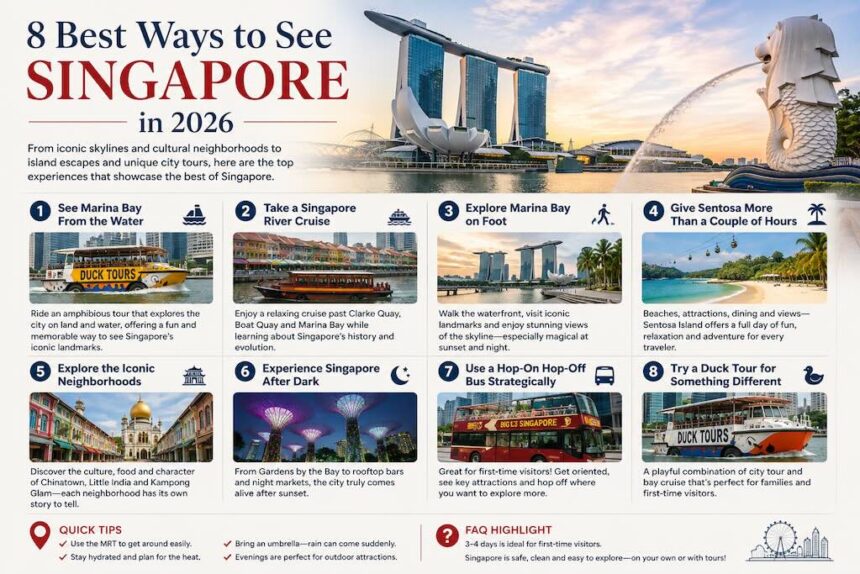
Singapore is one of those cities that can feel futuristic, historic, tropical and intensely urban within the space of a single afternoon. Glass towers rise beside colorful shophouses, gardens spill across the skyline, and some of the city’s best views appear from the water rather than the street.
- 1. See Marina Bay From the Water
- 2. Take a Singapore River Cruise
- 3. Explore Marina Bay on Foot
- 4. Give Sentosa More Than a Couple of Hours
- 5. Explore Singapore Through Its Neighborhoods
- 6. Experience Singapore After Dark
- 7. Use a Hop-On Hop-Off Bus Strategically
- 8. Try a Duck Tour if You Want Something Different
- Which Singapore Sightseeing Experience Should You Choose?
- How to Spend One Sightseeing Day in Singapore
- What to Know Before Sightseeing in Singapore
- FAQ: Sightseeing in Singapore
- How many days do you need in Singapore?
- Is Singapore easy to explore without a tour?
- Is Singapore a walkable city?
- Is a Singapore sightseeing bus worth it?
- What is the best time of day to visit Marina Bay?
- What can you do in Singapore when it rains?
- Should I take a Duck Tour or Singapore River Cruise?
- The Best Singapore Tour Might Not Be a Tour at All
For a first visit, the challenge isn’t finding things to see. It’s deciding how to experience them without spending the entire trip moving between attractions. Singapore’s compact size and excellent public transport make independent sightseeing remarkably easy, while river cruises, sightseeing buses and amphibious tours can offer a completely different perspective.
From Marina Bay after dark to the neighborhoods where much of Singapore’s cultural character lives, these are eight of the best ways to explore the city in 2026.
1. See Marina Bay From the Water
Singapore’s skyline makes sense from the water in a way it doesn’t always from street level.
From Marina Bay, the city opens up around you: Marina Bay Sands on one side, the downtown skyline on another and the Merlion looking considerably smaller than it does in photographs.
An amphibious sightseeing tour is one of the more unusual ways to experience this part of Singapore. The journey begins on land before the vehicle enters the water, combining conventional sightseeing with a short cruise around Marina Bay.
It’s particularly appealing for families or first-time visitors who want an introduction to central Singapore without immediately navigating everything independently.
If organized tours aren’t your thing, don’t worry. Marina Bay is also one of the easiest parts of Singapore to explore on foot.
2. Take a Singapore River Cruise
For a slower introduction to the city, take to the Singapore River.
Traditional-style bumboats travel along the historic waterway past areas including Boat Quay and Clarke Quay before reaching Marina Bay. It’s a relatively short experience, but the perspective from the river makes it worthwhile.
The route also reveals something important about Singapore’s history. Long before the skyline became the image most visitors associate with the city, the river was central to its development as a trading port.
Late afternoon is an especially good time to go. You’ll avoid some of the strongest midday heat, and depending on timing, the city may begin lighting up before the journey ends.
3. Explore Marina Bay on Foot
You don’t actually need a sightseeing tour to experience many of Singapore’s most recognizable landmarks.
Marina Bay rewards walking.
Start around the Merlion, follow the waterfront toward Marina Bay Sands and continue toward Gardens by the Bay. Along the way, you’ll get constantly changing views of the skyline and plenty of opportunities to stop when the heat inevitably suggests that it’s time for something cold.
If you want to see Singapore from above, the SkyPark Observation Deck at Marina Bay Sands offers a dramatically different perspective. From this height, the city’s density becomes obvious, but so does the amount of greenery woven through it.
Try to time a Marina Bay visit for late afternoon and stay into the evening. Watching the district transform as the buildings illuminate is one of Singapore’s simplest experiences — and one of its best.
4. Give Sentosa More Than a Couple of Hours
Sentosa is sometimes treated as a quick addition to a Singapore itinerary. If its attractions interest you, give it more time.
The island combines beaches, family attractions, resorts, restaurants and entertainment within a relatively small area. You can spend the morning around the water, move to an attraction in the afternoon and stay for dinner without needing to return to central Singapore between each stop.
The journey can be part of the experience too. Arriving by cable car gives you elevated views across the harbor and makes the transition from dense city to resort island feel much more dramatic.
Sentosa works particularly well for families, but it doesn’t have to mean filling every hour with ticketed attractions. Leaving room for the beaches and simply slowing down gives the day a completely different rhythm from sightseeing downtown.
5. Explore Singapore Through Its Neighborhoods
If you only see Marina Bay, you’ve seen Singapore’s most famous face — but not necessarily its most interesting one.
Make time for Chinatown, Little India and Kampong Glam. Each neighborhood has its own architecture, food, places of worship, shops and atmosphere, and exploring them adds cultural context that a skyline tour simply can’t provide.
In Kampong Glam, the streets around Sultan Mosque combine heritage architecture with cafés, boutiques and colorful side streets. Little India is denser and more energetic, while Chinatown rewards wandering beyond its most obvious tourist streets.
You don’t necessarily need a guide. Pick one neighborhood, arrive hungry and give yourself enough time to wander without treating every stop as something to check off a list.
It’s also one of the easiest ways to experience Singapore without spending much money.
6. Experience Singapore After Dark
Singapore deserves to be seen twice: once during the day and again after sunset.
The temperature becomes more comfortable, office towers illuminate, restaurants fill and Marina Bay takes on an entirely different atmosphere.
Gardens by the Bay is an obvious evening destination, particularly around the Supertree Grove. From there, continue toward Marina Bay or make the evening about food instead and head toward one of the city’s hawker centers.
Night sightseeing tours are available if you’d prefer someone else to handle the route, but they’re far from essential. Singapore’s public transport and compact central districts make it easy to build your own evening itinerary.
There’s something particularly satisfying about spending the afternoon exploring independently, stopping for dinner and then realizing the same city you were walking through a few hours earlier suddenly looks completely different.
7. Use a Hop-On Hop-Off Bus Strategically
Hop-on hop-off buses can be dismissed as overly touristy, but they have one very practical use: orientation.
If it’s your first morning in Singapore and you’re still working out where everything sits in relation to everything else, an open-top sightseeing route can quickly establish the geography of the city.
They’re particularly useful for travelers with limited time or anyone who would rather reduce the amount of walking between major sights.
For a longer stay, however, you probably won’t need one every day. Singapore’s MRT system is efficient and connects many of the places visitors are most likely to explore.
A good strategy is to use the sightseeing bus at the beginning of the trip, notice the places you want to explore properly, then return to them independently later.
8. Try a Duck Tour if You Want Something Different
There’s nothing subtle about driving through a city in an amphibious vehicle and then heading straight into the water — which is precisely the appeal.
Singapore’s Duck Tours combine a road-based sightseeing route with a water journey around Marina Bay. They’re more experience than essential transportation, but for families, groups or anyone who has already done plenty of conventional city tours, that’s the point.
It’s also an easy introduction for first-time visitors because you can see several central landmarks without spending the first few hours of the trip staring at a map.
If your time in Singapore is limited, however, choose between this and a river cruise rather than assuming you need both. The experiences are different, but there is enough overlap that most travelers can comfortably pick one.
Which Singapore Sightseeing Experience Should You Choose?
You don’t need to do all eight.
For a first visit, combine Marina Bay on foot with one water-based experience and at least one cultural neighborhood.
For families, Sentosa and an amphibious Duck Tour can make sightseeing feel less like sightseeing.
For photography and skyline views, concentrate on Marina Bay from late afternoon into the evening.
For culture and food, spend less time on organized tours and more time exploring Chinatown, Little India and Kampong Glam.
And if you’re traveling solo, Singapore is particularly easy to navigate independently. You can find more practical ideas in Divine’s female digital nomad’s travel guide to Singapore.
How to Spend One Sightseeing Day in Singapore
If you only have one full day, resist the temptation to cross the entire island repeatedly.
Start the morning in one of the heritage neighborhoods — Chinatown or Kampong Glam works well — before heading toward Marina Bay later in the day.
Spend the afternoon around the waterfront and Gardens by the Bay, adding either a river cruise or an observation-deck visit if you want one paid sightseeing experience.
Then stay.
Have dinner nearby and see Marina Bay after sunset rather than immediately rushing somewhere else. Singapore rewards efficient planning, but it rewards slowing down occasionally too.
What to Know Before Sightseeing in Singapore
Singapore is straightforward to explore, but the tropical climate can change how ambitious an itinerary feels once you’re actually outside.
- Don’t underestimate the heat and humidity. Build indoor stops into long sightseeing days.
- Carry water. You’ll appreciate it quickly when walking between attractions.
- Prepare for rain. Tropical showers can arrive suddenly, so a compact umbrella is useful.
- Use public transport. The MRT is often the simplest way to move between neighborhoods.
- Save outdoor attractions for earlier or later in the day. The middle of the afternoon can feel much hotter than expected.
- Check attraction schedules before leaving. Opening hours, maintenance closures and tour times can change.
FAQ: Sightseeing in Singapore
How many days do you need in Singapore?
Three or four days gives first-time visitors enough time to experience Marina Bay, several cultural neighborhoods, Gardens by the Bay and another major area such as Sentosa without rushing through everything. A longer stay allows more time for food, museums and neighborhoods beyond the most famous attractions.
Is Singapore easy to explore without a tour?
Yes. Singapore is particularly well suited to independent sightseeing thanks to its public transport system, English-language signage and concentration of attractions. Organized tours are best treated as optional experiences rather than necessities.
Is Singapore a walkable city?
Individual districts such as Marina Bay, Chinatown and Kampong Glam are very walkable. The heat and humidity can make long distances tiring, though, so combining walking with the MRT is often more comfortable than trying to cover the entire city on foot.
Is a Singapore sightseeing bus worth it?
It can be useful on a first visit, particularly if you have limited time or want an easy overview of the city. Travelers staying several days may get more value from using the MRT and exploring individual neighborhoods independently.
What is the best time of day to visit Marina Bay?
Late afternoon into evening gives you two versions of Marina Bay in one visit. You’ll see the architecture in daylight, experience sunset if conditions cooperate and then watch the skyline illuminate after dark.
What can you do in Singapore when it rains?
Singapore has plenty of indoor alternatives, including museums, galleries, shopping centers and covered food destinations. Tropical rain can also be intense but relatively short-lived, so adjusting the order of your itinerary may be enough to save the day.
Should I take a Duck Tour or Singapore River Cruise?
Choose the Duck Tour if you want a more playful sightseeing experience combining land and water, particularly with children. Choose the river cruise if you’d prefer a quieter journey focused on the historic river and waterfront. Most first-time visitors don’t need to do both unless water-based sightseeing is a particular interest.
The Best Singapore Tour Might Not Be a Tour at All
Singapore offers plenty of excellent ways to see the city from a bus, boat or observation deck, but don’t schedule every hour around an attraction.
Some of the most memorable moments happen between them: walking into a neighborhood you hadn’t planned to explore, stopping at a hawker center because something smells too good to ignore, or sitting beside Marina Bay as daylight disappears behind the skyline.
Use tours when they give you a perspective you couldn’t easily get on your own. For everything else, Singapore is one of the easiest cities in Asia to simply go out and explore.