



You can perfect your foundation in the bathroom, walk outside five minutes later and suddenly discover a patch you completely missed. The problem may not be your makeup skills. It could be your lighting.
Good makeup lighting should illuminate your face evenly, reproduce colors accurately and minimize the shadows that can make blending unnecessarily difficult. You don’t need an elaborate beauty room to achieve it, either. A window, the right bulbs and a well-positioned mirror can make a noticeable difference.
Natural Daylight Is the Best Place to Start
When it’s available, indirect natural daylight gives you an excellent reference for how your makeup will look outside the controlled lighting of your home.
Position yourself facing a window rather than placing the window behind or directly beside you. This allows daylight to fall more evenly across your face and makes it easier to spot foundation that hasn’t been fully blended, uneven blush or a concealer shade that doesn’t quite match.
Direct sunlight isn’t necessary — and can actually be uncomfortably harsh. Bright, diffused daylight is generally much easier to work with.
What If You Apply Makeup at Night?
Natural light isn’t particularly helpful when you’re getting ready for dinner at 8 p.m. in December.
For artificial lighting, look for LEDs that produce a neutral-to-warm white rather than strongly yellow or blue light. Color temperature is measured in kelvins (K), and lighting somewhere around the neutral daylight range can provide a useful environment for makeup application.
Color accuracy matters too. Look at a bulb’s Color Rendering Index (CRI), which describes how faithfully colors appear under a light source compared with a reference source. Higher-CRI lighting can make subtle differences between foundation, concealer, blush and skin tone easier to see.
The U.S. Department of Energy provides a useful introduction to LED lighting and the characteristics worth considering when choosing bulbs.
Avoid Relying on One Overhead Light
One ceiling light may illuminate the bathroom beautifully while being surprisingly unhelpful for your face.
Light coming predominantly from above can create shadows beneath the eyes, nose and chin. Those shadows can make you compensate with more concealer, contour or foundation than you actually need.
If you’ve ever finished your makeup under a bathroom ceiling light and wondered why it looked completely different outside, uneven illumination may have been part of the problem.
Light Your Face From Both Sides
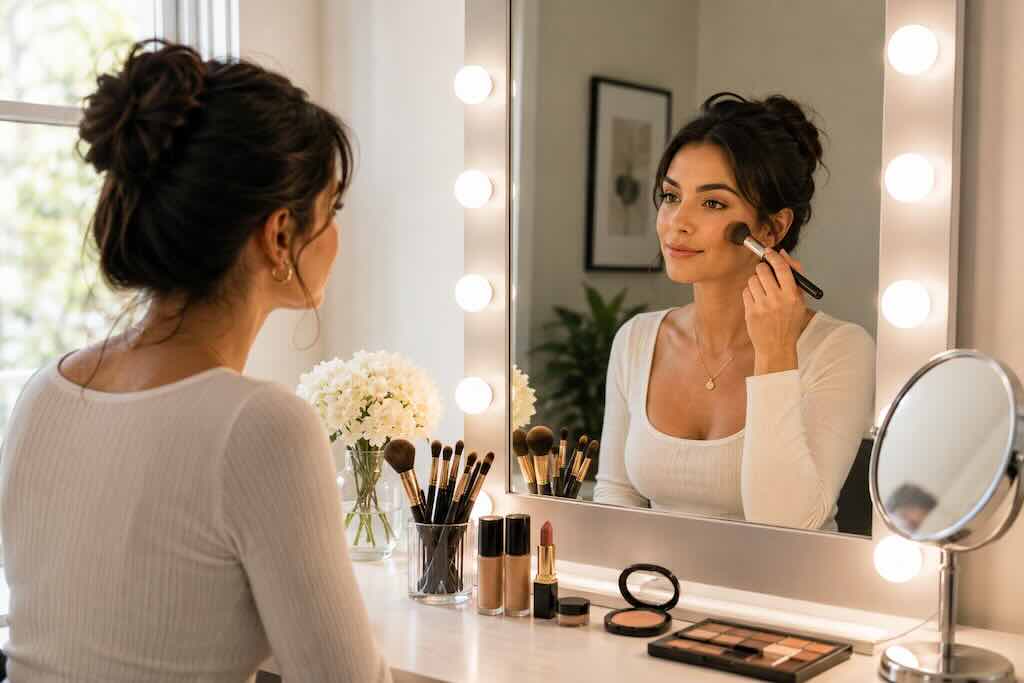
One of the most effective vanity arrangements places light on both sides of the mirror at roughly face level.
This cross-lighting helps reduce the strong shadows created when illumination comes from only one direction. Vertical fixtures positioned beside a mirror can work particularly well because they distribute light across more of the face.
If you’re renovating a bathroom or designing a dedicated vanity, think about the position of the fixtures before simply choosing whichever lights look prettiest. Beautiful lighting and useful lighting can — and should — be the same thing.
A Lighted Makeup Mirror Can Fix a Bad Setup
Renters and anyone working with an existing bathroom don’t necessarily have the option of moving electrical fixtures.
A good illuminated makeup mirror is an easy alternative. Look for even lighting around or beside the mirror rather than a small, intensely bright source concentrated in one spot.
Dimmable lighting is particularly useful. Applying makeup for a sunny afternoon and getting ready for a candlelit restaurant are two very different environments, so being able to adjust brightness gives you more control.
Check Your Makeup in More Than One Light
Even an excellent vanity can’t reproduce every environment you’ll encounter during the day.
Before leaving home, take a quick look at your makeup near a window if daylight is available. If you’re heading out at night, checking it under another light source can reveal anything that looked different at your vanity.
This is especially useful when you’re trying a new foundation or concealer. A shade that appears seamless under one bulb can reveal an unexpected undertone somewhere else.
The Simple Makeup-Lighting Formula
You don’t need a professional dressing room lined with Hollywood bulbs. Focus on three things: accurate color, even illumination and good positioning.
Use soft natural daylight when you can. When you can’t, choose good-quality artificial lighting that reproduces colors well. Illuminate your face from the front and sides rather than relying exclusively on a ceiling fixture.
Once the lighting stops fighting you, makeup becomes considerably easier to judge — and there are fewer surprises waiting when you step outside.