




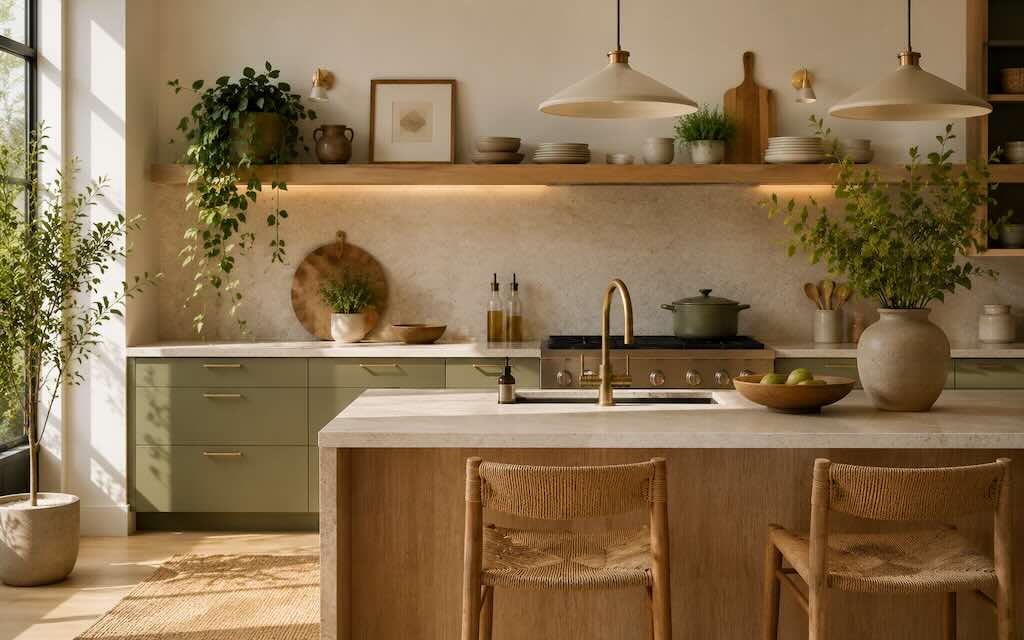
The kitchen can be one of the busiest rooms in a home: bright task lights, appliances humming, groceries arriving, dishes accumulating and several small decisions happening at once. Yet with a few deliberate design choices, that same room can feel noticeably quieter.
A calmer kitchen is less about chasing a particular aesthetic than reducing friction. Clear work zones, natural materials, controlled lighting, accessible storage and a little greenery can change how the room feels without demanding a full renovation. Research into indoor environments increasingly connects factors such as light, noise, thermal comfort and contact with nature with psychological and physiological wellbeing.
Why the Feeling of a Kitchen Matters
Our surroundings are not emotionally neutral. A 2025 systematic review of indoor environmental quality examined how lighting, noise, air quality and thermal comfort interact with physiological and psychological responses. Meanwhile, research into biophilic environments has repeatedly explored connections between natural elements and wellbeing.
That does not mean a houseplant or wooden countertop is a treatment for stress. Much of the strongest biophilic-design research comes from healthcare and other controlled environments, so claims about an ordinary residential kitchen should remain measured. Still, a recent systematic review of plants, light and natural elements found encouraging evidence for psychological benefits associated with greenery and other biophilic interventions indoors.
Start with Movement, Not Decoration
Before choosing paint, plants or pendant lights, watch how you actually use the room. Where do groceries land? Where do you chop vegetables? How far is the bin from the preparation surface? Which cupboard do you open repeatedly while cooking?
Group frequently used objects around the activity they support. Keep knives and chopping boards near the preparation area, pans near the hob and everyday dishes close to the dishwasher or drying area. In a compact kitchen, even a tray containing oils and seasonings can create a useful micro-zone.
The principle is practical: reduce unnecessary movement and searching. A room becomes easier to inhabit when its layout reflects the sequence of things you actually do there.
Bring Nature into the Room Carefully
Biophilic design goes well beyond filling shelves with plants. It can include daylight, views outdoors, natural textures, organic forms, fresh air and materials that retain some visual connection to the natural world. Divine has previously explored both bringing elements of nature into kitchen design and broader interior design ideas for creating a more considered home.
A systematic review of biophilic design research identified daylight, fresh air, quietness, thermal comfort and feelings of relaxation among important environmental characteristics in healthcare spaces. The setting is different from a home kitchen, but the findings offer useful context for understanding why designers pay attention to more than appearance alone.
- Let daylight remain visible: avoid unnecessarily blocking windows with tall objects or heavy window treatments.
- Add living greenery: herbs on a bright sill can bring color, texture and something useful to cooking.
- Work with tactile materials: timber, stone, linen, cork and ceramics can soften a room dominated by hard appliances.
- Use a restrained palette: warm white, clay, muted green, sand and natural wood tones can create a quieter visual field.
There is no need to turn the kitchen into an indoor garden. One healthy herb pot beside a wooden board can feel more intentional than ten decorative objects competing for attention.
Treat Lighting as a Layered System
A single bright ceiling fixture asks one light source to perform several jobs. Preparing food requires clarity. Eating calls for something softer. Walking into the kitchen late in the evening rarely requires the same intensity as chopping vegetables at noon.
Layer the room instead. Use ambient light for general visibility, focused task lighting over preparation areas and softer accent lighting when the working day is finished. Dimmers make those layers more adaptable.
There is also a biological reason to think about when and how brightly a home is illuminated. An expert consensus on indoor light exposure notes that light influences circadian rhythms, sleep and alertness, and recommends substantially lower light exposure during the hours approaching bedtime than during the day.
In practice, this makes adjustable lighting more useful than simply specifying one fashionable color temperature. Bright, functional illumination can serve cooking when it is needed; gentler evening light can change the atmosphere once dinner is finished.
Create Quiet Countertops
A calm kitchen still needs to work. The aim is not an immaculate showroom where nothing is allowed to exist on the counter. Instead, give visible space to objects that are either used frequently or genuinely contribute something to the room.
A coffee machine used every morning earns its place. An appliance used twice a year probably does not. Group smaller necessities on a tray, use drawer dividers for loose utensils and move duplicate or occasional equipment into less accessible storage.
Visibility can also influence food decisions. Research into choice architecture and food environments describes strategies such as positioning fruit and vegetables where they are easy to see and select. At home, that might translate into a bowl of fruit occupying prime counter space while less useful visual clutter disappears behind a cabinet door.
Remember Sound and Texture
Some kitchens look serene in photographs but sound completely different in person. Stone, glass, metal and tile are durable surfaces, yet a room dominated by hard finishes can feel acoustically sharp.
Introduce softness where it is practical and safe. A washable runner, upholstered dining chairs, linen blinds or curtains and fabric seat cushions can temper a hard room. Felt pads beneath objects also reduce the small scraping and clattering sounds that accumulate through the day.
Texture does similar visual work. Matte ceramics beside smooth stone, woven baskets against cabinetry and linen beside metal create subtle contrast without adding more color or ornament.
Design for Ritual, Not Perfection
The most effective calm kitchen may be one that makes a few good habits effortless. Create a dedicated coffee or tea corner rather than collecting supplies from several cupboards. Keep breakfast ingredients together. Leave the counter beside the sink clear enough that washing up never requires rearranging half the room first.
Then give the kitchen a closing ritual. Put ingredients away, wipe the main work surface, return stray objects and switch from task lighting to softer illumination. Five minutes can be enough. The reward appears the following morning when you enter a room that is already ready for the day.
A Calmer Kitchen Can Start with One Surface
You do not need new cabinetry, expensive stone or a larger floor plan to make a kitchen feel better. Start with the surface you see first. Clear it, decide what deserves to return, improve the nearby light and introduce one natural element.
Then observe the room for a week. The best changes become obvious through use: the drawer that is always awkward, the light that feels too bright after dinner, the utensils stored three steps too far away. A calm kitchen is built from those small corrections. Less visual noise. Better movement. Softer light. Space to cook without the room competing for your attention.
FAQ: Creating a Calm Kitchen
How can I make my kitchen feel calmer without renovating?
Clear one or two major work surfaces, reorganize frequently used tools around their tasks, soften evening lighting and introduce a small amount of greenery or natural texture. These changes can alter how the room functions without structural work.
What colors work well in a calm kitchen?
Warm neutrals, muted greens, clay tones and restrained natural colors are easy starting points. More important than following a particular palette is limiting unnecessary visual competition and choosing colors you find comfortable to live with.
Does biophilic design simply mean adding plants?
No. Biophilic design can incorporate daylight, views of nature, plants, natural materials, organic forms, air movement and other ways of connecting an interior with natural environments.
What should stay on a kitchen counter?
Prioritize items used almost every day. Group smaller objects rather than scattering them, and move occasional appliances into cupboards or other storage. The goal is functional breathing room, not an empty countertop.
What kitchen lighting is best at night?
Use enough light to move and work safely, but consider dimming unnecessary bright illumination as bedtime approaches. Current circadian-light research supports reducing evening light exposure while maintaining appropriate lighting for safety and visual tasks.