




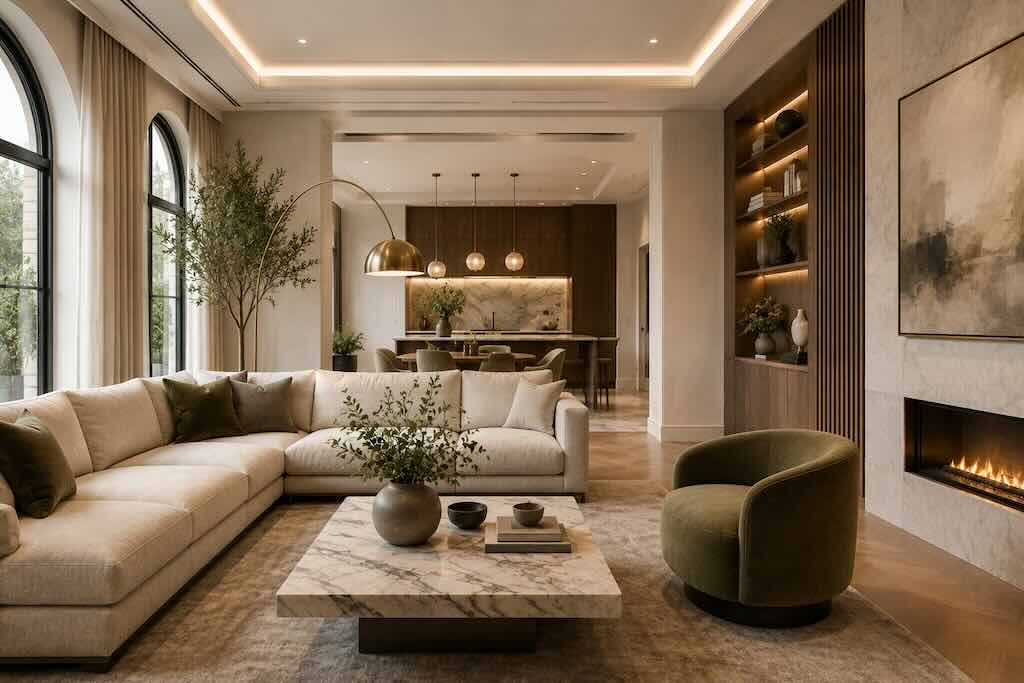
A home can feel luxurious without being filled with expensive things. Often the difference is quieter: natural light across a textured wall, enough empty space around furniture, materials that feel good under the hand and rooms designed around how people actually move through them.
That changes the question from “How can I make my home look expensive?” to something more useful: “What would make this room feel calmer, more comfortable and more considered?” The answer may cost considerably less than a complete renovation.
Editor’s note: This guide has been updated for 2026 with more practical advice on lighting, materials, bathroom design, visual clutter and where professional design help can genuinely be useful.
1. Make the Bathroom Feel Quiet
Bathrooms are particularly sensitive to visual noise. Bottles crowding a basin, mismatched storage and harsh lighting can make even an expensive room feel unsettled.

Start with the surfaces you see most. A restrained palette of warm white, stone, timber or muted color can create continuity, while closed storage keeps everyday toiletries within reach without leaving every product on display.
A substantial bath can become the visual center of a larger bathroom. The original guide highlighted a stone bathtub; if considering one, look beyond appearance and confirm weight, floor support, installation requirements, maintenance and compatibility with the room before buying.
In a smaller bathroom, a well-positioned mirror can reflect light and extend sightlines. It does not physically enlarge the room, but it can make the space feel more open.
2. Work With Natural Light
Natural light changes materials throughout the day. Timber warms. Stone reveals texture. Paint shifts subtly as morning becomes afternoon.
Before assuming you need larger windows, look at what is already blocking the light you have. Heavy window treatments, tall furniture, dark objects close to glazing and unnecessary partitions can all affect how far daylight travels into a room.
Light-colored surfaces can help redistribute daylight, while mirrors can redirect reflected light when positioned thoughtfully. Divine’s guide to using natural light to transform your home explores these techniques in greater detail.
There is also a practical reason to think carefully about daylight. The U.S. Department of Energy notes that daylighting design considers both natural illumination and the control of unwanted solar heat gain. More glazing is therefore not automatically better; orientation, shading and climate matter.
3. Reduce Visual Clutter
Minimalism does not require empty rooms, white walls or giving away everything you own.
Its most useful lesson is editing.

Give furniture enough space to breathe. Group smaller decorative objects instead of scattering them across every surface. Hide charging cables. Give keys, post and other daily clutter a permanent place. Leave some shelves intentionally sparse.
The aim is not deprivation. It is making the things you choose to keep easier to notice.
If that approach appeals to you, Divine’s guide to embracing minimalism and our feature on decluttering your home offer practical places to begin.
4. Spend on the Things You Touch
Luxury is often tactile.
A solid door handle, comfortable sofa fabric, substantial curtain, smooth drawer mechanism or beautifully finished timber surface is experienced repeatedly. These details can contribute more to the daily character of a room than decorative objects purchased primarily to fill space.
This creates a useful hierarchy when the budget is limited. Spend more attention on high-contact surfaces and objects. Save on decorative elements that are easy to change later.
It is also worth repairing or refinishing good existing pieces before automatically replacing them. A timber table with scratches may need care rather than disposal; an old chair with a strong frame may only need new upholstery.
5. Bring in Natural Materials Carefully
Timber, stone, linen, wool, ceramic, rattan and other tactile materials can soften a room because their surfaces carry natural variation.
They are particularly effective when used selectively. A timber dining table against smooth plaster, linen curtains beside glass or a wool rug across a hard floor creates contrast without requiring elaborate decoration.
Natural does not automatically mean environmentally preferable, however. Material sourcing, manufacturing, durability, transportation, maintenance and what happens at the end of a product’s life all matter. Avoid treating a material as sustainable based on appearance alone.
Scandinavian interiors have helped popularize the combination of natural materials, functional furniture and restrained color internationally, but there is no need to reproduce a particular style exactly. Borrow the principle: allow materials to provide some of the decoration themselves.
6. Layer Artificial Lighting
A beautiful room can become flat after sunset if every corner depends on one ceiling fixture.
Think in layers instead. General lighting lets you move through the room. Task lighting supports reading, cooking or working. Smaller lamps and carefully positioned fixtures create pools of softer light around seating, artwork or architectural details.
The U.S. Department of Energy identifies LED lighting as today’s most energy-efficient lighting technology. Dimming and separate lighting zones can make efficient fixtures considerably more adaptable as well.
The visual effect is simple: instead of illuminating everything equally, you decide where the eye should rest.
7. Make Storage Part of the Design
Rooms often feel more polished when everyday objects have somewhere logical to disappear.
That does not necessarily require expensive built-in cabinetry. A closed sideboard, baskets inside shelving, a storage bench or a well-proportioned cabinet can solve the same problem on a smaller budget.
Think about where clutter actually accumulates before buying storage. If shoes collect beside the entrance, solve that location. If kitchen counters fill with appliances, reconsider cabinet organization. Storage works best when it responds to behavior rather than forcing new habits.
Divine’s guide to making your home feel more personal also shows how practical spaces can retain character rather than becoming anonymous.
8. Use Repetition to Make Rooms Feel Connected
Expensive interiors often look coherent because something repeats.
It might be the same warm timber appearing in several rooms, a recurring metal finish, similar stone tones or one muted color moving through textiles and paint.
You do not need identical furniture. In fact, too much matching can make a home feel staged. Repetition works best as a quiet thread connecting otherwise individual rooms.
Before buying something new, look around the home and identify the materials and colors already working well. Repeating one of them may create more coherence than introducing another trend.
9. Know When Professional Help Is Worth Paying For
Professional design help does not need to mean handing over an entire house and an unlimited budget.
An interior designer can be particularly useful when a project involves difficult layouts, lighting plans, permanent materials, custom cabinetry or a large number of interconnected decisions. Some professionals also offer consultations rather than complete project management.

If the work affects structure, plumbing, electrical systems or other regulated elements, use appropriately qualified professionals and check local requirements. Interior styling and construction expertise are not interchangeable.
10. Finish Slowly
A room does not need to be completed in a weekend.
Live with the major pieces before filling every remaining surface. Notice where you naturally put a drink, where evening light feels too dark, whether a wall genuinely needs artwork and which empty corner is actually pleasant because it is empty.
This slower approach reduces impulse purchases and gives the home room to develop around real routines.
Luxury begins to feel convincing when nothing appears to be there simply because someone thought the room needed more stuff.
A Simple Luxury Home Checklist
- Clear unnecessary objects from visible surfaces.
- Improve natural light before adding more decoration.
- Use several smaller light sources instead of relying on one ceiling fixture.
- Choose a restrained palette of materials and repeat it through the home.
- Prioritize furniture and surfaces you touch every day.
- Create storage where clutter naturally accumulates.
- Repair worthwhile pieces before replacing them.
- Leave some visual space intentionally empty.
Conclusion

A luxurious home does not need to imitate a hotel or showroom. It should feel better to live in.
Clear the surfaces that make a room restless. Let daylight reach farther inside. Choose materials for their texture as well as their appearance. Give evening light several levels. Spend where quality will be touched every day and allow the less important details to arrive slowly.
The result may be quieter than the homes designed to impress instantly on a screen. That is often precisely why it feels more convincing.
FAQ
How can I make my home look luxurious on a budget?
Start with changes that affect the whole room: reduce visible clutter, improve lighting, simplify the color palette and rearrange furniture to create more breathing space. Then spend selectively on tactile items such as curtains, upholstery, hardware and rugs rather than replacing everything.
What colors make a home feel more luxurious?
There is no single luxury palette. Warm whites, earthy neutrals, deep greens, browns and muted colors can all work when they relate well to the room’s light and materials. Consistency usually matters more than choosing a supposedly expensive-looking color.
Does minimalism make a home look expensive?
Not automatically. What helps is the editing associated with minimal interiors: fewer competing objects, clearer furniture arrangements and more attention to material, proportion and light. A home can remain colorful and personal while using those principles.
Which home improvements should I spend more money on?
Prioritize permanent work and heavily used elements. Good lighting, functional storage, comfortable seating, durable flooring and properly executed bathroom or kitchen work can affect daily life more than purely decorative purchases.
Do I need an interior designer to create a luxury look?
No. Many improvements can be made through editing, furniture placement, lighting and careful material choices. Professional advice becomes more useful when expensive permanent decisions, complicated layouts or construction work make mistakes difficult to reverse.