




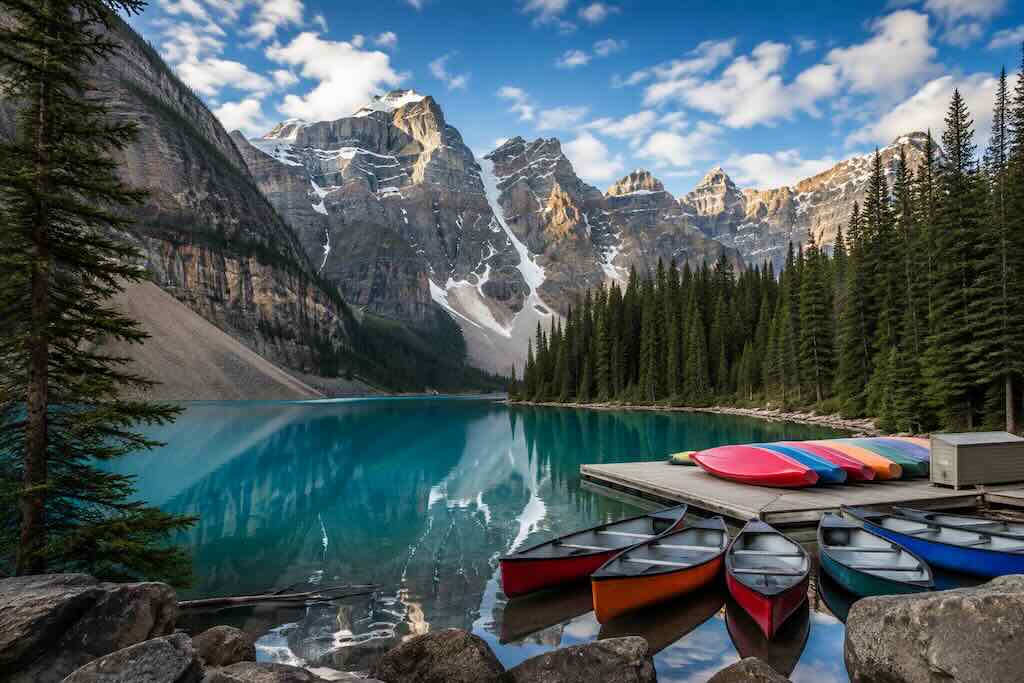
Canada is difficult to reduce to a single trip. Atlantic fishing towns, Montréal streets, prairie skies, Pacific rainforest and the sharp blue lakes of the Rockies can feel like different journeys entirely. The distances between them are equally serious.
That scale is part of the attraction, but it rewards restraint. Rather than trying to “see Canada,” choose a region, understand its seasons and give yourself enough time to experience the landscape without spending most of the holiday in transit.
Editor’s note: This guide has been updated for late 2026 with current Canadian entry information, Parks Canada planning advice, more respectful guidance for visiting First Nations territories and clearer recommendations for winter, wilderness and city travel.
1. Choose the Season Around the Trip You Want
Canada works throughout the year, but not as the same destination throughout the year.
Winter can mean skiing in British Columbia, frozen landscapes in the Rockies and deep cold across much of the country. Summer opens hiking trails, lakes and long outdoor evenings, while autumn brings cooler temperatures and changing foliage in many regions.
Conditions also vary enormously by geography. Vancouver’s coastal climate is not Winnipeg’s prairie climate, and conditions in Yukon cannot be inferred from a Toronto forecast.
Check forecasts and local conditions shortly before departure, then pack for the specific region and activity rather than for an abstract idea of “Canadian weather.”
2. Do Not Underestimate the Distances
One of the easiest mistakes is treating Canada like a destination where Toronto, Montréal, Banff and Vancouver can casually share the same short itinerary.
They can be combined, but doing so requires substantial travel. For a first trip, a regional itinerary often creates a better rhythm.
- Québec and Ontario: combine cities such as Montréal, Québec City and Toronto with carefully selected surrounding destinations.
- Alberta and the Rockies: build the trip around Calgary, Banff, Lake Louise and other mountain destinations.
- British Columbia: combine Vancouver with the coast, Vancouver Island or mountain destinations according to the season.
- Atlantic Canada: slow the pace and concentrate on coastal landscapes, smaller communities and regional food.
- Yukon: plan specifically for wilderness, long driving distances, seasonal conditions and remote travel.
Trains, domestic flights, road trips and organized tours can all make sense depending on the route. The important part is calculating travel time before filling the itinerary.
3. Explore Banff With a Plan
Banff National Park deserves its reputation. Pale mountain faces rise above turquoise water, conifer forests run towards the horizon and the scale of the Canadian Rockies becomes difficult to understand until you are standing inside it.
Popularity, however, means spontaneity has limits.
Use the official Parks Canada Banff National Park guide when planning access, trails, safety and current conditions. Camping and other activities at Parks Canada destinations may require advance reservations, particularly during busy periods.
Do not assume every lake, campsite or trail can simply be reached whenever you arrive. Check transportation arrangements, closures, wildlife information and reservation requirements for the specific places on your itinerary.
If hiking is part of the trip, Divine’s guide to destinations for running, biking and hiking offers more inspiration for an active holiday.
4. Travel Through Yukon With Respect
Yukon offers a different sense of scale: broad valleys, mountains, rivers, long roads and communities separated by stretches of sparsely populated land.
It is also important to understand whose land you are visiting. Yukon is home to 14 First Nations and eight Indigenous language groups, and all of Yukon lies within the Traditional Territories of Yukon First Nations.
Rather than approaching First Nations culture as something visitors can casually encounter or observe, follow the respectful travel guidance promoted by Travel Yukon. Cultural centres, Indigenous-led experiences, festivals, local guides and work purchased directly from First Nations artists can provide more appropriate ways to learn.
Remote travel also requires preparation. The Government of Yukon’s travel guidance recommends researching an outdoor trip in advance and telling someone where you are going. Fuel, communications, road conditions, weather and emergency planning become increasingly important as services grow farther apart.
5. Go Skiing in British Columbia
If winter is the reason for the journey, British Columbia provides far more than a single mountain.
Whistler Blackcomb is the internationally recognizable name, with extensive ski and snowboard terrain and a village built around mountain tourism. Check Tourism Whistler’s current ski information for seasonal planning before booking.
But Whistler is not the only option. Resorts around British Columbia offer very different combinations of terrain, atmosphere, access and accommodation. Revelstoke, Big White and SilverStar are among the alternatives worth researching.
Choose according to ability and the type of holiday you want rather than simply selecting the most famous resort. A beginner traveling with children may value different things from an experienced skier planning entire days around challenging terrain.
6. Give Montréal More Than an Evening
Montréal rewards walking. Stone façades, staircases, neighborhood cafés, contemporary galleries, restaurants and music venues give the city a texture that is difficult to appreciate from a checklist of attractions.
Food is particularly useful as a route through the city. Leave room for Québec specialties alongside the cuisines brought by generations of immigrant communities.
The city is also one of Canada’s important festival and cultural centers. Rather than assuming a particular event will coincide with your visit, check the official Montréal tourism calendar when choosing dates.
French is central to Québec’s identity and public life. Visitors do not need fluent French to experience Montréal, but learning a few basic phrases is a simple gesture of respect.
7. Use Toronto as More Than a Stopover
Toronto feels markedly different. Its scale is metropolitan, its neighborhoods are culturally varied and its music, food, arts and professional sports scenes can fill several days before you consider excursions beyond the city.
Lake Ontario also gives Toronto a geographic identity that becomes clearer along the waterfront and from the Toronto Islands.
Music fans can build evenings around independent venues and larger concerts, while sports schedules may offer hockey, basketball or baseball depending on the season.
The better approach is to choose neighborhoods and move through them rather than repeatedly crossing the city for isolated attractions.
8. Eat Beyond the Canadian Stereotypes
Poutine deserves a place on a first-time food list, particularly in Québec, but Canadian food cannot be compressed into fries, gravy and cheese curds.
Regional food changes with the landscape. Pacific seafood, Atlantic lobster, Québec cooking, prairie ingredients, Indigenous food traditions and the cuisines of Canada’s immigrant communities create a far more interesting picture.
Vancouver and Toronto are particularly rewarding places to experience the relationship between migration and food, while Québec has its own distinct culinary traditions.
For something sweet, Canadian treats range from butter tarts and regional berry desserts to BeaverTails pastries. Try them because they look good, not because a travel checklist says you have to finish every famous food in the country.
Divine’s journey through global food flavors offers more context on the way geography and culture shape what ends up on the table.
9. Check Your Entry Requirements Before Booking
Entry requirements depend on nationality, travel document and method of arrival.
The Government of Canada states that most travelers need either a visitor visa or an Electronic Travel Authorization to enter or transit through Canada. Visa-exempt foreign nationals generally need an eTA when flying to or transiting through a Canadian airport, subject to the applicable exemptions and rules.
Use the Government of Canada’s official visitor information to determine what applies to your passport and circumstances. Do this before purchasing non-refundable travel arrangements rather than relying on an airline forum, social-media post or old travel article.
10. Leave Space in the Itinerary
Canada encourages ambitious planning because the map is full of recognizable names: Niagara Falls, Tofino, Banff, Vancouver, Toronto, Montréal, Québec City, Halifax, Yukon and the Okanagan.
Trying to collect too many of them can weaken the trip.
Allow an afternoon when the only plan is a lake. Leave time for a neighborhood that looked interesting from the tram or bus. Build weather flexibility into mountain days. Stay somewhere for two nights when one would technically be enough.
In a country this large, slowing down is not wasted time. It is often the moment the landscape begins to make sense.
A Practical Canada Trip Checklist
- Choose a region before building a national itinerary.
- Check visa or eTA requirements using the Government of Canada website.
- Research seasonal weather for the specific destinations you will visit.
- Reserve popular national park camping or activities when required.
- Allow realistic travel time between cities and regions.
- Check road, trail, wildfire and weather conditions close to departure.
- Follow local and First Nations guidance when traveling through Indigenous territories.
- Keep some unscheduled time for weather changes and spontaneous discoveries.
Conclusion
The difficulty with Canada is not finding something worth seeing. It is deciding what to leave for another trip.
Spend a week among mountain lakes rather than racing between provinces. Let Montréal unfold neighborhood by neighborhood. Follow the Pacific coast, travel north into Yukon with preparation and respect, or arrive in winter specifically because you want snow beneath your skis.
Canada’s scale becomes far more rewarding when you stop trying to conquer it.
FAQ
What is the best month to visit Canada?
There is no single best month. Summer suits many road trips, hiking itineraries and outdoor activities, while winter is ideal for travelers specifically seeking snow sports and winter landscapes. Spring and autumn can offer quieter experiences in some destinations. Conditions vary substantially by region.
How long do you need for a first trip to Canada?
A week can work well for one city and its surrounding region, while 10 to 14 days gives more flexibility for a regional road trip or a carefully planned combination of destinations. Trying to cover both eastern and western Canada on a short visit usually means substantial time in transit.
Do tourists need a visa to visit Canada?
It depends on citizenship, travel documents and how you enter Canada. Many visa-exempt travelers flying to Canada require an eTA, while other travelers require a visitor visa. Check the Government of Canada website for the rules applying to your circumstances.
Is Canada easy to travel without a car?
Major cities can be explored without one, and flights and rail connect selected destinations. A car becomes more useful for many rural, mountain and remote itineraries. Some popular natural attractions also have seasonal shuttle or public transportation options, so research the specific region before renting.
Is Banff worth visiting on a first trip to Canada?
Yes, particularly if mountains, hiking and alpine scenery are priorities. Its popularity means accommodation, transportation and certain activities benefit from advance planning. Always check Parks Canada for current access, safety and reservation information.