


A good pantsuit can make getting dressed almost suspiciously easy. Two pieces, a pair of shoes, perhaps some jewellery — and suddenly the entire outfit looks considered.
But there is a reason one suit looks effortless while another feels stiff, dated or strangely borrowed. It is rarely the price tag alone. More often, it comes down to proportion: the relationship between shoulder, jacket length, waist, trouser shape, hem and shoe.
Get those details right and a pantsuit becomes less of a formal uniform and more of a flexible wardrobe system.
Editor’s note: This guide has been updated for 2026 with clearer advice on fit, proportion, fabric, alterations and styling a pantsuit beyond formal occasions.
1. Start With the Shoulders
If you are trying on a blazer, look at the shoulders before almost anything else.
On a traditionally fitted jacket, the shoulder should look clean rather than collapsing, pulling or extending unintentionally beyond your natural shoulder line. An oversized blazer follows a different logic: a dropped or extended shoulder can be part of the intended silhouette.
The distinction is intention. Clothes do not need to obey conventional tailoring proportions to look good, but the shape should appear deliberate.
This is also why it helps to think about the wider visual identity of your wardrobe. Divine’s guide to building a signature look without following trends explores how repeated proportions, colors and styling choices can become more useful than chasing individual fashion moments.
2. Judge the Jacket and Trousers Together
A cropped jacket and a long relaxed blazer can be cut from the same cloth and produce completely different silhouettes.
Shorter jackets expose more of the trouser and can place greater visual emphasis around the waist. Longer blazers create a stronger vertical line and often pair naturally with straight or wide-leg trousers.
Neither proportion is automatically more flattering. Try the complete suit and look at where the jacket finishes relative to the trouser waistband and leg. Then move. Sit down, turn sideways, button the jacket and put your hands in the pockets.
A suit is clothing, not a still photograph. It needs to work when your body does.
3. Let the Trousers Define the Mood
Trouser shape can move a pantsuit from traditional business dressing to something considerably more relaxed.
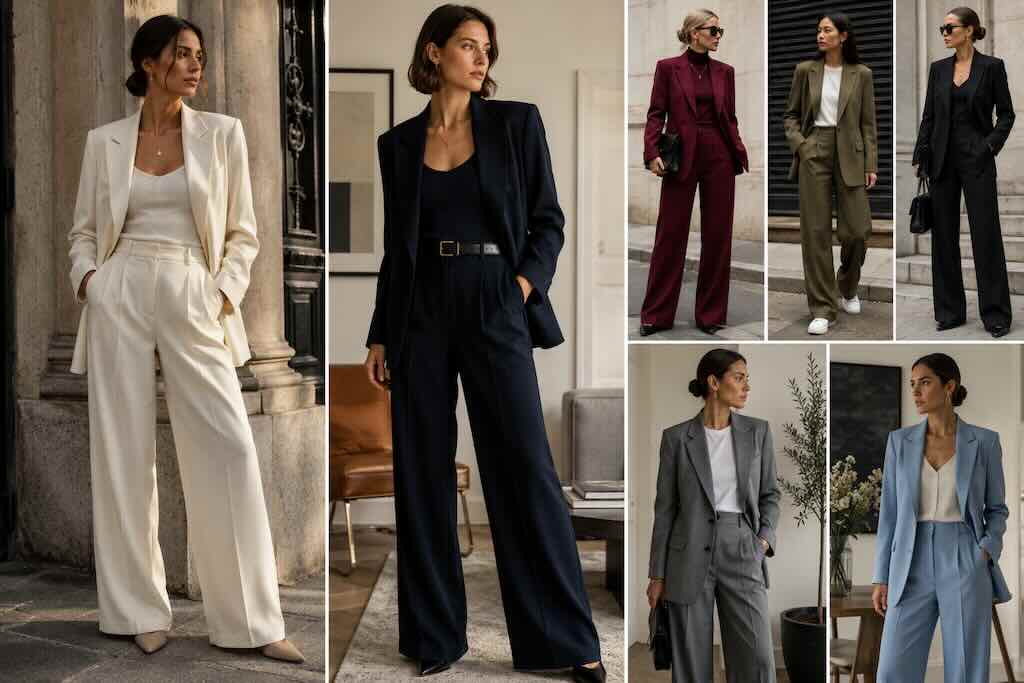
A straight leg keeps the silhouette clean. Wide-leg trousers introduce movement and can soften a structured jacket. Cropped trousers expose more of the shoe and work particularly well with loafers, flats and streamlined ankle boots.
Full-length trousers require more attention to footwear. Try them with the heel height you actually intend to wear and look at how the fabric meets the shoe.
If excess fabric pools around the ankle when that is not part of the design, a small hem alteration may improve the entire suit more effectively than replacing it with a more expensive one.
4. Choose Fabric for the Way You Want the Suit to Move
Tailoring does not automatically mean thick, rigid cloth.
Wool and wool blends can provide structure while still allowing movement, depending on weave and weight. Linen brings a drier texture and relaxed creasing that suits warm-weather tailoring. Velvet catches light and brings depth to evening suits, while fluid fabrics can create a softer line through both jacket and trouser.
Touch the material when possible. Look at it in natural light. Notice whether it springs back after being gently handled or immediately holds every crease.
Check the fiber composition and care instructions too. In the United States, the Federal Trade Commission’s textile labeling guidance explains requirements covering fiber content and other labeling information for textile and wool products.
5. Use Color Without Overstyling It
Black, navy and charcoal remain useful because they move easily between settings, but neutral tailoring extends far beyond them.
Chocolate brown has warmth without being difficult to combine. Cream creates a softer line. Burgundy adds richness. Olive, rust and muted blue introduce color while remaining relatively easy to repeat across a wardrobe.
Then there is the unapologetically bright suit.
If the tailoring is saturated red, cobalt or vivid pink, resist the assumption that the outfit needs equally complicated accessories. A simple shoe, restrained jewellery and a quiet layer underneath can give the color enough visual space.
For more ideas on making existing clothes feel current without rebuilding the wardrobe, see Divine’s eight ways to make your wardrobe feel fresh.
6. Change What You Wear Underneath
One of the simplest ways to change the personality of a pantsuit is to change the first layer.
A crisp shirt gives tailoring a familiar formality. A fine knit makes it softer. A plain T-shirt removes some of the office association. A camisole can shift the same jacket toward evening.
When the jacket cut allows it, wearing it buttoned with a minimal layer underneath can create an especially clean silhouette. Check the neckline and movement from several angles rather than judging the effect only while standing still in front of a mirror.
The useful idea here is repetition. The suit does not have to become a different outfit every time. Small changes in texture, neckline and shoe can be enough.
7. Wear the Pieces Separately
A blazer that only works with its matching trousers is doing less work than it could.
Try the jacket with denim, a simple skirt or a dress. Wear the trousers with a white shirt, fitted knit, relaxed sweater or minimal top. Suddenly a supposedly formal purchase begins connecting with clothes you already own.
This makes a useful test in the fitting room. Before buying, mentally build several outfits using the jacket alone and several more using the trousers.
If neither piece makes sense without the other, ask whether you genuinely need a complete occasion-specific suit or whether a more adaptable cut would serve you better.
This approach fits naturally with a more considered wardrobe. Divine’s feature on minimalism in beauty and fashion looks at the value of fewer, more purposeful choices.
8. Take the Shoes Into the Fitting Room
Shoes change the geometry of a suit.
Loafers can make tailoring feel grounded and practical. Minimal sneakers relax it. A pointed flat sharpens the line without adding height, while heels change both posture and the way a full-length trouser falls.
This matters most when deciding trouser length. If you are buying a suit for a particular event or work wardrobe, try it with a shoe close to the one you intend to wear.
If footwear is the difficult part of the outfit, Divine’s guide to finding the right shoes for an event can help narrow the choice.
9. Know What a Tailor Can Fix
Ready-to-wear clothing is produced around standardized sizing systems. Individual bodies are more varied.
That mismatch does not automatically mean a suit is wrong. Trouser hems, sleeve length and some waist or body adjustments may be relatively straightforward for an experienced alterations specialist, depending on the garment’s construction and seam allowance.
More fundamental changes to jacket shoulders and structure can be considerably more involved. When shopping, it therefore makes sense to prioritize a jacket whose basic architecture already works for you.
If you are considering alterations, ask a tailor what is practical before assuming a particular change will be simple or inexpensive.
10. Look at Construction Before Looking at the Label
An expensive suit is not automatically a well-fitting suit, and affordable tailoring does not automatically look inexpensive.
Look at the quieter details. Do the seams sit cleanly? Does the fabric hang smoothly? Do the lapels lie naturally? Does the jacket pull noticeably when buttoned? Are the sleeves intentionally proportioned? Do the trousers finish where they should?
Check the lining, buttons, pockets and stitching as well. These details will not tell you everything about how long a garment will last, but they can reveal whether the construction feels appropriate for the price and intended use.
A Quick Pantsuit Fit Check
- Check whether the shoulder shape looks intentional.
- Button the jacket and look for uncomfortable pulling or restriction.
- Raise your arms, sit down and walk before deciding on the fit.
- Look at jacket length in relation to the trouser silhouette.
- Try full-length trousers with the shoes you expect to wear.
- Check fiber composition and care requirements.
- Consider whether the jacket and trousers work separately.
- Ask a tailor about small adjustments before rejecting an otherwise strong suit.
Conclusion
The pantsuit has survived repeated fashion cycles because its basic idea is unusually adaptable. Change the shoulder, jacket length, trouser width, fabric, color or shoe and the same two-piece formula can feel completely different.
The strongest suit is rarely the one making the most noise. It is the one whose proportions feel resolved, whose fabric moves naturally and whose separate pieces keep finding their way into other outfits.
When that happens, you stop looking as though you are wearing a suit. The suit starts looking unmistakably yours.
FAQ
How should a women’s pantsuit fit?
The fit depends on the intended silhouette. Traditionally fitted tailoring should generally look clean through the shoulders and body without uncomfortable pulling, while oversized tailoring may intentionally use dropped shoulders and greater volume. Jacket and trouser proportions should be judged together.
What color pantsuit is most versatile?
Black, navy, charcoal and brown are easy to combine with other wardrobe pieces, but versatility depends on what you already wear. Cream, olive, burgundy and muted blue can function almost like neutrals in the right wardrobe.
Can you wear a pantsuit casually?
Yes. Try a suit with a T-shirt, fine knit, flats, loafers or minimal sneakers. Softer fabrics and relaxed trouser shapes can also reduce the formal character of traditional tailoring.
Can a pantsuit be altered?
Many suits can be adjusted, although what is practical depends on their construction. Hems and some sleeve or waist alterations may be relatively straightforward, while significant changes to jacket shoulders and structure can be more complex. Ask an experienced tailor before buying a suit that requires substantial work.
What shoes look good with a pantsuit?
Loafers, flats, streamlined boots, minimal sneakers and heels can all work. The best choice depends on the trouser length, occasion and desired level of formality. Always consider the shoe when deciding where a full-length trouser should finish.