




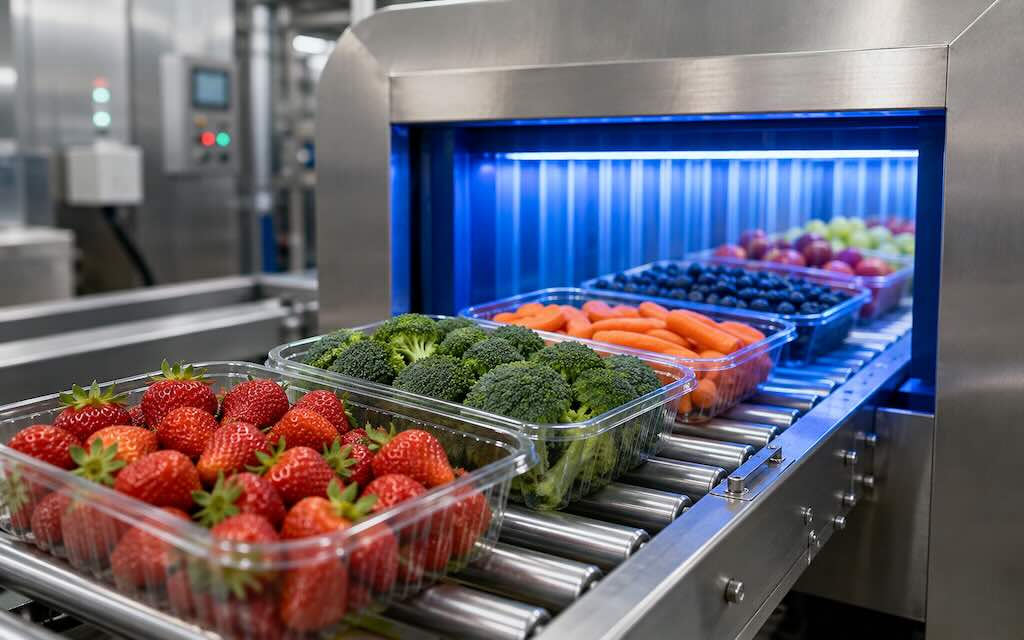
The word radiation on a food label can sound alarming. It may conjure images of nuclear accidents and radioactive materials — neither of which describes what happens when food is irradiated.
Food irradiation is a processing technique that exposes certain foods to controlled amounts of ionizing radiation. Depending on how it is used, the process can reduce harmful microorganisms, control insects, delay ripening or sprouting, and extend the usable life of some foods.
Most importantly, irradiating food does not make the food radioactive.
What Actually Happens When Food Is Irradiated?
It’s useful to think of irradiation as a food-processing method rather than something being added to your meal.
Food passes through a controlled field of ionizing radiation for a specified purpose. The energy can damage the DNA of microorganisms and insects, preventing them from reproducing or surviving.
The U.S. Food and Drug Administration describes irradiation as a technology that can improve food safety and extend shelf life by reducing or eliminating microorganisms and insects.
It isn’t a substitute for proper food handling, however. Irradiated food still needs to be stored, prepared and cooked appropriately.
Does Irradiated Food Become Radioactive?
No. This is probably the biggest misconception surrounding the technology.
The process exposes food to ionizing energy under controlled conditions; it doesn’t turn the food itself into a radioactive material.
There’s a useful everyday comparison: having an X-ray doesn’t make your body radioactive afterward. The technologies aren’t identical, but the distinction between being exposed to radiation and becoming radioactive is important.
Three Technologies Can Be Used
Food irradiation isn’t performed using a single type of equipment. According to the FDA, approved processes can use gamma rays, X-rays or electron beams.
Gamma rays
Gamma irradiation uses radiation produced by approved radioactive isotopes. The food is exposed to the radiation source under carefully controlled conditions, but the radioactive material itself does not become part of the food.
Electron beams
Electron-beam, or e-beam, systems use electrically generated streams of high-energy electrons. Unlike gamma irradiation, the equipment doesn’t require a radioactive isotope to generate the treatment.
X-rays
High-energy X-rays can also be generated by machines and directed through food. Like the other methods, the treatment is designed to deliver a controlled dose appropriate for the particular food and purpose.
Why Irradiate Food in the First Place?
There isn’t one universal reason. Different doses and applications can accomplish different things.
- Food safety: reducing certain disease-causing microorganisms.
- Pest control: controlling insects in foods and agricultural products.
- Longer usability: slowing some of the biological processes that contribute to spoilage.
- Sprout control: inhibiting sprouting in foods such as potatoes.
- Import and export: helping control agricultural pests that could otherwise travel between regions with food shipments.
Does Irradiation Destroy Nutrients?
No food-processing method leaves food completely unchanged. Cooking, freezing, drying and canning can all affect foods to varying degrees, and irradiation can cause some changes too.
That is different from claiming that irradiation strips food of its nutritional value. The significance of any changes depends on factors including the food itself and the treatment used.
The World Health Organization provides further information about the safety and use of food irradiation internationally.
Can You Tell If Food Has Been Irradiated?
You generally can’t determine whether a food has been irradiated simply by looking at it.
Labelling rules vary between countries. In the United States, the FDA requires certain irradiated foods sold at retail to carry an irradiation statement and the international Radura symbol.
The Radura is a simple green symbol that resembles a plant inside a broken circle. Once you know what you’re looking for, you may recognize it on foods treated using irradiation.
Is Food Irradiation a Replacement for Hygiene?
Absolutely not.
Irradiation shouldn’t be viewed as a magic reset button for unsafe food. Producers still need appropriate sanitation and handling practices, while consumers still need to refrigerate, prepare and cook foods safely.
Think of irradiation as another tool in the food-safety system rather than permission to ignore everything else.
Why Does Food Irradiation Still Make People Nervous?
The terminology probably doesn’t help.
Words such as radiation, gamma rays and radioactive isotopes naturally sound more threatening than familiar food-processing words such as pasteurized, frozen or canned.
But judging the process requires separating two very different ideas: radiation can be used to treat a food without making that food radioactive.
Once that distinction is understood, food irradiation becomes considerably less mysterious. It’s not futuristic radioactive food. It’s a decades-old technology used for specific food-safety, preservation and agricultural purposes.