




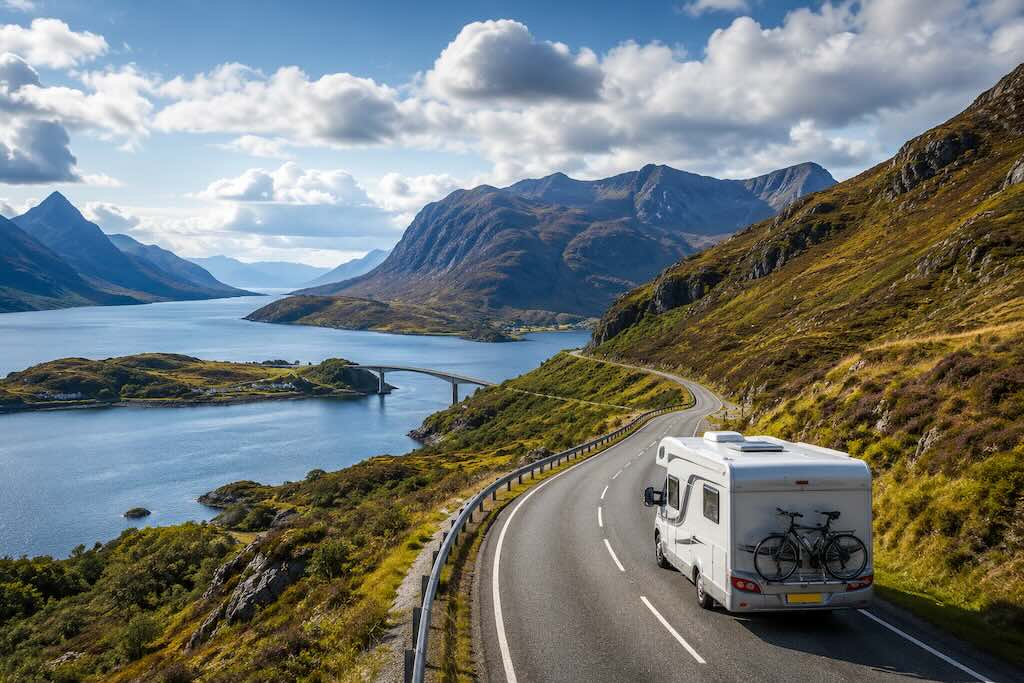
Scotland rewards slow driving. A road can leave a city in the morning, narrow beside dark water by afternoon and finish beneath mountains where the weather seems to move across the landscape faster than the traffic. For a road trip, that constant change is precisely the appeal.
Editor’s note: This article has been updated for 2026 to remove a commercial motorhome link, correct inaccurate advice about wild camping in vehicles, and add current guidance on overnight parking, single-track roads and responsible motorhome travel in Scotland.
Scotland is not the only beautiful place for a UK road trip, and there is no useful way to declare one landscape objectively better than another. What Scotland does offer is remarkable variety within manageable distances: cities, sea lochs, beaches, mountain roads, forests, islands and long stretches where the road itself becomes part of the experience.
A car works perfectly well, but a campervan or motorhome changes the rhythm. You can travel more slowly and stay closer to the landscape, provided you understand that travelling in a vehicle does not give you an unrestricted right to park or camp wherever you like.
Start With Edinburgh or Glasgow
For visitors arriving by train or plane, Edinburgh and Glasgow make practical starting points. Both provide access to vehicle rental, major roads and supplies before the landscape begins to open around you.
There is little reason to rush north immediately. A Scottish road trip becomes more interesting when the itinerary leaves space for smaller roads and unplanned stops rather than treating the country as a motorway between famous viewpoints.
If you are hiring a motorhome or campervan, spend time learning the vehicle before heading into remote areas. Know its height and width. Understand the water, toilet and electrical systems. Most importantly, be comfortable reversing it.
That last skill becomes particularly important farther north.
The Highlands Make You Slow Down
In the Highlands, distance on a map can become misleading. A relatively short journey may include narrow roads, sheep, cyclists, viewpoints and stretches of single-track tarmac threaded between rock and water.
That is part of the pleasure, but it requires different driving habits.
The official North Coast 500 road-safety guidance reminds drivers that passing places can be used to allow vehicles behind to overtake safely. They should not be treated as parking spaces.
If traffic is building behind your campervan, use an appropriate passing place or lay-by and let it through. Avoid travelling in a convoy on single-track roads, and never stop in a passing place simply because the view is beautiful.
In Scotland, good road-trip etiquette often means making yourself less noticeable.
The North Coast 500 Is Famous for a Reason
The North Coast 500 has become Scotland’s headline driving itinerary, tracing a roughly 500-mile circuit through the North Highlands from Inverness.
The attraction is easy to understand. Mountains rise behind empty-looking beaches. Fishing villages appear between long sections of moorland. The road curls around sea lochs before climbing again.
Do not approach the NC500 as something to complete as quickly as possible. Its official guidance recommends allowing at least five to seven days, and additional time makes detours and slower travel considerably easier.
Vehicle size matters as well. Current NC500 motorhome guidance advises larger motorhomes to use alternative routes in certain areas and specifically cautions against attempting roads such as Bealach na Bà or the B869 Drumbeg Road with larger vehicles or without sufficient experience.
A road being famous does not mean every vehicle belongs on it.
Look Beyond the NC500
Scotland’s road-trip map is much larger than its best-known circuit.
Head southwest through Ayrshire and the scenery becomes softer, with coastal roads and views across the Firth of Clyde. Continue into Dumfries and Galloway and the pace slows further. Wigtown, Scotland’s National Book Town, gives readers a particularly good reason to stop rather than simply drive through.
Drive west and the landscape changes again. Argyll brings sea lochs, wooded shores and ferry connections. Farther north, Skye combines dramatic geology with considerable visitor pressure, making advance planning useful during busy periods.
Then there are the islands.
Take the Road Trip Onto a Ferry
A ferry changes the scale of a Scottish road trip. The road ends at water, the engine stops and for a while the journey continues without driving at all.
The Outer Hebrides can form a road trip of their own, with Lewis and Harris in the north and islands extending south through North Uist, Benbecula, South Uist and Barra. Beaches, machair, peatland and small settlements replace the mountain-road drama found elsewhere.
Orkney offers a different atmosphere again: low horizons, coastal landscapes and extraordinary archaeological sites. Shetland requires more commitment to reach but rewards travellers who have enough time to treat the islands as a destination rather than an extension of a mainland itinerary.
For island travel, check ferry timetables and vehicle-booking requirements before building the rest of the route. Weather and seasonal demand can affect plans, so some flexibility remains useful.
The Important Truth About Wild Camping
This is where road-trip advice about Scotland frequently becomes inaccurate.
Scotland does have broad outdoor access rights, and responsible lightweight camping can be permitted where those rights apply. But those access rights do not extend to motor vehicles.
The Scottish Outdoor Access Code explains that responsible access includes lightweight camping in tents, generally in small numbers and for short periods. It separately makes clear that access rights do not include access with motor vehicles.
That distinction means you cannot assume that because a tent can legally be pitched somewhere, a campervan or motorhome can simply pull onto the same land and stay overnight.
The NC500’s motorhome guidance makes the same point: wild-camping rights under Scottish access legislation do not apply to campervans and motorhomes.
Where Can a Motorhome Stay Overnight?
Campsites and designated motorhome stopovers are the clearest options, particularly when you need water, waste disposal or other facilities.
Some car parks and formal lay-bys may permit overnight stays, while others specifically prohibit them. Read local signs and restrictions rather than assuming an empty parking area is available for camping.
Where overnight parking is permitted, keep the activity contained within the vehicle unless the location explicitly allows camping behavior. Setting out chairs, tables, awnings and cooking equipment can turn parking into something quite different.
Never empty grey water or toilet waste onto the ground. Use designated disposal facilities and carry rubbish until you find an appropriate place to dispose of it.
Responsible Travel Makes the Trip Better
The appeal of a remote road is partly the illusion that nobody else is there. Residents know otherwise.
Many of Scotland’s most photographed routes pass through working communities where roads, parking areas and services have to function long after visitors leave. Buying food locally, using established campsites, respecting private property and avoiding blocked gateways are small decisions with a cumulative effect.
The Scottish Outdoor Access Code reduces responsible outdoor access to three useful principles: respect other people’s interests, care for the environment and take responsibility for your own actions.
Those principles work just as well behind a steering wheel.
A Practical Scotland Road Trip Checklist
- Choose a vehicle you are comfortable driving and reversing.
- Know the vehicle’s height, width and length before entering narrow roads.
- Build fewer destinations into each day than the map initially suggests.
- Use passing places correctly and allow faster traffic to pass.
- Never park in passing places or block gates and road access.
- Check whether overnight parking is permitted before settling in.
- Do not assume Scotland’s wild-camping rights apply to motorhomes or campervans.
- Use designated facilities for toilet and grey-water disposal.
- Book ferries and popular campsites ahead during busy periods.
- Leave room in the itinerary for weather, ferries and spontaneous stops.
Conclusion
A Scottish road trip works best when it stops feeling like a list of places to collect.
Drive north and the roads narrow. Turn west and mountains dissolve into islands. Take a ferry and the horizon opens again. Somewhere between those moments, the urge to cover another hundred miles begins to disappear.
Give Scotland time. Drive responsibly, understand where you can stay and resist treating remote landscapes as empty land waiting to be occupied.
The reward is a slower kind of road trip: wet tarmac, salt air, long evening light and enough space between destinations to remember the journey itself.
Frequently Asked Questions
Can you wild camp anywhere in Scotland?
No. Scotland’s outdoor access rights permit responsible lightweight camping in many places where access rights apply, but there are exceptions and responsibilities. Importantly, these rights do not extend to motor vehicles.
Can you sleep overnight in a campervan in Scotland?
Yes, but not automatically anywhere you choose. Use campsites, designated motorhome stopovers or locations where overnight vehicle parking is permitted, and always follow local signs and restrictions.
Is the North Coast 500 suitable for motorhomes?
Much of it can be travelled by motorhome, but vehicle size and driver experience matter. Official NC500 guidance recommends alternative routes for larger vehicles around some particularly demanding roads.
How long should you spend driving the NC500?
The official NC500 guidance recommends at least five to seven days. More time allows for slower driving, walks, villages, weather changes and detours without turning the route into a race.
What is the best time for a Scotland road trip?
There is no single perfect month. Late spring and early autumn can offer a useful balance between daylight, visitor numbers and seasonal services, while summer brings long days but greater demand. Conditions in Scotland can change quickly in any season.
Do I need to book Scottish ferries in advance with a vehicle?
Advance planning is wise on popular island routes, particularly during busy travel periods. Check the relevant ferry operator’s current timetable, vehicle requirements and disruption information before departure.