




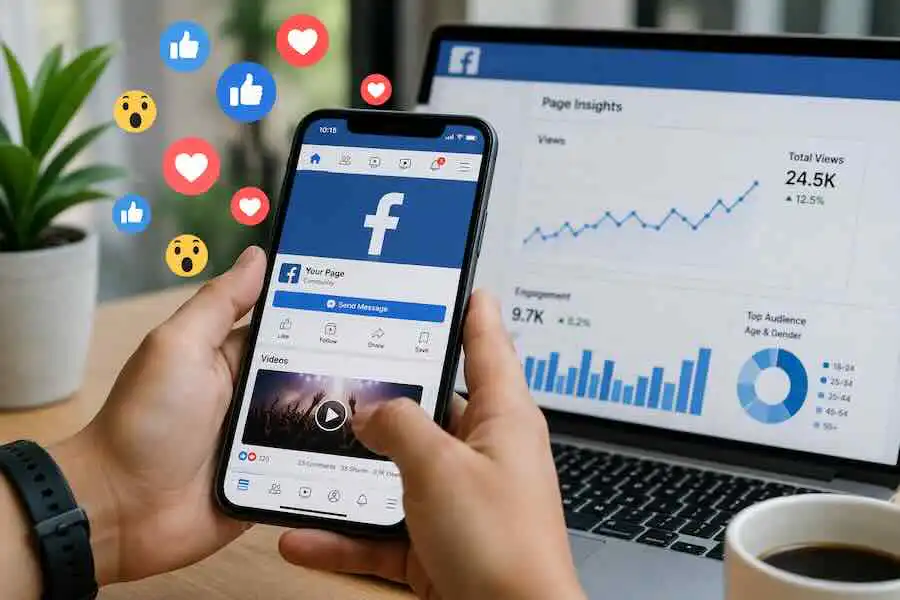
Getting more views on Facebook in 2026 is less about chasing a single algorithm trick and more about giving people a reason to stop, watch, react, and return. Facebook now spans Reels, video, Stories, Groups, Pages, and feed posts, so creators need content that feels native to the format rather than recycled from somewhere else.
The original version of this guide focused heavily on increasing raw view counts, including recommending purchased views. That advice has aged badly. Artificial numbers may make a counter look larger, but they do not create an audience that actually cares about your work. A healthier strategy is to build genuine reach through useful content, consistent publishing, audience insight, and experimentation.
How to Get More Views on Facebook in 2026
There is no guaranteed formula for Facebook reach. What you can control is the quality of the experience around your content: who it is for, how quickly it communicates its idea, whether people want to share it, and whether your publishing decisions are informed by actual performance data.
1. Define the Audience Before Creating the Post
Start with a specific person rather than “everyone on Facebook.” A beauty creator speaking to people interested in affordable skincare has a clearer editorial direction than one simply trying to reach anybody who might watch.
Study which subjects, formats, and opening ideas already generate meaningful responses from your audience. Then use those patterns to shape future content without producing the same post repeatedly.
2. Make Content People Naturally Want to Share
A share puts your work in front of another potential audience. That makes genuinely useful, entertaining, surprising, relatable, or emotionally resonant posts particularly valuable.
Before publishing, ask a simple question: why would somebody send this to a friend? A useful checklist, sharp observation, funny moment, revealing before-and-after sequence, or strong story gives the viewer a reason beyond helping your metrics.
3. Create for Facebook Rather Than Simply Reposting
A video designed for one social platform will not automatically feel natural on another. Adapt the opening, pacing, framing, caption, and duration for the Facebook experience you are targeting.
This does not mean every idea must be invented from scratch. One strong concept can become a Reel, a longer video, a photo post, and a discussion inside a relevant community. The creative idea remains consistent while its presentation changes.
4. Make the Opening Earn Attention
People move quickly through social feeds. Long introductions create friction, particularly in short-form video. Show viewers what they are about to receive as early as possible.
Instead of manufacturing empty curiosity, make the first visual or sentence specific. Demonstrate the result. Ask the central question. Introduce the conflict. Show the detail that makes the story worth watching.
5. Write Captions That Add Context
A good caption should complement the content rather than merely describe it. Use it to establish context, explain why something matters, introduce a useful detail, or invite a relevant conversation.
Avoid exaggerated promises the post cannot satisfy. A click or view followed immediately by disappointment is considerably less valuable than attracting someone genuinely interested in the subject.
6. Publish Consistently Without Posting for the Sake of It
A sustainable publishing rhythm gives you more opportunities to learn what works and gives returning viewers something new to discover. Consistency does not require filling the feed every hour.
Choose a schedule your team can maintain while protecting quality. Then examine performance over several weeks. If three thoughtful posts consistently outperform seven rushed ones, the data has already told you something useful.
7. Use Reels as a Discovery Format
Short-form video remains an important part of Facebook’s visual ecosystem. Reels are particularly suited to compact stories, transformations, demonstrations, humor, music moments, quick advice, and behind-the-scenes material.
Keep the frame visually clean and make the subject immediately recognizable. Captions or subtitles can also make spoken content easier to follow when viewers are not listening with sound.
8. Give Live Video a Real Purpose
Going live simply because the feature exists rarely makes compelling programming. Give the broadcast a reason: a Q&A, interview, performance, launch, tutorial, reaction, or access to something viewers cannot experience through an ordinary post.
Promote the session beforehand and tell people what they will get from joining. During the broadcast, acknowledge useful questions and keep the conversation moving rather than waiting passively for viewers to appear.
9. Use Facebook Groups With Context and Respect
Groups can put your expertise in front of highly focused communities, but treating them as free distribution channels is a quick way to look like a spammer.
Join communities where you can contribute something relevant. Read the rules. Participate in discussions. Share your own material only when it genuinely answers a question or adds something useful to the conversation.
10. Bring Existing Audiences Into Facebook
Your Facebook audience does not need to originate entirely inside Facebook. An email newsletter, website, podcast, YouTube audience, or another social profile can introduce interested people to content they might otherwise miss.
The important part is giving them a reason to follow the additional channel. Exclusive clips, live discussions, community interaction, or a particular content series are stronger incentives than simply asking people to follow everywhere.
11. Use Calls to Action Selectively
Not every Facebook post needs to end with “like, comment and share.” A call to action works better when it naturally follows the content.
Ask a specific question when you want discussion. Invite viewers to save something genuinely useful. Point them toward another video when it continues the story. The action should make sense to the person consuming the post, not simply serve the publisher.
12. Respond to the Audience You Already Have
Growth can make creators obsessed with people who have not discovered them yet. Meanwhile, the audience already commenting is telling you exactly what catches its attention.
Reply when there is something meaningful to say. Notice recurring questions. Watch which topics produce actual conversations rather than passive impressions. Those interactions can become ideas for future posts, videos, and recurring series.
13. Test Formats and Measure What Happens
Experiment with subject matter, video length, opening sequences, publishing times, visual styles, and formats. Change one major variable when possible so the result teaches you something.
Do not judge every experiment by views alone. Depending on your objective, watch time, retention, shares, comments, follows, clicks, or conversions may tell a more useful story. Even Meta’s own guidance around its advertising products stresses evaluating performance through multiple signals rather than treating one metric as the complete picture.
Why Buying Facebook Views Is a Bad Growth Strategy
The previous version of this article recommended buying Facebook views. We no longer recommend that approach.
A purchased number does not necessarily represent people who care about your content, remember your brand, join your community, or become customers. It can also distort your analytics. If the audience data is polluted by low-quality or artificial activity, deciding what your genuine audience wants becomes harder.
Meta maintains policies and quality controls intended to protect people and advertisers from deceptive and fraudulent behavior across its ecosystem. :contentReference[oaicite:0]{index=0} If you have money available for distribution, legitimate paid promotion through Meta’s advertising products gives you a measurable route to reach defined audiences instead of purchasing vanity metrics.
A Better Facebook Content Workflow
Start with one clear audience need. Build a piece of content around it. Give the opening enough visual energy to stop the scroll, then deliver what you promised without padding. Publish it in the Facebook format that suits the idea and give it enough time to collect meaningful data.
Then look at what happened. Did people stay? Did they share it? Did comments reveal another question? Did viewers follow after watching? Use those signals to design the next piece. Growth becomes less mysterious when publishing is treated as an editorial feedback loop rather than a hunt for hacks.
Conclusion
More Facebook views are useful only when the people behind those views matter to your goals. A smaller audience that watches, responds, shares, and returns can be considerably more valuable than an impressive-looking number with no relationship behind it.
Build for real people. Create natively, sharpen your openings, experiment with formats, participate in communities, and use performance data to decide what deserves another iteration. The number can grow from there.
FAQ: Getting More Views on Facebook
How can I get more Facebook views organically?
Focus on a defined audience, publish useful or entertaining native content, create strong openings, use appropriate formats such as Reels and video, encourage genuine interaction, and study your performance data to identify what viewers actually respond to.
Do Facebook Reels help increase reach?
Reels can provide another discovery surface for short-form video. They are particularly useful when the idea works visually and can communicate its value quickly. Results still depend on the content, audience, and execution rather than the format guaranteeing reach.
How often should I post on Facebook?
There is no universal posting frequency that guarantees more views. Choose a sustainable schedule, monitor results, and compare performance over time. Quality and audience response are more informative than hitting an arbitrary daily quota.
Should I buy Facebook views?
No. Buying views can produce numbers without creating meaningful audience relationships and can make performance data less useful. If you want to pay for additional reach, use legitimate advertising and promotion tools with transparent targeting and measurement.
What Facebook metrics should I track?
Track metrics that match your objective. Views can show exposure, while watch time and retention help assess video attention. Shares and comments can reveal engagement, and follows, clicks, leads, or sales may be more useful when your goal extends beyond awareness.
This article was originally contributed by Johny Walker and has been substantially updated for current Facebook publishing practices.