




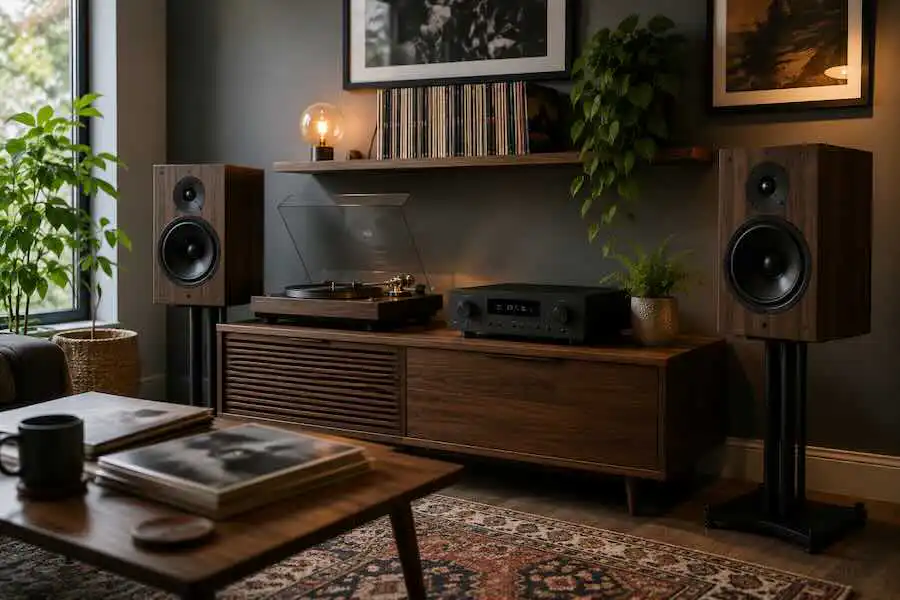
There is a moment in a familiar song when a better stereo changes the room. A bass line you had barely noticed gains shape. The vocal moves forward. A cymbal hangs in the air for another fraction of a second. Nothing about the recording has changed, yet your relationship with it has.
That is the appeal of hi-fi. Not louder sound, necessarily. Not a wall of expensive equipment. At its best, high-fidelity audio is about reproducing recorded music with enough clarity, balance and spatial information that the equipment itself becomes less distracting.
For listeners accustomed to phones, wireless earbuds and compact Bluetooth speakers, building a home stereo can initially look complicated. It becomes much simpler once you understand what each component actually does.
Hi-Fi Is Less Mysterious Than It Looks
A traditional stereo system can be remarkably straightforward. You need a source for the music, amplification and a pair of speakers. Depending on the equipment you choose, several of those functions may already live inside one component.
Your source might be a turntable, CD player, network streamer or computer. An amplifier takes the audio signal and provides the power needed by passive speakers. Alternatively, active speakers contain their own amplification and can reduce the number of boxes considerably.
Modern systems can also combine old and new without looking like an electronics laboratory. A turntable can sit beside a network streamer. Vinyl on Sunday morning, streaming on Tuesday night. The format matters less than creating a system you genuinely want to use.
The First Upgrade You Hear Is Often the Speakers
Speakers have an enormous influence on the character of a system. One pair may sound warm and relaxed; another can feel leaner, brighter or more revealing. Specifications tell part of the story, but they cannot tell you whether you will enjoy listening to a particular speaker for three hours.
Room size matters too. Huge floorstanding speakers are not automatically superior in a compact apartment, just as tiny bookshelf models may struggle to provide the scale you want in a large open-plan room.
If possible, audition speakers using recordings you know intimately. Choose ordinary favorites rather than pristine demonstration tracks. A system should make the records you already love more compelling, not simply make audiophile recordings sound impressive.
Streaming Changed Hi-Fi Without Replacing It
The old image of serious home audio—towering shelves of records, tangled cables and imposing black components—is now only one version of the experience.
Network streaming has made high-quality home listening considerably more convenient. Depending on the hardware and service, modern systems can access large digital libraries while still accommodating physical formats. Bluetooth can be useful for casual playback, while Wi-Fi or wired network streaming may offer additional flexibility for listeners building a more dedicated setup.
Specialist retailers such as KJ West One illustrate how broad contemporary hi-fi has become, spanning turntables, amplifiers, streamers, speakers and complete systems rather than one prescribed way of listening.
This flexibility is important. Someone with hundreds of records needs a different system from a listener whose collection exists almost entirely in streaming libraries.
Do Not Ignore the Room
You can spend heavily on equipment and still place it badly.
A bare room filled with glass, hard flooring and empty walls behaves differently from one softened by rugs, curtains, books and upholstered furniture. Speaker distance from walls, the space between the speakers and your listening position can all change what reaches your ears.
Before replacing a component, experiment. Move the speakers slightly away from the wall. Adjust their angle. Sit somewhere different. Small changes can alter bass response and stereo imaging without costing anything.
There is something pleasantly physical about this process. You move a speaker a few centimeters, sit down, press play and listen again. hi-fi rewards attention.
You Don’t Need to Buy Everything at Once
This is where home audio can become unnecessarily intimidating. Enthusiast culture has a habit of turning equipment into a hierarchy, as though every listener should eventually own an enormous collection of increasingly expensive components.
A better system is one built around priorities.
- If streaming dominates your listening, prioritize a convenient network source.
- If vinyl matters most, pay attention to the turntable, cartridge and phono amplification.
- If space is limited, consider active speakers or an integrated amplifier.
- If you already own equipment you enjoy, upgrade one weak link rather than replacing everything.
Set a budget before walking into a showroom. Then reserve enough of it for speakers that suit both the room and your taste. Used and ex-demonstration equipment can also be worth considering when purchased from a reputable source.
Good Equipment Can Stay With You for Years
One of hi-fi’s quieter pleasures is longevity. A well-made pair of passive speakers does not suddenly become obsolete because a new streaming app appears. Neither does a good amplifier simply stop sounding good when another model reaches the market.
Digital components can date more quickly because software, wireless standards and streaming services change. That makes modularity useful. Separating the streaming component from amplification and speakers can allow the digital side of a system to change without rebuilding everything around it.
Before buying, check connectivity carefully. Think about what you listen to now and what you might reasonably add later: a television, turntable, headphones, subwoofer or another digital source. buying for realistic flexibility is more useful than collecting features you will never touch.
The Best Test Is Still Music
Numbers matter. Reviews can narrow the field. Awards and specifications can tell you whether equipment belongs on your shortlist.
Then put on a record you have heard a hundred times.
Listen for the things that make you stay in the chair: the texture of a voice, the weight of the kick drum, the space around a guitar, the quiet intake of breath before a phrase. If you stop thinking about the hardware and start listening to the next song, the system is doing something right.
Build Around the Way You Listen
Hi-fi does not require an acoustically perfect room or a heroic budget. It requires a sensible match between source, amplification, speakers, space and listener.
Start modestly. Listen before buying when you can. Resist upgrading simply because the internet says you should. A carefully chosen stereo can remain part of a home for years, quietly waiting for the evening when you lower the lights, choose an album and realize you have just heard something in it for the first time.
Hi-Fi Questions for First-Time Buyers
What do I need for a basic hi-fi system?
At its simplest, you need a music source, amplification and speakers. An integrated amplifier combines several functions in one unit, while active speakers contain amplification themselves and can make a compact system even simpler.
Should I spend more on speakers or the amplifier?
There is no universal ratio, but speakers strongly influence what you hear and should suit the size and acoustics of your room. The amplifier must also be appropriately matched to the speakers.
Can a hi-fi system play streaming music?
Yes. Many contemporary amplifiers and dedicated network streamers support digital music services and network playback. Available services and formats depend on the specific hardware.
Is vinyl necessary for hi-fi?
No. Hi-fi describes an approach to sound reproduction rather than a requirement to use vinyl. A system can be built around records, CDs, digital files, streaming or a combination of formats.
Is expensive hi-fi always better?
No. Price alone does not guarantee that equipment will suit your room, existing components or listening preferences. System matching, speaker placement and personal taste can be just as important as the price tag.