




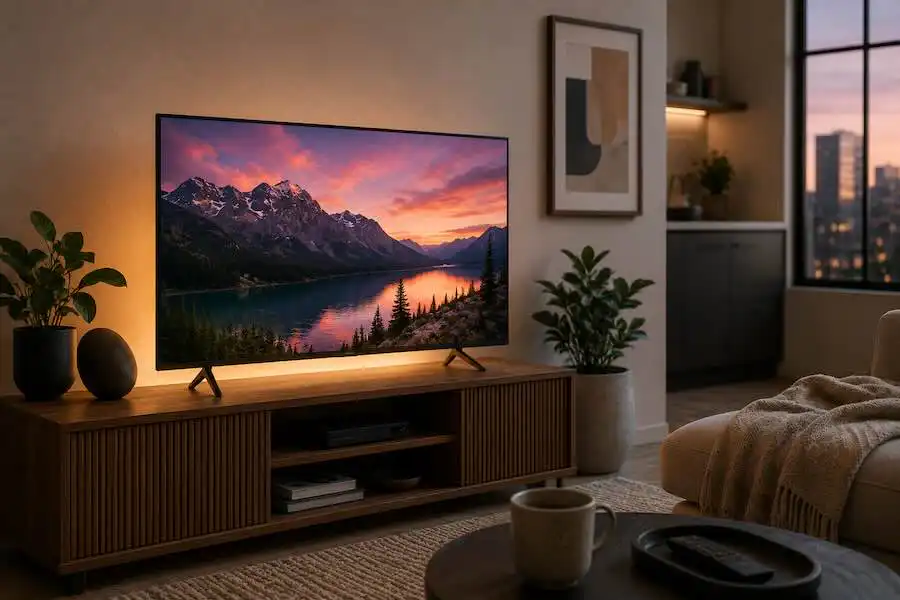
A small TV no longer has to feel like the lesser screen in the house. For bedrooms, kitchens, compact apartments, and gaming setups, the real challenge in 2026 is choosing technology that earns the limited space it occupies.
Small TVs live differently from their living-room counterparts. You watch them from closer distances. They sit beside furniture, cabinetry, desks, and artwork. Sometimes they become computer monitors after dinner. That makes dimensions, viewing distance, panel quality, connectivity, and visual restraint more important than chasing the longest specification sheet.
The shift fits naturally with architectural trends for small modern homes, where individual objects increasingly need to perform more than one job. A well-chosen 32-to-43-inch TV can disappear quietly into a room and still deliver a genuinely premium experience when switched on.
Start With the Space, Not the TV
Before comparing OLED, QLED, refresh rates, or smart platforms, measure the physical space. Width matters, but so do the stand, ventilation, wall clearance, cable access, and where your eyes naturally fall when seated.
Modern bezels are slim enough that an older television’s exterior dimensions can sometimes accommodate a larger contemporary screen. Never assume that from the diagonal measurement alone, though. Check the manufacturer’s exact dimensions both with and without the stand.
Think about scale in the same way you would when approaching decor for a small space. The screen should belong to the wall or furniture rather than visually consuming it.
32 Inch or 43 Inch: Which Small TV Size Is Better?
A 32-inch TV remains useful where distance is genuinely tight: kitchens, small guest rooms, counters, compact desks, and secondary viewing spaces. At this size, Full HD can still look perfectly acceptable from normal viewing distances, although resolution becomes more noticeable when the television doubles as a computer display.
A 42-to-43-inch screen is the more interesting sweet spot for bedrooms, studios, gaming corners, and small living rooms. The additional area makes 4K worthwhile while remaining compact enough to integrate into furniture that would be overwhelmed by a 55-inch panel.
Viewing distance should be treated as a range rather than a magic number. Resolution, eyesight, content, room layout, and personal preference all affect what feels comfortable. The Society of Motion Picture and Television Engineers publishes technical standards used throughout the moving-image industry, but your own seating position should ultimately decide whether the screen feels immersive or simply too large.
OLED vs QLED: Choose for the Room
OLED is particularly compelling in a bedroom or darker media space. Because individual pixels can switch off, black scenes remain genuinely dark rather than taking on the grey cast that can appear on conventional backlit LCD televisions. Films with deep shadows look especially beautiful at night.
QLED and other advanced LCD technologies remain strong alternatives, particularly in brighter rooms. They can deliver vivid color and substantial brightness without requiring you to pay the premium attached to smaller OLED models.
Do not buy based on the acronym alone. Look at contrast, viewing angles, reflection handling, brightness, color accuracy, and motion performance. Independent testing from RTINGS is useful when comparing how individual televisions behave outside carefully controlled showroom lighting.
4K Matters More as the Screen Gets Closer
For a 43-inch television, 4K should be high on the shopping list. At 32 inches, the decision is more nuanced. A kitchen TV watched from across the room does not have the same resolution demands as a 32-inch display positioned two or three feet from your face.
If the television will also function as a monitor, prioritize 4K resolution and confirm that it handles computer text cleanly. For traditional television viewing from farther away, a good Full HD model can still make financial sense.
Gaming Changes the Shopping List
A small television can make an excellent gaming display, but refresh-rate marketing deserves careful reading. Look beyond a large number printed on the box and check which resolutions and inputs actually support that refresh rate.
For contemporary consoles and PCs, useful features include 4K at 120Hz where supported, Variable Refresh Rate, Auto Low Latency Mode, and sufficiently low input lag. HDMI functionality matters here, although an HDMI 2.1 label by itself does not guarantee that every desirable feature or maximum bandwidth is available on every port.
The HDMI specification information explains the broader feature set, while the television manufacturer’s detailed specifications should tell you what a particular model actually supports.
Don’t Ignore Sound
Thin displays leave very little physical volume for speakers. That engineering problem becomes particularly obvious with dialogue, bass, and films designed around a broad soundstage.
Before automatically adding a soundbar, listen to the television in your actual room. A bedroom with soft furnishings may be forgiving, while a kitchen filled with hard surfaces can make thin speakers sound harsher.
If an upgrade is necessary, choose a compact soundbar proportional to the screen rather than installing something visually heavier than the television itself. Models supporting Dolby Atmos can offer compatible spatial-audio features, although speaker configuration and room acoustics still matter more than the badge alone.
The Best Small TV Can Almost Disappear
A television is unusual furniture because it becomes a large black rectangle whenever you stop using it. In a compact room, that visual interruption becomes harder to ignore.
Art-display televisions offer one answer. Samsung’s The Frame helped popularize the idea of using a matte display, interchangeable frame-like bezels, and artwork to make the television behave more like part of the interior.
You do not necessarily need an art TV to achieve the effect. A restrained wall mount, disciplined cable routing, furniture with integrated cable management, and enough negative space around the panel can make an ordinary television feel much calmer.
Smart TV Features Worth Checking
The panel may survive for years, but the software is what you interact with every evening. Before buying, check whether the operating system carries the streaming services you actually use, how quickly menus respond, whether advertisements dominate the interface, and what update support the manufacturer provides.
Smart-home integration can also be useful, particularly in a bedroom or kitchen. Matter is designed to improve interoperability among compatible smart-home products, but support differs between devices and ecosystems. Confirm the exact functions of the TV you are considering rather than assuming a Matter logo turns the television into a universal control center.
What to Look for in a Small TV in 2026
- For bedrooms: Prioritize contrast, reflection control, quiet operation, and a simple interface.
- For kitchens: Favor brightness, wide viewing angles, easy cleaning, and strong wireless connectivity.
- For gaming: Check native refresh rate, VRR, input lag, supported HDMI features, and resolution at maximum refresh.
- For desk use: Prioritize 4K resolution, text clarity, low input lag, and comfortable viewing distance.
- For design-led interiors: Look for slim profiles, matte finishes, thoughtful stands, cable management, and art-display options.
Future-Proof Without Buying Specifications You Won’t Use
Future-proofing sounds sensible until it becomes an excuse to pay for technology that has no relationship to how you watch television.
A gamer has good reason to care about high refresh rates and VRR. Someone placing a television above a bedroom dresser to watch films does not necessarily need the same specification. A kitchen screen may benefit more from good viewing angles and a responsive streaming interface than another HDMI port.
Energy consumption deserves attention too, particularly for a screen used for several hours every day. In the United States, ENERGY STAR provides efficiency information for qualifying electronics. Elsewhere, consult the applicable regional energy label when comparing models.
Practical Takeaway: Buy for the Room You Have
Start with five questions: How far away will you sit? How bright is the room? Will you game on it? Will it double as a monitor? How visible will the television be when switched off?
Those answers quickly remove features you do not need and expose the ones worth paying for. In a small room, restraint usually creates the better result.
Conclusion: Small Screens Have Grown Up
The best small TV in 2026 is not simply a scaled-down version of the largest television you can afford. It is a display chosen around distance, light, furniture, content, and the way the room moves throughout the day.
For some homes, that means a compact 32-inch screen tucked neatly into a kitchen. For others, a 42-to-43-inch 4K display can become a bedroom cinema, gaming station, and occasional monitor without taking control of the room.
Measure first. Decide how the screen will actually be used. Then spend on the technology you will notice every day rather than specifications you may never switch on.
FAQ: Buying a Small TV in 2026
Is 4K worth it on a 32-inch TV?
It depends heavily on viewing distance. At typical kitchen or bedroom distances, Full HD can remain adequate on a 32-inch screen. At desk distance, where individual pixels and text are easier to see, 4K becomes considerably more useful.
Can I use a small TV as a computer monitor?
Yes, but check resolution, input lag, refresh-rate support, and text rendering. If desktop use is important, confirm the television handles chroma correctly at the resolution and refresh rate you intend to use. Our TV positioning guide can also help when planning the setup.
Is OLED burn-in still possible?
OLED protection systems have improved, but uneven pixel wear remains possible, particularly when static interface elements remain on screen for long periods. That makes usage patterns worth considering if a television will spend much of each day displaying a computer desktop or fixed graphics.
How can I mount a small TV without ruining a rental wall?
Consider freestanding floor mounts, easel-style stands, or suitable television furniture instead of drilling. Check the television’s VESA mounting pattern and weight against the stand manufacturer’s limits. VESA provides information about its mounting standards.
Do I need HDMI 2.1 on a small TV?
Not everyone does. It becomes particularly relevant for gaming setups that need features such as high-refresh-rate 4K input and VRR. For straightforward streaming and television viewing, those gaming-focused capabilities may provide little practical benefit.
Is a 43-inch TV too large for a bedroom?
Not necessarily. A 43-inch television can work beautifully in a bedroom when the viewing distance and furniture proportions support it. Measure the wall and test the screen dimensions with painter’s tape before buying if you are uncertain.