




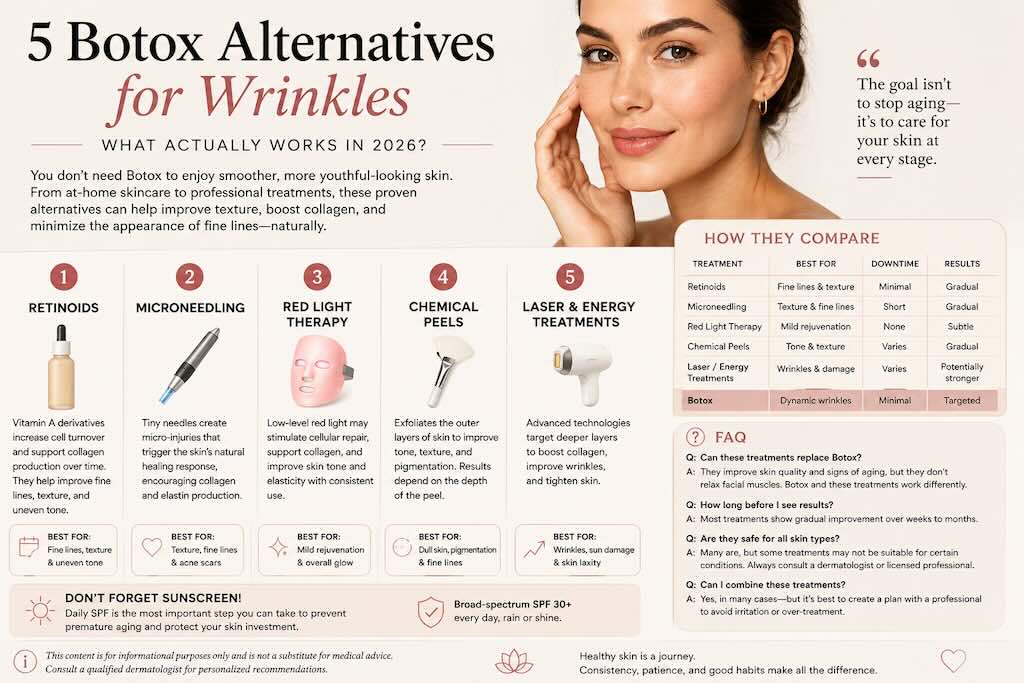
Botox may be one of the best-known treatments for softening wrinkles, but it isn’t the only option for people who want smoother, more even-looking skin. From retinoids and microneedling to red light therapy and professional resurfacing treatments, there are several ways to target visible signs of skin aging without using botulinum toxin.
There is one important distinction, though: these treatments don’t work the same way Botox does. Some improve texture and pigmentation, others encourage collagen remodeling, and some are better suited to fine lines than the expression lines Botox typically targets.
So which options are actually worth considering? Here’s what five popular Botox alternatives can — and can’t — do for aging skin in 2026.
First: What Does Botox Actually Do?
Before comparing alternatives, it helps to understand why Botox produces a different result from most skincare treatments.
Botulinum toxin injections temporarily reduce activity in specific muscles. They’re commonly used on dynamic wrinkles — lines created or deepened by repeated facial movements such as frowning, squinting or raising the eyebrows.
Forehead lines, frown lines between the eyebrows and crow’s feet are common examples.
Other treatments tend to focus more on the skin itself. They may improve texture, encourage collagen production, address pigmentation or soften fine lines, but they don’t necessarily reduce the muscle movement responsible for dynamic wrinkles.
That doesn’t make them inferior. It simply means the right treatment depends on what you’re actually trying to change.
1. Retinoids
If you’re looking for a topical ingredient with a substantial history in skin-aging research, retinoids deserve attention.
Derived from vitamin A, retinoids can support skin-cell turnover and collagen production over time. Regular use may improve the appearance of fine lines, uneven pigmentation and skin texture.
The category includes prescription retinoids such as tretinoin as well as cosmetic products containing ingredients such as retinol and retinal. Their strength, tolerability and results aren’t identical, so stronger isn’t automatically better for every skin type.
Retinoids also require patience. This isn’t an overnight transformation, and irritation, dryness or peeling can occur, particularly when beginning treatment or using a product that’s too strong.
Introducing a retinoid gradually and pairing it with a simple moisturizer can make the adjustment easier. Anyone who is pregnant, breastfeeding or managing a skin condition should discuss retinoid use with an appropriate healthcare professional.
2. Microneedling
Microneedling uses very fine needles to create controlled micro-injuries in the skin. The resulting wound-healing response can stimulate collagen and elastin remodeling as the skin repairs itself.
Rather than freezing facial movement, microneedling is generally used to address concerns such as skin texture, fine lines and certain types of scarring.
Results develop gradually rather than appearing immediately. Depending on the concern being treated, a dermatologist or other qualified practitioner may recommend a series of treatments rather than a single session.
Professional microneedling is also very different from aggressively rolling needles across the face at home. Incorrect technique can cause irritation, infection or injury, so this is one treatment where professional guidance matters.
3. Red Light Therapy
Red light therapy — also known as a form of photobiomodulation — has become one of the more accessible non-invasive options in the skincare world.
Devices expose the skin to specific wavelengths of red or near-infrared light. Research suggests this may influence cellular processes associated with skin repair and collagen production, potentially producing modest improvements in fine lines and overall skin appearance with consistent use.
The key word is modest.
An LED mask shouldn’t be expected to erase established wrinkles or produce the same effect as an injectable treatment. Its appeal is instead the combination of being non-invasive, requiring little or no downtime and fitting relatively easily into a regular skincare routine.
At-home devices also vary considerably in their specifications and quality. Follow the manufacturer’s instructions carefully, protect the eyes when required and speak with a healthcare professional if you have a photosensitive condition or use medication that increases sensitivity to light.
4. Chemical Peels
Chemical peels work differently again. Rather than affecting facial muscles, they use chemical solutions to exfoliate layers of the skin.
Depending on the type and depth of the peel, they may be used to improve uneven pigmentation, rough texture, sun damage and some fine lines.
Peels range from relatively superficial treatments with limited downtime to substantially deeper procedures that require professional supervision and a much longer recovery period.
This makes the phrase “chemical peel” deceptively broad. A gentle exfoliating peel and a deeper medical procedure aren’t interchangeable, and the safest option depends on skin type, pigmentation, sensitivity and the concern being treated.
For stronger treatments, professional assessment is particularly important because inappropriate peeling agents or depths can cause burns, prolonged irritation and changes in pigmentation.
5. Laser and Energy-Based Skin Treatments
For people looking for more noticeable skin resurfacing or rejuvenation, dermatology practices and aesthetic clinics offer a wide range of laser and other energy-based treatments.
Depending on the technology, these procedures can target concerns including fine lines, uneven pigmentation, sun damage, texture and loss of firmness.
Some treatments work primarily at the skin’s surface, while others deliver energy deeper into the tissue to stimulate remodeling. That also means downtime, discomfort, cost and potential risks vary enormously from one procedure to another.
This isn’t a category where choosing whatever treatment happens to be trending on social media is particularly useful. A qualified dermatologist can assess the skin and determine whether laser resurfacing, radiofrequency or another approach is appropriate for the concern being treated.
What Botox Does That These Treatments Don’t
This is where expectations matter.
If a forehead line becomes prominent when you raise your eyebrows, repeated muscle movement is contributing to it. Botox targets that movement directly by temporarily reducing activity in the treated muscle.
Retinoids, microneedling, red light therapy and resurfacing treatments don’t work that way.
They’re generally better thought of as treatments for the skin rather than substitutes for the muscle-relaxing action of Botox.
That distinction becomes particularly important when comparing dynamic and static wrinkles.
- Dynamic wrinkles appear or deepen when facial muscles move, such as when smiling, frowning or raising the eyebrows.
- Static wrinkles remain visible when the face is relaxed and can be influenced by age, cumulative sun exposure, collagen loss and other changes within the skin.
Many people have a combination of both, which is one reason there isn’t a single anti-aging treatment that’s best for everyone.
Don’t Overlook Vitamin C and Peptides
A skincare routine doesn’t need to contain a dozen active ingredients to support healthy-looking skin.
Vitamin C is commonly used for its antioxidant properties and may help with the appearance of uneven pigmentation while supporting collagen-related processes. Peptides are another popular category, although evidence varies significantly depending on the particular peptide and formulation.
Neither should be marketed as “Botox in a bottle.” That’s an appealing phrase, but topical cosmetics simply don’t replicate what an injectable neuromodulator does inside a muscle.
They make more sense as part of a consistent skincare routine built around realistic expectations.
The Most Important Anti-Aging Product May Still Be Sunscreen
It’s much easier to become interested in treatments promising to reverse visible aging than in the everyday product designed to prevent additional damage.
But cumulative exposure to ultraviolet radiation contributes significantly to premature skin aging, including wrinkles, pigmentation changes and loss of elasticity.
Regular use of broad-spectrum sunscreen is therefore one of the foundations of a sensible skin-aging routine. Expensive serums and professional treatments have considerably less value if the skin continues accumulating avoidable UV damage.
Think of sunscreen as protecting the investment you’re making everywhere else in your routine.
Botox Alternatives Compared
| Treatment | Best Suited To | Downtime | Results |
|---|---|---|---|
| Retinoids | Fine lines, texture and uneven tone | Usually none, although irritation can occur | Gradual |
| Microneedling | Texture, fine lines and certain scars | Usually short | Gradual |
| Red light therapy | Mild skin rejuvenation | Little to none | Typically subtle and gradual |
| Chemical peels | Texture, pigmentation and some fine lines | Varies by peel depth | Varies |
| Laser/energy treatments | Wrinkles, texture, pigmentation and sun damage | Varies considerably | Potentially more noticeable |
| Botox | Dynamic expression lines | Usually minimal | Targeted and temporary |
So, What’s the Best Botox Alternative?
There isn’t one.
The best option depends on what you see when you look in the mirror — and what, if anything, you’d actually like to change.
For fine lines and overall texture, a retinoid may be a sensible place to begin. Microneedling can offer another approach to collagen remodeling. Red light therapy appeals to people who want something non-invasive, while chemical peels and professional energy-based treatments can address more specific concerns.
And if the primary concern is expression lines caused by facial movement, none of those treatments should be presented as an exact replacement for Botox.
The goal doesn’t have to be making skin look younger, either. A good routine can simply mean keeping skin healthy, comfortable and protected while allowing it to age normally.
For more inspiration around a simpler approach to skincare, explore Divine’s guide to Scandinavian beauty and Nordic skin secrets.
FAQ: Botox Alternatives for Wrinkles
Can you reduce wrinkles without Botox?
Some treatments can improve the appearance of fine lines, texture and other signs of skin aging without Botox. However, treatments such as retinoids, microneedling and red light therapy don’t replicate Botox’s effect on the facial muscles responsible for dynamic expression lines.
What is the best non-invasive alternative to Botox?
That depends on the concern. Retinoids are a well-established topical option for fine lines and photoaging, while red light therapy is non-invasive and may offer modest skin-rejuvenation benefits. Neither produces the same muscle-relaxing effect as Botox.
Does microneedling work better than Botox?
They’re designed to do different things. Microneedling encourages a wound-healing response and collagen remodeling and is often used for texture, fine lines and certain scars. Botox temporarily reduces muscle activity and is particularly suited to dynamic expression lines.
Can retinol replace Botox?
No. Retinoids can improve fine lines, texture and signs of photoaging over time, but they don’t temporarily relax facial muscles in the way Botox does. The two approaches target different aspects of skin aging.
Can different anti-aging treatments be combined?
Sometimes, but combining active skincare ingredients and professional procedures can also increase irritation or other risks. A dermatologist or appropriately qualified practitioner can recommend which treatments can be combined and how they should be spaced.
This article is for general informational purposes only and isn’t a substitute for medical advice. Skin treatments can carry risks and may not be appropriate for everyone. Consult a qualified healthcare professional or dermatologist for advice based on your individual skin and medical history.