

If you’re starting strength training in 2026, it’s easy to assume that progress comes from lifting heavier weights or mastering complicated machines. But here’s the surprising truth: one of the most powerful ways to build a strong, resilient body doesn’t involve movement at all—it starts with stillness.
Isometric exercises—where your muscles work without changing length and your joints stay fixed—act like the “anchor points” of your entire athletic foundation. They boost stability, sharpen your mind‑muscle connection, and are incredibly joint‑friendly.
Here’s why holding still can make you stronger—and the beginner‑friendly moves you should start with today.
1. The Science of Stillness
Unlike traditional lifts (think curls or squats), isometric exercises challenge your body by maintaining tension in a single position. This does more than build strength—it helps your body learn how to stabilize.
Why it works:
- Injury Prevention
No joint movement means less wear and tear. You can build strength safely, especially if you’re recovering or just starting out. - Time‑Efficient Training
You can create deep muscle fatigue in as little as 20–30 seconds. Perfect for busy schedules. - Blood Pressure Support
Studies show isometric training may be one of the most effective non‑medication methods for reducing blood pressure naturally.
2. The Essential Beginner Isometric Trio
Add these three simple holds to your routine to build a stable, well-balanced body.

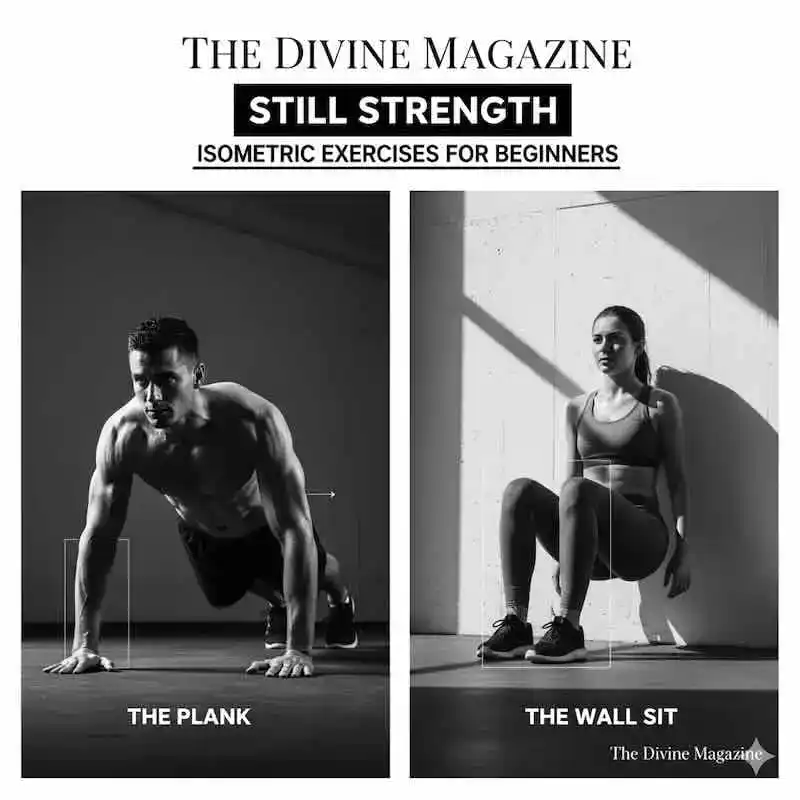
A. Wall Sit—Lower Body Strength & Endurance
Targets: quads, glutes, calves
How to do it:
Lean back against a wall and slide down until your thighs are parallel to the floor. Keep your knees stacked over your ankles.
Goal: Hold for 30–60 seconds.
B. Plank—Core Integration & Stability
Targets: core, shoulders, glutes
How to do it:
Rest on your forearms and toes. Keep a straight line from head to heels, squeeze your glutes, and gently draw your belly button inward.
Goal: Three sets of 30 seconds.
C. Isometric Glute Bridge—Posterior Chain Activation
Targets: glutes, hamstrings, lower back
How to do it:
Lie on your back with knees bent. Lift hips until your body forms a straight line from shoulders to knees. Focus on squeezing your glutes.
Goal: Hold for 45 seconds with slow, steady breathing.
| Feature | Isometric Training (Still) | Dynamic Training (Moving) |
| Primary Benefit | Joint Stability & Max Tension | Range of Motion & Power |
| Risk of Injury | Very Low | Moderate |
| Equipment | Minimal/Bodyweight | Often requires weights |
| Mind-Muscle Link | High (Deep focus on contraction) | Moderate (Focus on tempo) |
FAQ: Isometrics for Beginners
Q: Can I build actual muscle size with just isometrics? A: Yes, but they are best used in conjunction with dynamic movements. Isometrics are incredible for “thickening” the connective tissue and ensuring your muscles can handle heavier loads later on.
Q: How often should I do these? A: Since they are low-impact, you can perform these 3–4 times a week. They make excellent “finishers” at the end of a workout.
Q: Why do I shake when holding a plank? A: That “shiver” is your nervous system learning how to recruit muscle fibers. It’s a sign of progress! As you get stronger, the shaking will decrease.
Conclusion
In 2026, we’ve realized that being “strong” isn’t just about how much weight you can move; it’s about how well you can control your body. By adding isometric holds to your beginner strength routine, you are reinforcing your joints and teaching your muscles to fire with precision. Start small, stay still, and watch your overall performance skyrocket.
Are you ready to test your limits? Try a 60-second wall seat right now and see how your legs feel!