

An engagement ring may be one of the smallest things you’ll ever spend this much time thinking about.
There is the stone, of course. But then come the questions of shape, setting, metal, colour, practicality and whether something that looks spectacular under jewellery-store lighting will still feel right ten years from now.
The good news is that you don’t need to chase whatever happens to be labelled the engagement-ring trend of the moment. Some of the most interesting choices — three-stone settings, elongated diamonds, coloured gemstones and beautifully simple solitaires — have histories far longer than any trend cycle.
Start With the Person, Not the Ring
Before comparing carats and settings, look at the jewellery that’s already being worn.
Is it mostly yellow gold or silver-toned? Delicate or substantial? Vintage-inspired or minimal? Does jewellery stay on all day, or only come out for particular occasions?
These small clues are often more valuable than trying to guess which ring photographs look most impressive online. An engagement ring becomes part of everyday life, so personal style and lifestyle deserve at least as much attention as spectacle.
The Solitaire Hasn’t Become Boring
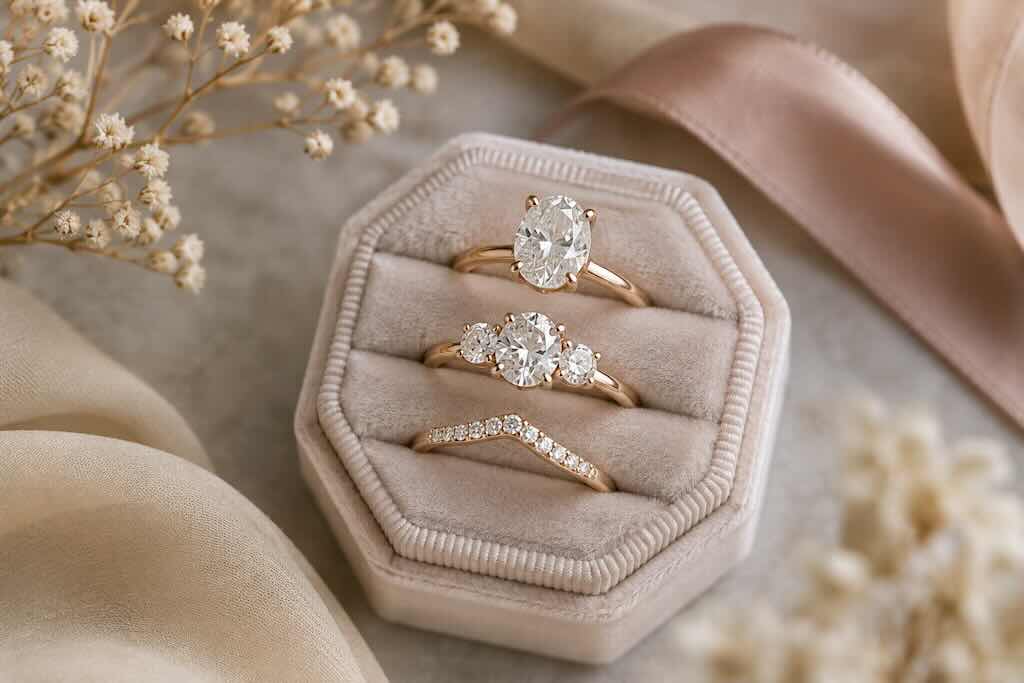
One stone, one band, very little distraction. The solitaire survives precisely because there isn’t much for fashion to date.
What changes its personality is everything around that apparent simplicity. A fine yellow-gold band feels different from a wider platinum one. Four prongs create a different impression from six, while a bezel surrounds the stone rather than holding it with exposed claws.
If you’re comparing settings, the Gemological Institute of America’s guide to engagement-ring settings is useful because it explains how different settings affect not only appearance but also security and wearability.
Three Stones, Without the Old-Fashioned Feeling
A three-stone ring — sometimes called a trilogy ring — places a centre gemstone between two side stones. It’s an old idea with enormous room for reinterpretation.
The three stones are often associated with the past, present and future of a relationship, although you certainly don’t need the symbolism to appreciate the design.
Matching round stones can produce something unmistakably traditional. Pair an oval centre with pear-shaped side stones and the mood changes. Introduce sapphires or another contrasting gemstone and it changes again.
That flexibility is probably the trilogy ring’s greatest strength: the basic composition is classic, while the stones can make it completely personal.
Oval and Pear Shapes Change the Proportions
If a round stone doesn’t immediately speak to you, shape is one of the most interesting places to experiment.
Oval and pear-shaped diamonds have elongated outlines, which can create the impression of greater size compared with a round diamond of the same carat weight. They also create a longer visual line across the finger.
But shape isn’t simply an aesthetic decision. Pointed stones such as pears require thoughtful settings to protect more vulnerable areas. GIA’s diamond shape guide is a useful starting point for understanding how shape, facet style and setting work together.
Colour Can Be Quiet
A coloured engagement ring doesn’t have to mean an enormous emerald or ruby surrounded by diamonds.
Champagne, yellow and other warm-toned diamonds can introduce colour subtly, while sapphires extend far beyond the deep blue most people immediately picture. Coloured stones can appear at the centre of the ring or as smaller accents beside a diamond.
If you’re considering something other than a conventional colourless diamond, investigate the gemstone itself rather than choosing solely by appearance. Durability matters enormously for jewellery designed to be worn frequently.
Halo or Hidden Halo?
A traditional halo surrounds the centre stone with smaller stones, creating additional sparkle and making the centre appear visually larger.
A hidden halo takes a quieter approach. The smaller stones sit beneath the centre stone and become more noticeable when the ring is viewed from the side.
The difference sounds minor on paper but feels significant on the hand. One makes the extra detail part of the ring’s immediate identity; the other saves it for closer inspection.
There is a practical consideration too. Designs containing numerous small stones can require more maintenance to ensure those stones remain secure.
Don’t Forget How the Ring Will Be Worn
This may be the least romantic part of choosing an engagement ring, but it could become the most important.
A high-set stone that catches constantly on clothing may become frustrating for someone who works extensively with their hands. Elaborate settings introduce more areas that may require cleaning and inspection. Certain shapes have points that deserve additional protection.
Think about ordinary Tuesdays, not only the proposal photographs.
Understand What You’re Paying For
If you’re buying a diamond, learn the basics before deciding where to compromise. The four characteristics commonly used to evaluate diamonds are colour, clarity, cut and carat weight — the 4Cs.
They don’t simply provide four boxes to maximise. Understanding them helps you decide which qualities matter most to you and where your budget is better spent. The GIA’s engagement-ring buying guide provides a useful independent introduction before you start comparing stones.
The Ring Doesn’t Need to Look Like Anyone Else’s
Perhaps the most useful shift in engagement-ring shopping is moving away from the idea that there is one correct choice.
A tiny vintage ring can carry more personality than something five times its price. A simple solitaire can feel more distinctive on one person than an elaborate custom design. A sapphire may make infinitely more sense than a diamond.
Look at trends if they help you discover possibilities. Learn enough about stones and settings to understand what you’re buying. Then forget about what you’re supposedly meant to choose.
The best engagement ring is the one that still feels like the person wearing it after the proposal has become a memory.