




France doesn’t reward the tourist who arrives with a checklist and the confidence to clear it in a week. The country is too rich, too layered, too spread across centuries of history to conquer in one trip — and trying usually means seeing less, not more. Here are the landmarks worth actually slowing down for.
Provence
The cities and towns get plenty of coverage elsewhere, so here the focus stays on the landscapes and landmarks that live outside any single urban center — or with no urban center at all. Driving through Provence, it’s genuinely hard to go wrong pulling over anywhere along the road and stepping out into lavender-scented air; the whole region reads as one long stretch of sensory overload, in the best sense. The Luberon area in particular delivers the scenery most people picture when they think of rural Provence — endless lavender fields, vineyards, rustic villages built from the same warm stone. The region is also home to St. Rémy and Avignon, medieval city structures that are worth the detour on their own.
Pont du Gard
Follow the road south and a turn near the small town of Vers-Pont-du-Gard leads to the Pont du Gard, a Roman aqueduct crossing the Gardon River with three tiers of stacked arches. It still looks like something out of a fantasy film today, which says something about how it must have struck people two thousand years ago. A genuine testament to Roman engineering, it was one of the most ambitious architectural undertakings of its era — and it’s now a unesco world heritage site in its own right.
Mont Blanc
The highest peak in both the Alps and Europe, Mont Blanc — literally “White Mountain” — earns its name honestly, perpetually capped in snow. Straddling the border between France and Italy, it’s a must-see for anyone who considers themselves a serious country-trekker. The Aiguille du Midi cable car can take visitors straight up near the summit, where the surrounding mountain range unfolds in a way photographs never quite manage to capture.
Gorges du Verdon
Turquoise water cuts through limestone cliff walls here, forming one of France’s genuine natural wonders and a dream destination for kayakers and swimmers alike. Hikers can explore the gorge on foot too, from the canyon floor up to the lavender-covered rim. The gorge sits within the Verdon Regional Nature Park, still one of the most beautiful protected landscapes in the country.
Loire Valley
Staying on the theme of water, the valley surrounding the Loire River is exactly as picturesque as it looks in the paintings — and it offers a genuinely relaxing way to see it, via barge cruises that drift slowly past chateaux and historic towns. The rich greenery gives way to legendary vineyards throughout — lavender fields and vineyards being something of a running theme across the whole country. The entire valley holds UNESCO World Heritage status as a living cultural landscape, which is about as strong an endorsement as a stretch of countryside can get.
The Palace of Versailles
One of Europe’s most significant landmarks sits just a day trip away from Paris, which leaves little excuse to skip it. The ornate architecture, the meticulously kept gardens, and a history rich enough to fill several documentaries make the Palace of Versailles worth the full day it deserves. Guided tours are genuinely informative, and there’s ample time built in to wander the grounds independently. The palace as it stands today was built under Louis XIV, and it remains a striking physical record of absolute monarchical power.
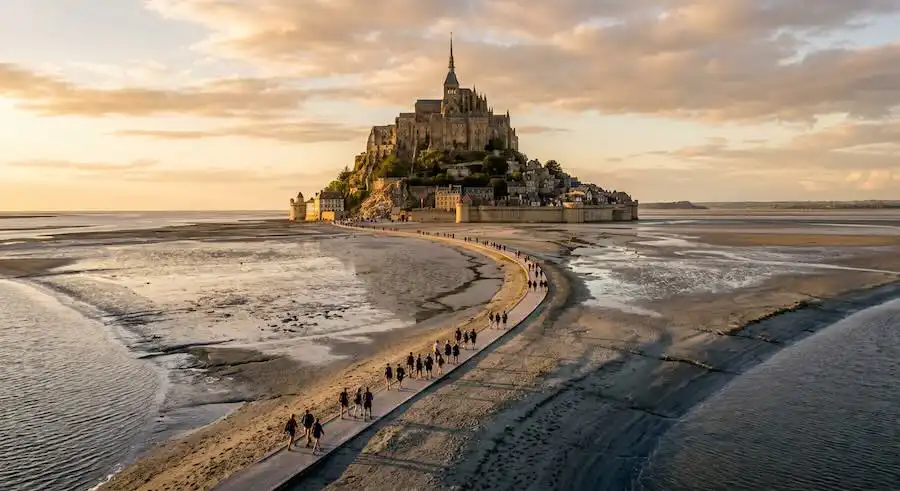
Mont Saint-Michel
Few sights in France look quite so much like they stepped out of a storybook. Mont Saint-Michel sits less than a mile off the northwestern coast, a Norman abbey and its surrounding medieval town perched atop a rocky tidal island. It’s protected as a UNESCO World Heritage Site, and the tide is what makes it genuinely magical rather than merely scenic — at low tide, the causeway opens for a walk straight to the base of the abbey; as the water rises, both the beach and the path vanish beneath the waves of the English Channel.
Conclusion
Choosing what to see in France is a genuinely hard problem, because there’s rarely a single step that doesn’t lead to another beautiful landscape or a building with centuries of history behind it. The only real solution for anyone who falls for the country is the obvious one — come back for more the first chance that arises.
FAQ: Visiting France’s Landmarks
Q: What’s the best time of year to visit Provence for the lavender fields? A: Mid-June through late July is peak bloom, with the Luberon and Valensole plateau at their most vivid. Fields are typically harvested by early August, so timing matters more here than almost anywhere else on this list.
Q: Do I need to book Mont Saint-Michel tickets in advance? A: Advance booking isn’t strictly required for the site itself, but pre-booking abbey tickets and arriving early in the day avoids the worst of the midday crowds, especially in summer. Checking the tide tables before the trip is essential — they determine whether the causeway is walkable.
Q: How long should I budget for a Palace of Versailles visit? A: A full day is realistic if the gardens and the Trianon estate are on the list alongside the main palace. A rushed half-day covers just the state apartments, but skips most of what makes Versailles worth the trip from Paris.
Q: Is the Gorges du Verdon suitable for beginner kayakers? A: Calmer stretches near Lac de Sainte-Croix suit beginners well, while the deeper canyon sections demand real paddling experience and, in places, a guide. Water levels vary seasonally, so checking conditions locally before setting out is worth the extra step.