




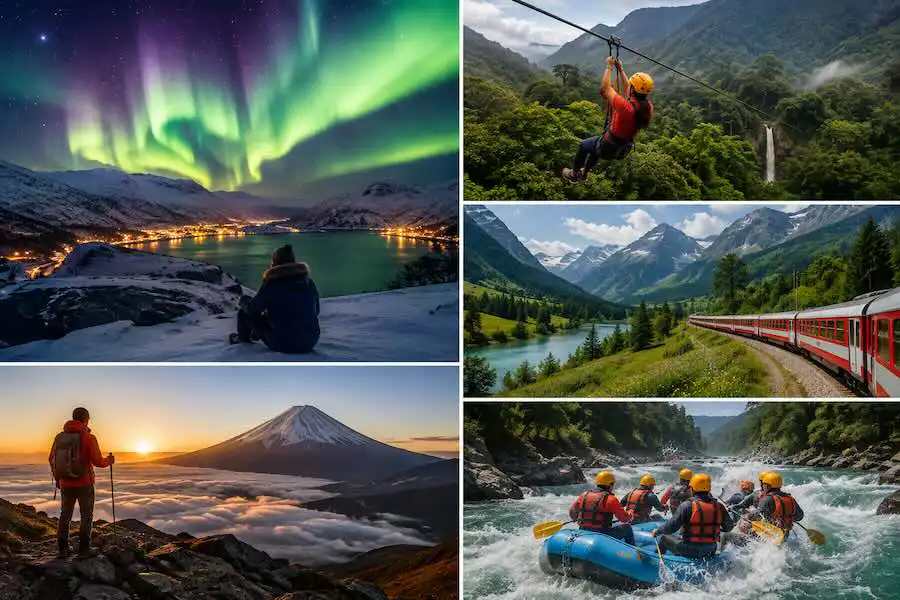
Some journeys stay remarkably sharp in memory: green light moving across an Arctic sky, the first glimpse of a mountain above the clouds, cold river spray against your face, or a train window framing a landscape you have never seen before.
Adventure travel in 2026 does not need to mean going farther, faster, or higher simply for the story. The most memorable trips create a closer relationship with a place. Sometimes that comes through physical challenge. Sometimes it means slowing down enough to watch the landscape change outside a railway carriage. These five bucket-list adventures offer very different ways to experience that feeling.
Watch the Northern Lights Above the Arctic
The first thing to understand about the Northern Lights is that nature makes no reservations. You can travel to the right latitude during the right season and still spend an evening beneath an empty black sky. That uncertainty is part of the experience.
When the aurora does appear, it can begin almost imperceptibly: a pale arc above the horizon, followed by curtains and ribbons that shift across the darkness. Photographs capture the color. Standing beneath it provides the scale.
Destinations across the auroral zone include Tromsø in northern Norway, Abisko in Swedish Lapland, Finnish Lapland, Iceland, northern Canada, and Fairbanks in Alaska. Dark skies and favorable conditions matter more than simply choosing a famous destination.
The darker months generally provide the necessary nighttime conditions, but cloud cover, solar activity, artificial light, and local weather all influence visibility. Build several nights into the itinerary rather than treating an aurora sighting as a one-evening appointment.
For destination research, National Geographic’s Northern Lights guide provides useful background for planning an aurora-focused journey.
Fly Through the Landscape on a Zip Line
Zip-lining compresses adventure into seconds. There is the click of equipment, a final safety check, then suddenly the platform disappears behind you and the landscape opens beneath your feet.
The setting makes the experience. Costa Rica combines zip-line adventures with dense tropical and cloud-forest landscapes, including the Monteverde region. Puerto Rico offers large-scale adventure parks surrounded by mountainous terrain, while Hawaii pairs aerial experiences with deeply textured island scenery.
Do not choose an operator solely because it advertises the highest, longest, or fastest course. Safety procedures matter considerably more than superlatives. Before booking, review age and weight restrictions, weather policies, equipment standards, guide procedures, accessibility requirements, and the operator’s safety information.
Environmental practices deserve attention too. Adventure infrastructure can place pressure on sensitive landscapes, so look for operators that clearly explain how trails, platforms, wildlife habitats, and surrounding ecosystems are managed.
Cross Europe by Train
Not every great adventure requires a helmet. Sometimes it begins with a platform number and a departure board.
European rail travel changes the scale of a trip. Instead of disappearing into one airport and emerging from another, you watch geography happen. Apartment blocks give way to fields. Mountains rise beyond the glass. Languages change on station signs. Lunch can begin in one country and dinner in another.
The temptation is to connect as many capitals as possible, but fewer stops usually create a richer journey. Paris, Amsterdam, Vienna, Budapest, Rome, Madrid, Lisbon, Oslo, and countless smaller cities can form part of a rail itinerary, but spending two or three nights somewhere is often more satisfying than collecting stations.
Planning platforms such as Rail Europe can help with routes and tickets, while Interrail provides rail-pass information for eligible European residents. Reservation requirements vary between trains and countries, so check individual journeys rather than assuming a rail pass covers every seat automatically.
Rail also fits naturally into a slower style of travel. Instead of building a trip around airport transfers, consider choosing one geographic corridor and allowing the route itself to become part of the experience. Our guide to travel trends and slower journeys explores that shift in pace further.
Climb Mount Fuji in Japan
Mount Fuji has a silhouette so familiar that seeing it in person can feel strangely unreal. Climbing it changes the perspective entirely.
At 3,776 meters, Japan’s highest mountain requires respect. The established climbing routes make Fuji accessible to many prepared hikers during the official season, but accessibility should not be confused with an effortless walk. Altitude, rapidly changing weather, cold temperatures, darkness, fatigue, and crowded trails can all become part of the climb.
If hiking and trekking are already part of your travels, prepare specifically for Fuji rather than relying on general fitness. Study the official trail information, carry appropriate layers and water, allow time for acclimatization, and understand the current rules before setting out.
Japan’s official tourism resources provide a Mount Fuji climbing guide with practical information for visitors. Regulations, access arrangements, fees, trail conditions, and seasonal dates can change, so verify current details close to departure.
Fuji can also become part of a wider Japanese itinerary rather than the sole destination. After days outdoors, the electric density of Tokyo provides a dramatic contrast. Our guide to visiting Tokyo offers ideas for extending the journey.
Take On a Whitewater River
Whitewater rafting places you directly inside the landscape. There is no viewing platform between you and the river. The water dictates the rhythm.
Trips range from relatively gentle sections suitable for newcomers to powerful technical rapids intended for experienced participants. Rivers are commonly described using an international rapids classification system, but conditions can change with water levels, weather, season, and the specific section being run.
Famous rafting regions include western Canada, the western United States, New Zealand, Costa Rica, and sections of the Zambezi in southern Africa. The right destination depends less on fame than on your experience level, desired intensity, season, and comfort in moving water.
For broader inspiration, Travel + Leisure’s rafting recommendations provide examples of river experiences in different parts of the world.
Use a reputable professional outfitter, listen closely to the safety briefing, and wear the equipment provided. A well-run rafting trip can deliver extraordinary access to gorges, forests, rock formations, and river corridors that are difficult to experience any other way.
How to Plan a Better Adventure Trip
Begin with the experience rather than the destination. If seeing the aurora is the priority, optimize the trip around darkness, weather flexibility, and several nights in the viewing region. If Fuji is the goal, work backward from official climbing conditions. For European rail travel, build the route around places where you actually want to stop rather than the maximum number of borders you can cross.
physical preparation should match the activity. So should insurance. Read policy exclusions carefully when a trip involves altitude, rafting, climbing, zip-lines, or other adventure activities, and confirm that the specific activity and destination are covered.
Finally, leave space around the headline experience. A journey becomes richer when there is time for an unexpected café, an extra trail, a conversation with a guide, or simply an afternoon without an itinerary.
Travel With the Landscape in Mind
Adventure tourism depends on the places that make it possible. Arctic environments, mountain trails, forests, rivers, and remote communities can all experience pressure from increasing visitor numbers.
Travel outside peak periods when conditions and local guidance make that practical. Stay on established trails, follow waste and wildlife rules, use reputable local operators, respect closures, and avoid treating fragile environments as scenery built solely for photographs.
On rail journeys, staying longer in fewer destinations can reduce the constant churn of transportation while creating more meaningful time on the ground. Sustainability is rarely one perfect decision. It is usually a series of smaller choices made throughout the trip.
Conclusion
The best bucket-list adventures are not memorable because they look impressive on an itinerary. They stay with us because they alter our sense of scale. A mountain makes the body feel small. A river demands attention. An aurora reminds us that the sky can still surprise us.
Choose the experience that genuinely draws you rather than the one you think belongs on a list. Prepare carefully, travel with respect for the place, and give the journey enough time to become more than its headline attraction. The photograph may last for years. The feeling tends to last longer.
FAQ: Bucket-List Adventure Travel in 2026
When is the best time to see the Northern Lights?
You need sufficiently dark skies, so autumn through early spring is generally the main viewing period across many northern destinations. Exact conditions vary by latitude and location. Cloud cover and solar activity also affect visibility, so allow several nights when possible.
Is zip-lining safe for beginners?
Many commercial courses are designed for first-time participants, but requirements and risk levels vary. Choose an established operator, follow guide instructions, disclose relevant limitations, and check the company’s equipment, weather, age, and weight policies before booking.
What is the best way to plan a European train trip?
Choose a region or logical route first, then research individual train connections and reservation requirements. Avoid squeezing too many cities into a short itinerary. Rail passes such as Interrail can offer flexibility, but reservations and supplements may still apply to certain services.
Can beginners climb Mount Fuji?
Many prepared recreational hikers climb Mount Fuji during the official season, but the mountain still presents altitude, weather, temperature, and fatigue risks. Train beforehand, use official routes, carry suitable equipment, and check current access and safety guidance before attempting the climb.
What should I wear for whitewater rafting?
Requirements depend on water and weather conditions. Quick-drying clothing and secure footwear are commonly useful, while professional operators typically specify or supply essential safety equipment such as personal flotation devices and helmets. Follow the outfitter’s packing instructions for your particular river and season.